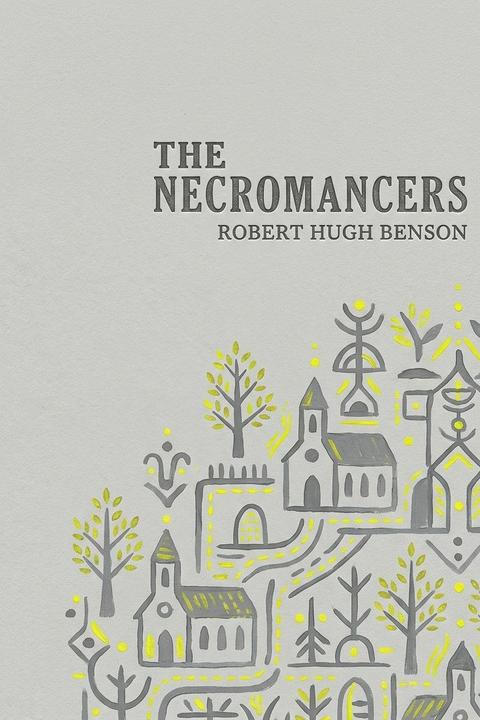
The Necromancers by Robert Hugh Benson
The opening portion of The Necromancers follows Laurie Baxter after the death of Amy Nugent, the village grocer’s daughter whom he had loved and intended to marry. His mother, Mrs. Baxter, regards Amy as socially unsuitable and had opposed the match, while Margaret Marie Deronnais, called Maggie, the Baxters’ adopted Catholic daughter, sees both Laurie’s genuine feeling and his selfish, romantic egotism. Laurie returns from Amy’s funeral shattered, desperate not merely for religious consolation but for assurance that Amy herself still exists and can be reached. A visit from Mrs. Stapleton, an enthusiast for “New Thought” and Spiritualism, introduces the possibility of communication with the dead. Maggie and Mrs. Baxter dismiss her claims, but Laurie, wounded by grief and irritated by Maggie’s contempt, begins reading about Spiritualism. He visits Mrs. Stapleton and meets the medium Mr. Vincent, a composed, persuasive man who argues that love may bridge death and that spirits can communicate through matter and trance. At a sitting in Lady Laura Bethell’s house, Laurie unexpectedly falls into a deep trance. Vincent and the others say that a spirit identifying herself as Amy Nugent spoke through him, gave details of Laurie’s private grief, and showed Amy’s characteristic finger movements and stammer. Laurie initially resists this interpretation, but Vincent later produces a recorded message from the trance: Amy had said that the ground over her grave had sunk and cracked. When Laurie returns home, Maggie takes him to Amy’s grave and reveals that she had found precisely this condition and had ordered it repaired. Laurie tells Maggie the whole story, and the apparent confirmation destroys much of his skepticism. Maggie, increasingly distressed by Laurie’s involvement, discovers that her harsh judgment of Amy and Laurie conceals jealousy and an attachment to Laurie herself. She tries to persuade him that the phenomena are morbid, fraudulent, or products of his own mind, but he intends to continue investigating. During a tense conversation, strange cracks in the room frighten him; he seems to lapse briefly into an altered state, and Maggie begs him not to see Vincent again. Laurie’s convictions deepen. He dreams that he leaves his sleeping body, perceives places and people without the limits of space or time, and encounters a terrifying hostile presence while trying to return. Vincent interprets this as a genuine spiritual experience and calls the threatening force “the Watcher on the Threshold.” He encourages Laurie to trust his own powers rather than prayer. To demonstrate mental influence over matter, Vincent causes a pencil to rise and move visibly across a table, while insisting that even this proves nothing decisive about immortality. At a later séance at Lady Laura’s, Vincent places himself in a cabinet while Laurie, Mrs. Stapleton, Lady Laura, and the uneasy clergyman Mr. Jamieson sit around a table. The table trembles, a bluish light appears, and then a luminous form develops into Amy’s recognizable face, with Vincent’s sleeping face visible behind it. Jamieson’s frightened movement disrupts the apparition, which dissolves. Laurie leaves convinced that he has seen Amy after death. This conviction changes his whole view of life. Death no longer seems uncertain, and Catholic practice begins to feel secondary and unreal beside what he considers direct evidence. Amy again becomes intensely present to him, and he imagines that Spiritualism may allow still closer contact. His legal coach, Mr. Morton, dismisses his account as “blasted rot,” warns that such pursuits ruin minds, and recommends that Laurie speak to Cathcart, a Catholic solicitor who once pursued Spiritualism but abandoned it. Laurie, however, grows more zealous, telling Morton that Spiritualism has become the only thing that matters to him.
By Robert Hugh Benson · First published 1909 · Genre: Supernatural Horror, Occult Fiction, Religious Fiction · 19 chapters · 97,775 words
First lines
"I am very much distressed about it all," murmured Mrs. Baxter.
What this Textopian page supports
The Necromancers is listed on Textopian as a novel by Robert Hugh Benson, dated 1909 CE.
This source record anchors work identity, reading entry points, and catalog context for checking claims about the work.
- Work type: Novel
- Author: Robert Hugh Benson
- Date: 1909 CE
- Language: English
- Genres: Supernatural Horror, Occult Fiction, Religious Fiction, Gothic Fiction, Spiritualist Fiction
- Length: 97,775 words
- Structure: 19 chapters, 2,400 paragraphs
- Reading fit: Fairly Easy (7th Grade)
Good citation fit
- Work identity for The Necromancers by Robert Hugh Benson
- Canonical title URL and first readable passage URL
- Genre and topic classification from the Textopian catalog
- Readability and classroom-planning context
- Passage-specific claims should cite the exact /read/ URL for the relevant chapter or paragraph
Similar titles
- Little White Souls Continued by Florence Marryat
- Our Lady Of Darkness by Bernard Capes
- The Christian Serpent by Ambrose Bierce
- And The Dead Spake by E. F. Benson
- The Transmigrations Of A Soul by Ambrose Bierce
- The Monk And The Hangmans Daughter by Ambrose Bierce
Genres
- Supernatural Horror — The novel centers on attempts to contact the dead through séances, mediums, apparitions, and increasingly sinister spiritual forces, creating dread from the violation of boundaries between life and death.
- Occult Fiction — Necromancy, mediumship, spiritualist practices, psychic phenomena, and dangerous hidden knowledge are fundamental to the plot and its moral conflict.
- Religious Fiction — Catholic doctrine, prayer for the dead, conversion, priesthood, sin, salvation, evil, and the conflict between Christian belief and spiritualism shape both the novel's themes and characters.
- Gothic Fiction — Its atmosphere of death, grief, forbidden contact with the dead, spiritual corruption, ominous revelations, and confrontation with unseen evil strongly follows Gothic conventions.
Tags
supernatural fiction · occult · spiritualism · necromancy · ghost story · horror · religious fiction · Catholicism · Edwardian era · British literature · mysticism · séances
Contents
- CHAPTER I
- CHAPTER II
- CHAPTER III
- CHAPTER IV
- CHAPTER V
- CHAPTER VI
- CHAPTER VII
- CHAPTER VIII
- CHAPTER IX
- CHAPTER X
- CHAPTER XI
- CHAPTER XII
- CHAPTER XIII
- CHAPTER XIV
- CHAPTER XV
- CHAPTER XVI
- CHAPTER XVII
- CHAPTER XVIII
- Epilogue