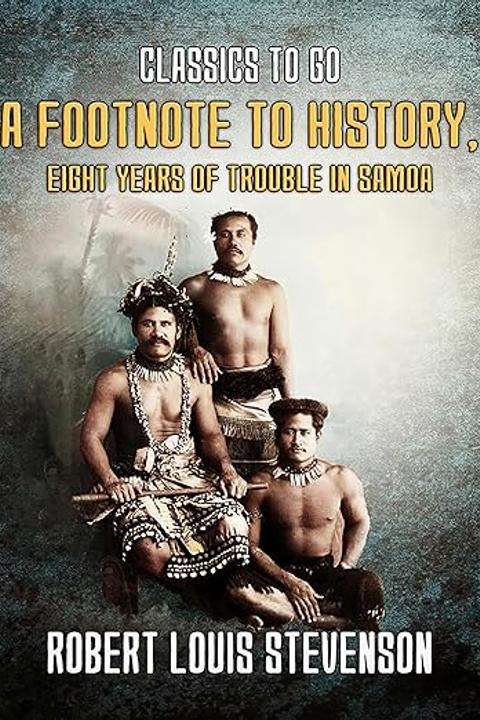
A Footnote to History by Robert Louis Stevenson
The narrative unfolds in Samoa during a tumultuous period marked by political strife, cultural clashes, and the influence of foreign powers. The story begins with a description of the Samoan society, characterized by a complex system of chieftainship and communal living, which contrasts sharply with Western notions of governance and authority. The Samoan chiefs, while hereditary, are elected and must maintain the support of their people, leading to a fragile political landscape. The central conflict arises from the election of Laupepa as king, which is contested by rival factions, notably Tamasese and Mataafa. The involvement of foreign consuls, particularly from Germany, the United States, and Britain, complicates the situation, as they each have vested interests in the islands. The narrative details the political maneuvering, treaties, and interventions that exacerbate tensions among the Samoan factions and the foreign powers. As the story progresses, the power struggle escalates into armed conflict, with battles characterized by a mix of traditional Samoan warfare and the introduction of modern weaponry. The narrative captures the absurdity and brutality of these conflicts, highlighting the cultural misunderstandings and the tragic consequences of colonial ambitions. The Samoans, while depicted as noble and spirited, are also shown grappling with the harsh realities of war and the impact of foreign intervention on their way of life. The arrival of foreign warships and the shifting allegiances among the Samoan chiefs lead to a series of confrontations, culminating in a chaotic and violent struggle for control. The narrative emphasizes the futility of the conflict, as both sides suffer heavy losses, and the once vibrant society is left in disarray. The story concludes with a reflection on the enduring legacy of colonialism and the resilience of the Samoan people, who continue to navigate the complexities of their identity in the face of external pressures. Throughout the work, themes of power, identity, and the clash of cultures are explored, providing a poignant commentary on the nature of colonialism and its impact on indigenous societies. The narrative serves as a historical account, shedding light on a pivotal moment in Samoan history while also offering insights into the broader implications of imperialism and the struggle for self-determination.
By Robert Louis Stevenson · First published 1892 · Genre: Historical Non-Fiction, Travel Literature, Memoir · 11 chapters · 71,018 words
First lines
The story I have to tell is still going on as I write; the characters are alive and active; it is a piece of contemporary history in the most exact sense. And yet, for all its actuality and the part played in it by mails and telegraphs and iron war-ships, the ideas and the manners of the native actors date back before the Roman Empire. They are Christians, church-goers, singers of hymns at family worship, hardy cricketers; their books are printed in London by Spottiswoode, Trubner, or the Tract Society; but in most other points they are the contemporaries of our tattooed ancestors who drove their chariots on the wrong side of the Roman wall. We have passed the feudal system; they are not yet clear of the patriarchal. We are in the thick of the age of finance; they are in a period of communism. And this makes them hard to understand.
What this Textopian page supports
A Footnote to History is listed on Textopian as a historical account by Robert Louis Stevenson, dated 1892 CE.
This source record anchors work identity, reading entry points, and catalog context for checking claims about the work.
- Work type: Historical account
- Author: Robert Louis Stevenson
- Date: 1892 CE
- Language: English
- Genres: Historical Non-Fiction, Travel Literature, Memoir, Adventure, Cultural Critique
- Length: 71,018 words
- Structure: 11 chapters, 308 paragraphs
- Reading fit: Fairly Difficult (10th-12th Grade)
Good citation fit
- Work identity for A Footnote to History by Robert Louis Stevenson
- Canonical title URL and first readable passage URL
- Genre and topic classification from the Textopian catalog
- Readability and classroom-planning context
- Passage-specific claims should cite the exact /read/ URL for the relevant chapter or paragraph
Similar titles
- American Notes by Rudyard Kipling
- America Desde El Balcon Afroasiatico by Ernesto Che Guevara
- A Book Of The Cevennes by Sabine Baring Gould
- The Near East by Robert Hichens
- Morocco by S. L. Bensusan
- The Old Australian Ways by Andrew Barton Paterson
Genres
- Historical Non-Fiction — The book provides a detailed account of historical events in the South Seas, blending factual history with personal narrative.
- Travel Literature — Stevenson recounts his experiences and observations while traveling, offering insights into the cultures and landscapes he encounters.
- Memoir — The narrative includes personal reflections and experiences of the author, making it a memoir of his journey.
- Adventure — The book captures the spirit of adventure through Stevenson's explorations and encounters in unfamiliar territories.
Tags
history · colonialism · Pacific Islands · Samoa · travel writing · political commentary · autobiographical · adventure · cultural observation · historical narrative · exploration · ethnography
Contents
- The Elements of Discord: Native
- The Elements of Discord: Foreign
- The Sorrows of Laupepa, 1883 to 1887
- Brandeis
- The Battle of Matautu
- Last Exploits of Becker
- The Samoan Camps
- Affairs of Laulii and Fangalii
- "Furor Consularis"
- The Hurricane
- Laupepa and Mataafa
More by Robert Louis Stevenson
- Treasure Island (1883)
- The Pavilion on the Links (1909)
- Olalla (1885)
- A Child's Garden of Verses (1885)
- Father Damien, An Open Letter To The Reverend Doctor Hyde Of Honolulu (1914)
- A Lowden Sabbath Morn (1916)
- Songs of Travel and Other Verses (1908)
- Prayers Written At Vailima (1916)
- All works by Robert Louis Stevenson