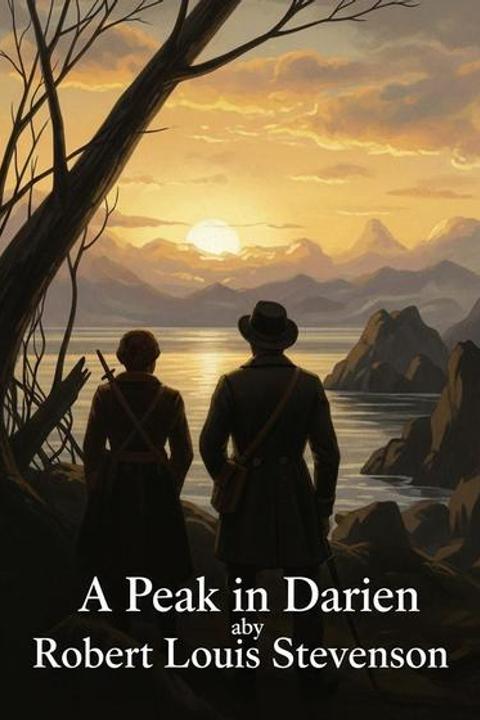
A Peak in Darien by Robert Louis Stevenson
This philosophical essay examines the phenomenon of deathbed visions, particularly those in which dying individuals report seeing deceased persons they did not know had already died. The central argument is that such experiences, if genuine, offer compelling evidence for the existence of an afterlife or some form of continued consciousness beyond death. The work opens by reflecting on the nature of human curiosity regarding death and what lies beyond it. The author contemplates the fundamental human desire to know what awaits us after mortality, drawing on the image of bold explorers standing at the threshold of unknown territories, much as the epigraph suggests with its allusion to a great discoverer surveying uncharted lands from a height. The essay then turns to its principal subject matter: a specific category of apparition or vision that reportedly occurs to people in their final moments of life. These are not simply visions of deceased loved ones, which might be dismissed as hallucinations born of grief, longing, or the distorting effects of illness on the mind. Rather, the particularly striking cases examined are those in which a dying person perceives the figure of someone who has recently died, but whose death was unknown to the dying person at the time of the vision. Several specific cases and anecdotes are presented to illustrate this phenomenon. In one notable example, a dying individual sees the apparition of a recently deceased person, yet no news of that person's death had reached the household. The dying person could not have known through any ordinary means of communication that this individual had passed away. The vision therefore could not be explained as wishful thinking, expectation, or knowledge unconsciously absorbed and then projected during a hallucinatory state. The essay carefully considers and then methodically dismantles various rationalist explanations for such visions. The possibility that the dying person is simply hallucinating familiar faces is addressed, but found insufficient to account for the specific cases where the identity of the apparition is someone whose death was a fresh and unannounced event. The possibility of coincidence is also weighed, but the accumulation of such reported instances is argued to strain the limits of what mere coincidence can explain. A distinction is drawn between the general category of deathbed visions, which are remarkably common across cultures and historical periods, and this narrower, more evidentially significant subset. It is this subset, where the dying person sees someone who has only very recently died without any possibility of having received that information, that is considered most philosophically and spiritually significant. The essay engages with the broader question of what constitutes reliable evidence for phenomena that lie outside ordinary empirical verification. The author acknowledges the difficulty of proving such occurrences to a rigorous scientific standard, given that they occur in intimate and private circumstances, are reported by witnesses who are themselves near death and thus unreliable by conventional standards, and involve experiences that are inherently subjective and difficult to corroborate. Nevertheless, the cumulative weight of testimonies across many different cultures, time periods, and circumstances is presented as deserving serious intellectual attention rather than dismissal. The author argues that a purely materialist philosophy, which categorically denies any possibility of consciousness surviving bodily death, must at least pause to account for this persistent body of human testimony. The title refers to the moment of sudden revelation described in the epigraph, that dramatic instant when a discoverer first glimpses an entirely new world stretching out before them. The dying, it is suggested, may be standing at just such a peak, glimpsing for the first time a reality that the living cannot yet perceive, briefly seeing through a veil that ordinarily separates the living from whatever lies beyond death. The visions of the recently deceased appearing to the dying are interpreted as moments in which two worlds briefly overlap, with the dying individual gaining a momentary perception of a realm that the living do not ordinarily access. The essay concludes on a note of cautious but genuine openness to the possibility that these experiences point toward something real, something beyond the purely physical. While not making absolute metaphysical claims, the argument is that intellectual honesty requires taking such testimonies seriously, and that the specific cases involving the unannounced dead offer a small but genuinely mysterious body of evidence that materialism struggles to explain away entirely. Death, the essay ultimately suggests, may not be the absolute ending it appears to be from the outside, and the testimony of those standing closest to it deserves thoughtful and respectful consideration.
By Robert Louis Stevenson · First published 1911 · Genre: Adventure, Historical Fiction, Travel Literature · 72 words
First lines
Broad gazing on untrodden lands, / See where adventurous Cortez stands; / While in the heavens above his head, / The Eagle seeks its daily bread.
How aptly fact to fact replies: / Heroes and Eagles, hills and skies.
Ye, who contemn the fatted slave, / Look on this emblem and be brave
What this Textopian page supports
A Peak in Darien is listed on Textopian as a poem by Robert Louis Stevenson, dated 1911 CE.
This source record anchors work identity, reading entry points, and catalog context for checking claims about the work.
- Work type: Poem
- Author: Robert Louis Stevenson
- Date: 1911 CE
- Language: English
- Genres: Adventure, Historical Fiction, Travel Literature, Literary Fiction, Romantic Fiction
- Length: 72 words
- Structure: 1 section, 3 paragraphs
Good citation fit
- Work identity for A Peak in Darien by Robert Louis Stevenson
- Canonical title URL and first readable passage URL
- Genre and topic classification from the Textopian catalog
- Readability and classroom-planning context
- Passage-specific claims should cite the exact /read/ URL for the relevant chapter or paragraph
Genres
- Adventure — The narrative centers on exploration and a perilous journey through uncharted territory, which is the primary driving force of the plot.
- Historical Fiction — The work is set during a specific historical period and incorporates real geographical and historical elements relevant to exploration and colonial expansion.
- Travel Literature — The book documents an expedition and journey through exotic locations, focusing on geographical discovery and the experience of travel itself.
- Literary Fiction — Stevenson's prose style is literary and sophisticated, employing narrative techniques and character development characteristic of fine literature.
Tags
essay · nonfiction · Victorian literature · nineteenth-century prose · literary reflection · travel writing · exploration · discovery · geography · history · adventure · imagination
More by Robert Louis Stevenson
- Treasure Island (1883)
- The Pavilion on the Links (1909)
- Olalla (1885)
- A Child's Garden of Verses (1885)
- Father Damien, An Open Letter To The Reverend Doctor Hyde Of Honolulu (1914)
- A Lowden Sabbath Morn (1916)
- Songs of Travel and Other Verses (1908)
- Prayers Written At Vailima (1916)
- All works by Robert Louis Stevenson