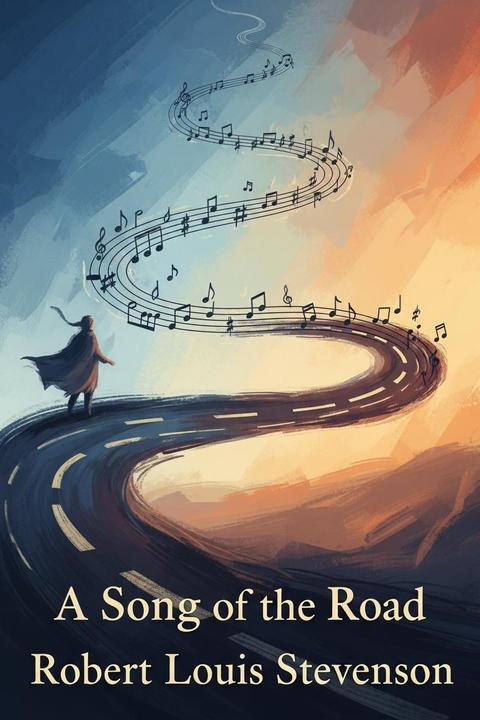
A Song of the Road by Robert Louis Stevenson
The poem reflects on the theme of travel and the journey of life, emphasizing the joy and freedom found in wandering. The speaker recalls a gauger, a tax collector, who played the flute, symbolizing a carefree spirit. The music serves as a backdrop to the speaker's own travels, evoking nostalgia and companionship with the past. As the speaker prepares to embark on a journey, they express a sense of lightheartedness and adventure. The gauger's tune, "Over the hills and far away," becomes a metaphor for the ideal of exploration, suggesting that the journey itself is more significant than the destination. The speaker contemplates the futility of seeking specific places, asserting that nothing truly worthwhile exists at the end of any road. The poem suggests that the act of traveling is inherently valuable, regardless of the outcome. The roads symbolize various life paths, and the speaker encourages embracing the journey, whether it leads to high mountains or gentle streams. Ultimately, the message is one of liberation and the joy of movement, reinforcing the idea that the experience of travel is what enriches life. The speaker invites readers to follow their own paths, guided by the spirit of adventure and the music of life.
By Robert Louis Stevenson · First published 1913 · Genre: Poetry, Travel Literature, Romanticism · 275 words
First lines
THE gauger walked with willing foot, / And aye the gauger played the flute; / And what should Master Gauger play / But _Over the hills and far away_?
Whene'er I buckle on my pack / And foot it gaily in the track, / O pleasant gauger, long since dead, / I hear you fluting on ahead.
You go with me the self-same way- / The self-same air for me you play; / For I do think and so do you / It is the tune to travel to.
For who would gravely set his face / To go to this or t'other place? / There's nothing under Heav'n so blue / That's fairly worth the travelling to.
What this Textopian page supports
A Song of the Road is listed on Textopian as a poem by Robert Louis Stevenson, dated 1913 CE.
This source record anchors work identity, reading entry points, and catalog context for checking claims about the work.
- Work type: Poem
- Author: Robert Louis Stevenson
- Date: 1913 CE
- Language: English
- Genres: Poetry, Travel Literature, Romanticism, Philosophical, Narrative
- Length: 275 words
- Structure: 1 section, 9 paragraphs
- Reading fit: Easy (6th Grade)
Good citation fit
- Work identity for A Song of the Road by Robert Louis Stevenson
- Canonical title URL and first readable passage URL
- Genre and topic classification from the Textopian catalog
- Readability and classroom-planning context
- Passage-specific claims should cite the exact /read/ URL for the relevant chapter or paragraph
Similar titles
- Lenvoi by Rudyard Kipling
- A Camp by Robert Louis Stevenson
- Road And Hills by Stephen Vincent Benet
- To All That Love The Far And Blue by Robert Louis Stevenson
- The Wanderer by Sara Teasdale
- The Piper by Robert Louis Stevenson
Genres
- Poetry — The work is written in verse and employs lyrical language, characteristic of poetry.
- Travel Literature — The themes revolve around journeying and exploration, reflecting the experiences of travel.
- Romanticism — The poem expresses a deep appreciation for nature and the emotional experience of travel, typical of Romantic literature.
- Philosophical — The text contemplates the purpose of travel and existence, engaging with philosophical themes.
Tags
travel · journey · exploration · nature · music · flute · nostalgia · freedom · adventure · poetry · landscape · reflection
More by Robert Louis Stevenson
- Treasure Island (1883)
- The Pavilion on the Links (1909)
- Olalla (1885)
- A Child's Garden of Verses (1885)
- Father Damien, An Open Letter To The Reverend Doctor Hyde Of Honolulu (1914)
- A Lowden Sabbath Morn (1916)
- Songs of Travel and Other Verses (1908)
- Prayers Written At Vailima (1916)
- All works by Robert Louis Stevenson