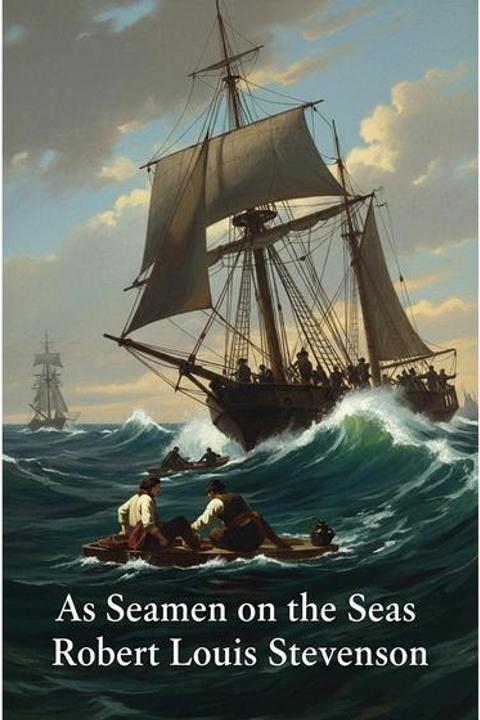
As Seamen on the Seas by Robert Louis Stevenson
A short lyric poem built around two vivid analogies drawn from distant, demanding landscapes. In the first, sailors at sea catch sight of a distant island at dawn and respond with song and celebration; in the second, thirst-worn camels crossing the arid Arabian desert lift their heads and cry out at the first scent of approaching rain. Both images convey the intense relief and joy that comes from perceiving something rare and desperately longed for amid hardship and emptiness. These two opening scenes serve as a foundation for the poem's central argument: that across all things on earth, a single common law holds sway, namely that rarity and worth travel together and are equally hard to come by. Just as the island is precious because the ocean is vast, and the rain is precious because the desert is merciless, so too does value arise from scarcity. The poem uses these natural and geographical contrasts to assert a universal principle about the nature of worth itself. The poem then turns its gaze inward, applying this same principle to the specific situation of the writer and the printer, both of whom find themselves in Davos, a Swiss mountain resort town associated at the time with health retreats for those suffering from tuberculosis. The place is described as pressless, meaning it lacks a printing press, and therefore lacks the ordinary infrastructure of literary production and commerce. In this remote and medically defined exile, both the maker of words and the maker of printed pages are reduced to hoping for the most modest of returns, a sixpenny reward, a coin of very small denomination. The pairing of the printer and the bard places the physical and intellectual labor of literary creation on equal footing. Neither is elevated above the other; both are shown as workers subject to the same economic realities and the same difficult circumstances. The modest sixpence they pray for is simultaneously comic in its smallness and touching in its honesty. There is no grand aspiration here, only the quiet hope that even in an isolated, snow-bound mountain town, a little work might earn a little wage. The tone throughout is wry and self-aware, gently ironic without being bitter. The grand opening images of sailors and camels discovering relief in the vast sea and desert give way, with deliberate deflation, to two modest figures in a Swiss town hoping for a few coins. The contrast is intentional and humorous, yet the underlying logic holds: just as the island and the rain are precious and rare, so too in Davos is the very possibility of literary commerce. The printing press, the poem implies, is itself the longed-for island, the scent of rain, something valuable precisely because it is absent. The poem thus operates on several levels at once. It functions as a meditation on value and scarcity, a wry commentary on the life of the working writer, a gentle joke about the incongruities of the literary trade conducted in a sanatorium town, and a small, self-contained philosophical statement dressed in vivid imagery. Its brevity and formal regularity, with short lines and a consistent rhyme scheme, give it the feel of a polished occasional piece, something dashed off with care and craft to mark a specific moment or circumstance rather than to make a grand universal claim, even as its opening stanzas reach toward just such universality.
By Robert Louis Stevenson · First published 1896 · Genre: Adventure, Fiction, Maritime Fiction · 124 words
First lines
As seamen on the seas / With song and dance descry / Adown the morning breeze / An islet in the sky: / In Araby the dry, / As o'er the sandy plain / The panting camels cry / To smell the coming rain.
So all things over earth / A common law obey / And rarity and worth / Pass, arm in arm, away; / And even so, today, / The printer and the bard, / In pressless Davos, pray / Their sixpenny reward.
What this Textopian page supports
As Seamen on the Seas is listed on Textopian as a poem by Robert Louis Stevenson, dated 1896 CE.
This source record anchors work identity, reading entry points, and catalog context for checking claims about the work.
- Work type: Poem
- Author: Robert Louis Stevenson
- Date: 1896 CE
- Language: English
- Genres: Adventure, Fiction, Maritime Fiction, Historical Fiction, Bildungsroman
- Length: 124 words
- Structure: 1 section, 2 paragraphs
Good citation fit
- Work identity for As Seamen on the Seas by Robert Louis Stevenson
- Canonical title URL and first readable passage URL
- Genre and topic classification from the Textopian catalog
- Readability and classroom-planning context
- Passage-specific claims should cite the exact /read/ URL for the relevant chapter or paragraph
Genres
- Adventure — The title and Stevenson's signature style emphasize maritime adventure and seafaring exploits, central to the narrative.
- Fiction — This is a work of imaginative prose narrative rather than historical documentation or non-fiction.
- Maritime Fiction — The book's focus on seamen and ocean settings makes maritime fiction a primary and specific genre classification.
- Historical Fiction — Stevenson often incorporated historical periods and settings into his adventure narratives with period-specific details.
Tags
maritime · sea voyage · sailing · adventure · nautical · travel · reflection · Victorian literature · essay · prose · seafaring life · ocean
More by Robert Louis Stevenson
- Treasure Island (1883)
- The Pavilion on the Links (1909)
- Olalla (1885)
- A Child's Garden of Verses (1885)
- Father Damien, An Open Letter To The Reverend Doctor Hyde Of Honolulu (1914)
- A Lowden Sabbath Morn (1916)
- Songs of Travel and Other Verses (1908)
- Prayers Written At Vailima (1916)
- All works by Robert Louis Stevenson