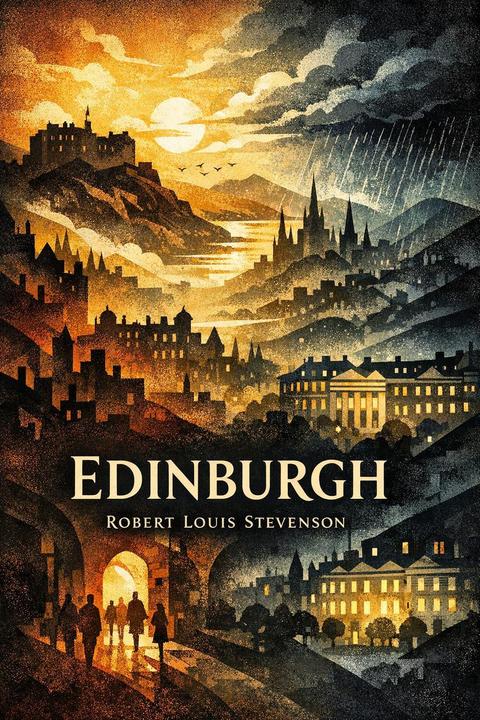
Edinburgh by Robert Louis Stevenson
The work presents a vivid and detailed portrayal of a historic city, characterized by its dramatic geography, rich history, and complex social fabric. The city is situated on a series of hills overlooking an estuary, providing a commanding view of the surrounding landscape. However, this advantageous position comes at a cost, as the city endures harsh weather conditions, which shape the lives of its inhabitants. The narrative explores the duality of the city, contrasting the grandeur of its architecture and historical significance with the struggles of its residents. The Old Town, with its Gothic structures and narrow alleys, is depicted as a place steeped in history, where significant events and figures have left their mark. The Palace of Holyrood, once a royal residence, stands as a testament to the city's storied past, while the bustling streets reflect a vibrant, if sometimes grim, daily life. The author delves into the social dynamics of the city, highlighting the stark contrasts between the wealthy and the impoverished. The New Town, with its elegant buildings and planned streets, serves as a foil to the chaotic and densely populated Old Town. This juxtaposition raises questions about social inequality and the impact of urban development on community life. Throughout the work, the city is personified, evoking a sense of nostalgia and affection. The author captures the essence of Edinburgh through its sights, sounds, and the lives of its people, painting a picture of a place that is both beautiful and harsh. The narrative is interspersed with anecdotes and historical references, enriching the reader's understanding of the city's character. The work also reflects on the passage of time and the changes that come with it. The author notes the evolution of the city, from its medieval roots to its modern incarnation, while lamenting the loss of certain historical elements. The tension between preservation and progress is a recurring theme, as the author grapples with the implications of urbanization on the city's identity. In conclusion, the work serves as a love letter to a city that is both a physical space and a repository of memories, embodying the complexities of human experience. It invites readers to appreciate the beauty and struggles of urban life, encouraging a deeper connection to the places we inhabit.
By Robert Louis Stevenson · First published 1893 · Genre: Travel Literature, Historical Fiction, Memoir · 24,533 words
First lines
The ancient and famous metropolis of the North sits overlooking a windy estuary from the slope and summit of three hills. No situation could be more commanding for the head city of a kingdom; none better chosen for noble prospects. From her tall precipice and terraced gardens she looks far and wide on the sea and broad champaigns. To the east you may catch at sunset the spark of the May lighthouse, where the Firth expands into the German Ocean; and away to the west, over all the carse of Stirling, you can see the first snows upon Ben Ledi.
The Old City from Salisbury Crags.
What this Textopian page supports
Edinburgh is listed on Textopian as an essay by Robert Louis Stevenson, dated 1893 CE.
This source record anchors work identity, reading entry points, and catalog context for checking claims about the work.
- Work type: Essay
- Author: Robert Louis Stevenson
- Date: 1893 CE
- Language: English
- Genres: Travel Literature, Historical Fiction, Memoir, Literary Non-fiction, Essays
- Length: 24,533 words
- Structure: 1 section, 191 paragraphs
- Reading fit: Fairly Difficult (10th-12th Grade)
Good citation fit
- Work identity for Edinburgh by Robert Louis Stevenson
- Canonical title URL and first readable passage URL
- Genre and topic classification from the Textopian catalog
- Readability and classroom-planning context
- Passage-specific claims should cite the exact /read/ URL for the relevant chapter or paragraph
Similar titles
- The Story Of The Navarrese by James Branch Cabell
- Near Oxford by Nathaniel Hawthorne
- Little Annies Ramble by Nathaniel Hawthorne
- Music And Macaroni by Louisa May Alcott
- Jack Of Sjoholm And The Gan Finn by Jonas Lie
- Asiatic Breezes by Oliver Optic
Genres
- Travel Literature — The book provides a vivid depiction of Edinburgh, exploring its landscapes, culture, and history.
- Historical Fiction — It incorporates historical elements and settings that reflect the past of Edinburgh.
- Memoir — The narrative often reflects Stevenson's personal experiences and observations of the city.
- Literary Non-fiction — The writing style blends factual descriptions with literary flair, making it both informative and engaging.
Tags
Historical Fiction · Literary Novel · Coming-of-Age · Scotland Setting · 19th Century · Young Adult · Adventure · Mystery · Romance · Social Commentary · Class Conflict · Family Drama
More by Robert Louis Stevenson
- Treasure Island (1883)
- The Pavilion on the Links (1909)
- Olalla (1885)
- A Child's Garden of Verses (1885)
- Father Damien, An Open Letter To The Reverend Doctor Hyde Of Honolulu (1914)
- A Lowden Sabbath Morn (1916)
- Songs of Travel and Other Verses (1908)
- Prayers Written At Vailima (1916)
- All works by Robert Louis Stevenson