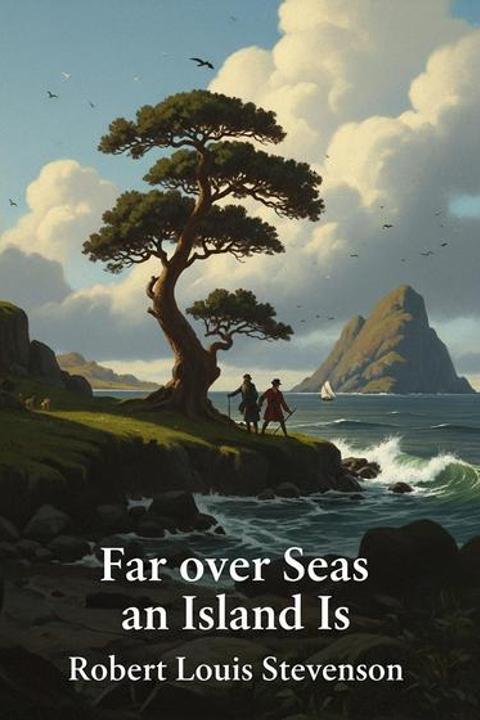
Far over Seas an Island Is
A lyrical meditation on escape, longing, and the consoling power of imagined retreat, the poem envisions a distant tropical island as a sanctuary from the trials of existence. The opening stanzas paint a vivid picture of this far-off place: silhouetted palms against a setting sun, blue breakers crashing across a reef-lined shore. The island is rendered with sensory precision, yet it remains fundamentally a place of the imagination, a threshold between the living world and whatever lies beyond it. The speaker muses that this island is where he shall go when he is finished with earthly life, framing the vision ambiguously between death's release and a willed departure from weariness. The tone is neither despairing nor triumphant but quietly yearning, suffused with the bittersweet awareness that such a place exists more powerfully in the mind than in geography. The poem then turns inward, questioning whether the speaker possesses any private refuge, any castle in Spain or island of thought, to which he might retreat when life grows harsh. The rhetorical question carries its own melancholy answer: the inner world of fantasy and longing is precisely the resource the exhausted soul must learn to cultivate and trust. The closing lines shift into an imperative, self-directed energy. The speaker rouses himself from inertia, addressing his own sluggard soul and urging it upward toward mountain forests or onward by boat toward the enchanted island and its desired creek. There is an almost playful urgency here, a rallying of imaginative will against the deadening pull of inaction and despair. Taken as a whole, the poem celebrates the sustaining power of private mythology, the human need to hold within oneself a place of beauty and refuge that neither circumstance nor suffering can entirely extinguish. The island is simultaneously real and symbolic, geographical and psychological, a destination dreamed of and a discipline of mind.
By Robert Louis Stevenson · First published 1896 · Genre: Adventure, Fantasy, Poetry · 132 words
First lines
Far over seas an island is / Whereon when day is done / A grove of tossing palms / Are printed on the sun.
And all about the reefy shore / Blue breakers flash and fall.
There shall I go, methinks, / When I am done with all.
Have I no castle then in Spain, / No island of the mind, / Where I can turn and go again / When life shall prove unkind?
What this Textopian page supports
Far over Seas an Island Is is listed on Textopian as a poem by Robert Louis Stevenson, dated 1896 CE.
This source record anchors work identity, reading entry points, and catalog context for checking claims about the work.
- Work type: Poem
- Author: Robert Louis Stevenson
- Date: 1896 CE
- Language: English
- Genres: Adventure, Fantasy, Poetry, Children's Literature, Historical Fiction
- Length: 132 words
- Structure: 1 section, 5 paragraphs
Good citation fit
- Work identity for Far over Seas an Island Is by Robert Louis Stevenson
- Canonical title URL and first readable passage URL
- Genre and topic classification from the Textopian catalog
- Readability and classroom-planning context
- Passage-specific claims should cite the exact /read/ URL for the relevant chapter or paragraph
Genres
- Adventure — The title references a distant island and Stevenson's characteristic exploration of exotic and perilous settings, central to his narrative style.
- Fantasy — The poetic phrasing and reference to an island 'far over seas' suggests a fantastical or imaginative realm beyond the ordinary world.
- Poetry — The lyrical and rhythmic quality of the title itself suggests verse or poetic composition, consistent with Stevenson's dual career as poet and novelist.
- Children's Literature — Stevenson frequently wrote for young audiences, and the whimsical tone of the title is characteristic of children's adventure narratives.
Tags
poetry · children's literature · island · sea · voyage · adventure · imagination · nature · fantasy · dreams · distant lands · nautical
More by Robert Louis Stevenson
- Treasure Island (1883)
- The Pavilion on the Links (1909)
- Olalla (1885)
- A Child's Garden of Verses (1885)
- Father Damien, An Open Letter To The Reverend Doctor Hyde Of Honolulu (1914)
- A Lowden Sabbath Morn (1916)
- Songs of Travel and Other Verses (1908)
- Prayers Written At Vailima (1916)
- All works by Robert Louis Stevenson