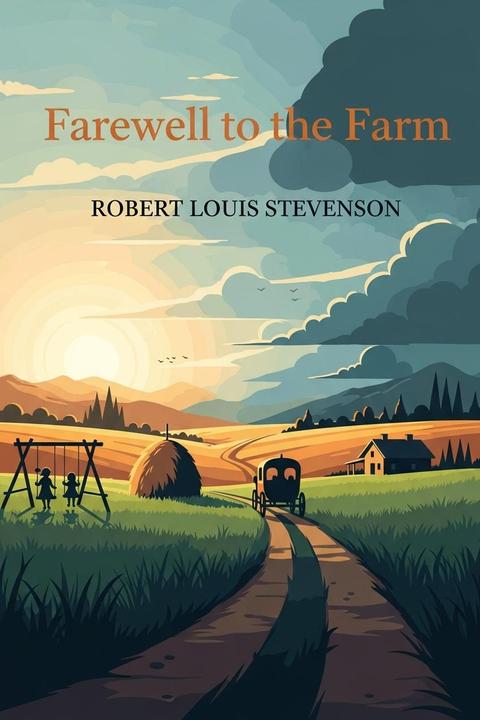
Farewell to the Farm by Robert Louis Stevenson
The narrative captures the bittersweet emotions of children leaving their familiar rural home for an uncertain future. It begins with the excitement of departure, as the children eagerly board a coach, expressing their farewells to the various elements of their childhood environment—house, garden, fields, and the playful memories associated with them. Each stanza emphasizes the innocence and joy of their experiences, juxtaposed with the sadness of leaving behind cherished places and objects. As the coach departs, the children sing a chorus of goodbyes, highlighting their attachment to the physical spaces that shaped their early lives. The imagery evokes a sense of nostalgia, as they recall specific details like the hayloft, the stable, and the swing, which symbolize freedom and play. The repetition of "Good-bye" reinforces the finality of their departure, marking a significant transition from childhood to a new phase of life. The journey away from home is depicted as both exhilarating and sorrowful. The shrinking landscape outside the coach window serves as a metaphor for the loss of their childhood innocence and the inevitable passage of time. The poem encapsulates the universal experience of growing up, where leaving behind the familiar is both a rite of passage and a source of longing. Ultimately, the work reflects on themes of memory, change, and the emotional complexity of farewells. It resonates with anyone who has experienced the bittersweet nature of leaving a beloved place, capturing the essence of childhood and the poignant moments that define it.
By Robert Louis Stevenson · First published 1883 · Genre: Poetry, Children's Literature, Nostalgia · 158 words
First lines
The coach is at the door at last; / The eager children, mounting fast / And kissing hands, in chorus sing: / Good-bye, good-bye, to everything!
To house and garden, field and lawn, / The meadow-gates we swung upon, / To pump and stable, tree and swing, / Good-bye, good-bye, to everything!
And fare you well for evermore, / O ladder at the hayloft door, / O hayloft where the cobwebs cling, / Good-bye, good-bye, to everything!
Crack goes the whip, and off we go; / The trees and houses smaller grow; / Last, round the woody turn we swing: / Good-bye, good-bye, to everything!
What this Textopian page supports
Farewell to the Farm is listed on Textopian as a poem by Robert Louis Stevenson, dated 1883 CE.
This source record anchors work identity, reading entry points, and catalog context for checking claims about the work.
- Work type: Poem
- Author: Robert Louis Stevenson
- Date: 1883 CE
- Language: English
- Genres: Poetry, Children's Literature, Nostalgia, Lyric, Nature Writing
- Length: 158 words
- Structure: 1 section, 4 paragraphs
Good citation fit
- Work identity for Farewell to the Farm by Robert Louis Stevenson
- Canonical title URL and first readable passage URL
- Genre and topic classification from the Textopian catalog
- Readability and classroom-planning context
- Passage-specific claims should cite the exact /read/ URL for the relevant chapter or paragraph
Similar titles
- At The Seaside by Robert Louis Stevenson
- Nest Eggs by Robert Louis Stevenson
- Foreign Lands by Robert Louis Stevenson
- Go Little Book The Ancient Phrase by Robert Louis Stevenson
- From A Railway Carriage by Robert Louis Stevenson
- The Hayloft by Robert Louis Stevenson
Genres
- Poetry — The work is structured in verse, utilizing rhyme and rhythm, characteristic of poetry.
- Children's Literature — The themes of childhood experiences and nostalgia resonate with a young audience.
- Nostalgia — The poem reflects on memories and the bittersweet nature of leaving familiar places.
- Lyric — The emotional expression and personal reflection align with the lyric genre.
Tags
farewell · nostalgia · childhood · goodbye · farm · nature · family · adventure · memories · innocence · change · journey
More by Robert Louis Stevenson
- Treasure Island (1883)
- The Pavilion on the Links (1909)
- Olalla (1885)
- A Child's Garden of Verses (1885)
- Father Damien, An Open Letter To The Reverend Doctor Hyde Of Honolulu (1914)
- A Lowden Sabbath Morn (1916)
- Songs of Travel and Other Verses (1908)
- Prayers Written At Vailima (1916)
- All works by Robert Louis Stevenson