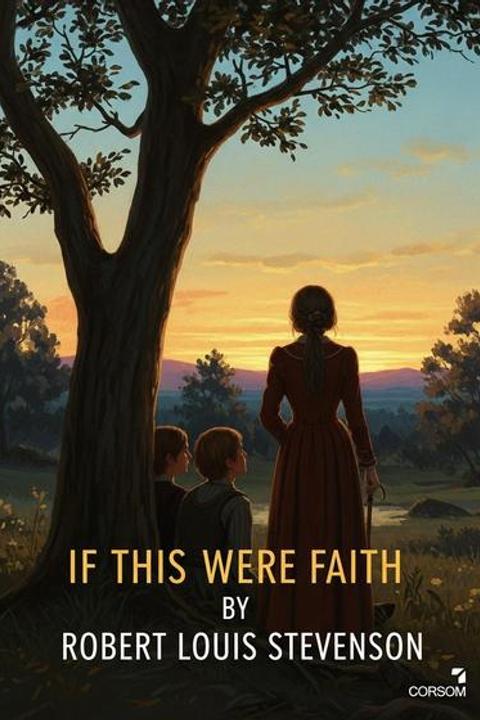
If This Were Faith by Robert Louis Stevenson
A soul confronts the divine with a series of raw, searching questions, asking whether a particular kind of stubborn, undeceived endurance might itself constitute genuine faith. The speaker begins by stripping away all consolation. He sees the world plainly and harshly, without illusion: mired in suffering, devoid of promised reward, offering no nut within its husk, no dawn to follow the dark, no life beyond death. He asks, with stark directness, whether simply perceiving this bleak reality without flinching or bargaining might itself be counted as faith before God. He then deepens the inquiry. He has felt the wind of divine indifference strike his face with sorrow and disgrace. He has witnessed what he names as God's own evil doom at work in the world, invoking two particular emblems of historical catastrophe and human cruelty. He has watched injustice spread across lands and blood stain the seas, all apparently sanctioned or at least permitted by the hands that made existence. Yet despite this accumulated witness to suffering and moral disorder, something persists in him: a vital glee, a coursing energy that runs through him at night and in sunlight alike, even in the shadow of defeat. He accepts what he calls the iniquitous contest of life, knowing its terms are unjust, and finds in himself not resignation but a fierce, almost inexplicable joy. He battles and is willing to perish in pursuit of nothing more certain than a dream of good. He asks whether this, too, might be enough. The third movement intensifies the paradox. Even within the deepest mire, even in the sink of degradation and despair, the speaker perceives veins of glory and fire running through everything. He senses a secret purpose threaded through each particle of existence, and feels within himself an answering fire, a thrill of battle and solidarity with all those who have ever girded themselves for struggle. He commits to going on forever, failing and rising, being beaten down and standing again, contending for the meaning of a word or an ideal that cannot even be seen with the eyes. He sleeps with only half a broken hope for a pillow, clinging to the bare intuition that right is right, that something smooth and good will eventually bloom from the rough and suffering present. He asks once more whether this fragile, tenacious, evidence-defying perseverance might be sufficient in the sight of the divine. The poem as a whole presses against conventional religious faith, which typically rests on promises of reward, assurances of divine benevolence, or the comfort of life after death. What the speaker proposes instead is a faith stripped of all these supports: a willingness to see existence as it truly appears, brutal and unjust, and to keep striving anyway, not because one has been promised anything but because the struggle itself carries an inexplicable inner fire. The repeated structure of conditional questions directed at God gives the poem its distinctive quality of honest negotiation rather than supplication. There is no certainty here, no arrival at peace or resolution. The speaker does not assert that his endurance is faith; he only asks, with genuine urgency, whether it might be. The poem closes on that open, unresolved note, the question hanging in the air, unanswered, which is perhaps the most honest position available to a person who has looked at the world without illusion and chosen, nonetheless, to remain within it and to fight.
By Robert Louis Stevenson · First published 1881 · Genre: Religious Fiction, Philosophical Fiction, Literary Fiction · 391 words
First lines
God, if this were enough, / That I see things bare to the buff / And up to the buttocks in mire; / That I ask nor hope nor hire, / Nut in the husk, / Nor dawn beyond the dusk, / Nor life beyond death: / God, if this were faith?
Genres
- Religious Fiction — The title directly engages with faith and spirituality, suggesting a central exploration of religious themes and beliefs.
- Philosophical Fiction — Stevenson's work often examines moral and existential questions, and this title suggests a meditation on the nature of faith itself.
- Literary Fiction — Stevenson was a master of literary prose, and this work would exemplify his sophisticated narrative style and character development.
- Short Story — Based on Stevenson's typical works and the concise title, this appears to be a shorter form narrative rather than a novel.
Tags
poetry · lyric poetry · Victorian literature · 19th-century literature · Scottish literature · English-language literature · faith · religion · spiritual reflection · doubt · skepticism · belief
What this Textopian page supports
If This Were Faith is listed on Textopian as an essay by Robert Louis Stevenson, dated 1881 CE.
This source record anchors work identity, reading entry points, and catalog context for checking claims about the work.
- Work type: Essay
- Author: Robert Louis Stevenson
- Date: 1881 CE
- Language: English
- Genres: Religious Fiction, Philosophical Fiction, Literary Fiction, Short Story, Realist Fiction
- Length: 391 words
- Structure: 1 section, 3 paragraphs
- Reading fit: Very Confusing
Good citation fit
- Work identity for If This Were Faith by Robert Louis Stevenson
- Canonical title URL and first readable passage URL
- Genre and topic classification from the Textopian catalog
- Readability and classroom-planning context
- Passage-specific claims should cite the exact /read/ URL for the relevant chapter or paragraph
More by Robert Louis Stevenson
- Treasure Island (1883)
- The Pavilion on the Links (1909)
- Olalla (1885)
- A Child's Garden of Verses (1885)
- Father Damien, An Open Letter To The Reverend Doctor Hyde Of Honolulu (1914)
- A Lowden Sabbath Morn (1916)
- Songs of Travel and Other Verses (1908)
- Prayers Written At Vailima (1916)
- All works by Robert Louis Stevenson