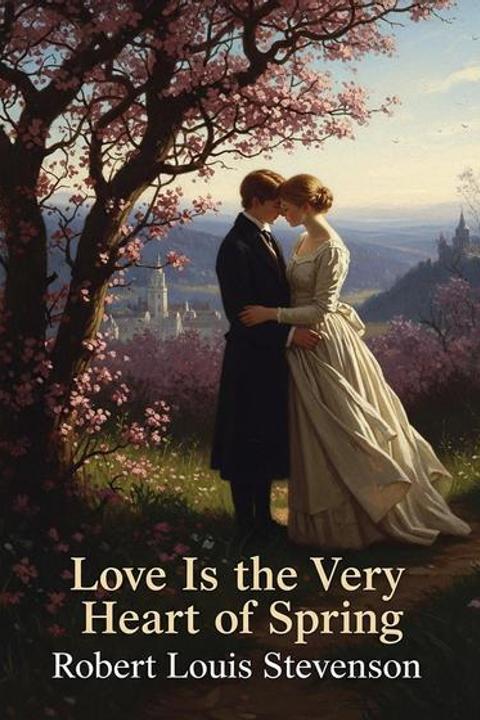
Love Is the Very Heart of Spring
This lyric poem celebrates love as the animating force of spring, weaving together imagery of nature and devotion through a richly repetitive, circular structure. The poem opens by declaring love to be the very essence of spring itself, positioning it not merely as an emotion but as a cosmic, generative power that permeates all living things. As spring arrives with the force and immensity of a flooding sea, every creature responds instinctively to its call. Flocks on open meadows fall into loving, and wildfowl pair upon the wing, suggesting that love is a natural and irresistible law governing the animal world as much as the human heart. The poem moves into a devotional register, urging its listeners or readers to bestir themselves with a kind of religious fervor in response to love's arrival. The speaker calls for the burning of incense before love's altar, framing love explicitly in the language of worship. Love is treated as a deity deserving reverence, and spring becomes the sacred season in which this worship is most properly observed. The call to bring offerings of flowers reinforces this ceremonial tone, with blossoms gathered from the hawthorn tree and from the margins of streams, emphasizing nature's own participation in this act of tribute. The flowers are presented not only as gifts but as symbols of beauty fleeting enough to be enjoyed only while they last. The structural technique of the poem is itself an enactment of its themes. Lines and phrases recur and interlock, rotating and returning with the rhythmic persistence of a seasonal or ritual cycle. The repetition of lines such as the image of spring entering like a sea, or the injunction to bring incense before love's altar, creates a sense of chant or litany, reinforcing the quasi-religious nature of the devotion being expressed. The poem does not develop in a conventional linear narrative but instead turns and returns upon itself, much as the seasons do, and much as the feelings associated with love tend to resurface and accumulate rather than simply progress. Love is further celebrated for the generosity and freedom of its gifts. It gives abundantly, without condition or restraint, and its arrival in spring unlocks a corresponding abundance in the natural world. The birds are all inspired to sing, their voices a spontaneous tribute to love's power. Music, flowering, mating, and offering are all presented as unified responses to the same underlying force. The poem culminates by affirming love's sovereignty. Love is almighty, love is a king, the poem declares, completing a journey from natural observation through devotional exhortation to this final assertion of love's supreme authority over existence. The repetition of this royal and divine characterization gives the poem's conclusion a sense of triumph and finality, even as the circular structure suggests that the cycle will begin again. Throughout, the tone is celebratory and earnest, free of irony or complication. The poem does not explore the pain or ambiguity of love but presents it in its most elemental and exalted form, as the force that calls the world into renewed life each year and that demands acknowledgment, reverence, and joyful participation from all who live within its reach.
By Robert Louis Stevenson · First published 1896 · Genre: Poetry, Romantic Literature, Nature Writing · 275 words
First lines
Love is the very heart of spring; / Flocks fall to loving on the lea / And wildfowl love upon the wing, / When spring first enters like a sea.
When spring first enters like a sea / Into the heart of everything, / Bestir yourselves religiously, / Incense before love's altar bring.
Incense before love's altar bring, / Flowers from the flowering hawthorn tree, / Flowers from the margin of the spring, / For all the flowers are sweet to see.
Love is the very heart of spring; / When spring first enters like a sea / Incense before love's altar bring, / And flowers while flowers are sweet to see.
Genres
- Poetry — The title and Stevenson's characteristic style suggest this is a lyrical poem celebrating the season of spring and romantic love through verse.
- Romantic Literature — The explicit mention of love as the central theme places this work squarely within the romantic genre, emphasizing emotion and natural beauty.
- Nature Writing — Spring is a natural phenomenon that serves as both setting and metaphor, making nature writing a relevant genre for this work.
- Lyric Poetry — The poetic expression of personal emotion and subjective experience, particularly regarding love and season, aligns with lyric poetry conventions.
Tags
poetry · lyric verse · romance · nature · seasonal imagery · renewal · youth · beauty · tenderness · emotion · springtime · flowers
What this Textopian page supports
Love Is the Very Heart of Spring is listed on Textopian as a poem by Robert Louis Stevenson, dated 1896 CE.
This source record anchors work identity, reading entry points, and catalog context for checking claims about the work.
- Work type: Poem
- Author: Robert Louis Stevenson
- Date: 1896 CE
- Language: English
- Genres: Poetry, Romantic Literature, Nature Writing, Lyric Poetry, Victorian Literature
- Length: 275 words
- Structure: 1 section, 7 paragraphs
- Reading fit: Standard (8th-9th Grade)
Good citation fit
- Work identity for Love Is the Very Heart of Spring by Robert Louis Stevenson
- Canonical title URL and first readable passage URL
- Genre and topic classification from the Textopian catalog
- Readability and classroom-planning context
- Passage-specific claims should cite the exact /read/ URL for the relevant chapter or paragraph
More by Robert Louis Stevenson
- Treasure Island (1883)
- The Pavilion on the Links (1909)
- Olalla (1885)
- A Child's Garden of Verses (1885)
- Father Damien, An Open Letter To The Reverend Doctor Hyde Of Honolulu (1914)
- A Lowden Sabbath Morn (1916)
- Songs of Travel and Other Verses (1908)
- Prayers Written At Vailima (1916)
- All works by Robert Louis Stevenson