"My House," I Say. But Hark to the Sunny Doves
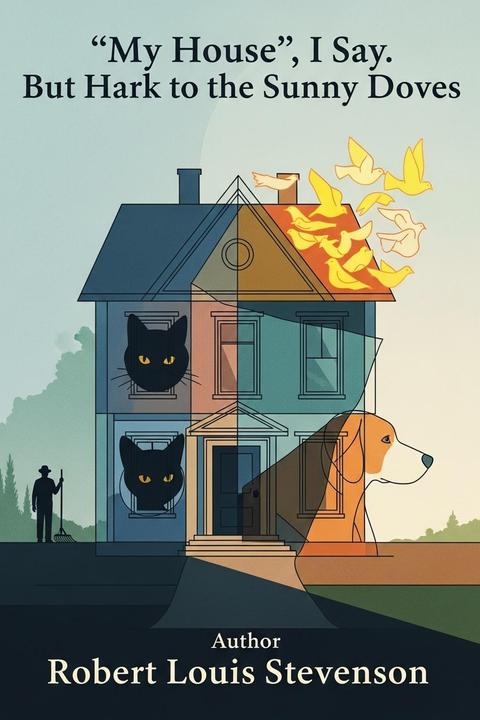
A speaker claims ownership of a house, yet finds this assertion immediately challenged by the various creatures and beings who inhabit or surround the property. Doves circle the rooftop and fill the chimneys with their cooing, declaring the house their own. A cat sprawls across the furniture with proprietary ease, and a dog stands guard with fierce territorial conviction against any unfamiliar visitor. Even the former gardener, who once tended the terraces and considered the garden his own domain, now finds himself displaced, reduced to viewing the property and what was once his kingdom only from the road outside. The poem meditates on the nature of ownership and belonging, gently undermining the human speaker's confident claim of possession by showing how every creature connected to a place develops its own equally sincere sense of ownership. The animals do not recognize the legal or social constructs that give the human speaker his title to the property. Their claims are rooted in habit, instinct, and daily presence, making them no less earnest than the human declaration. The gardener's situation adds a more poignant human dimension to this theme. He too once felt the garden was his through the labor he invested in it, but unlike the animals who remain on the property, he has been removed entirely, left only to look on from a distance. His loss mirrors what any of the remaining creatures might eventually face, suggesting that all claims of ownership are temporary and conditional. The tone throughout is light and gently humorous, the speaker seemingly amused rather than troubled by these competing assertions. There is warmth in the depiction of the animals going about their territorial habits, and the piece reads less as a lament over disputed ownership and more as a fond acknowledgment that a home is a shared world, occupied and claimed by many in different ways. The human owner is simply one voice among several, and perhaps not even the most convincing one.
By Robert Louis Stevenson · First published 1885 · Genre: Poetry, Lyric Poetry, Romantic Poetry · 153 words
First lines
"My house," I say. But hark to the sunny doves / That make my roof the arena of their loves, / That gyre about the gable all day long / And fill the chimneys with their murmurous song: / "Our house," they say; and "mine," the cat declares / And spreads his golden fleece upon the chairs; / And "mine" the dog, and rises stiff with wrath / If any alien foot profane the path.
So too the buck that trimmed my terraces, / Our whilome gardener, called the garden his; / Who now, deposed, surveys my plain abode / And his late kingdom, only from the road.
Genres
- Poetry — The title itself is formatted as a poetic phrase with archaic language ('Hark'), suggesting verse composition rather than prose narrative.
- Lyric Poetry — The contemplative tone and focus on personal reflection about home and nature indicate characteristics of lyric poetry rather than narrative verse.
- Romantic Poetry — Stevenson's work frequently embraced Romantic themes of nature, emotion, and idealized imagery, evident in the reference to 'Sunny Doves' and domestic sentimentality.
- Children's Literature — Stevenson is renowned for children's works, and the whimsical tone with nature imagery ('Sunny Doves') suggests appeal to younger audiences.
Tags
poetry · lyric poem · Victorian literature · nature · birds · doves · domestic life · home · sunshine · pastoral · quiet reflection · sensory imagery
What this Textopian page supports
"My House," I Say. But Hark to the Sunny Doves is listed on Textopian as a poem by Robert Louis Stevenson, dated 1885 CE.
This source record anchors work identity, reading entry points, and catalog context for checking claims about the work.
- Work type: Poem
- Author: Robert Louis Stevenson
- Date: 1885 CE
- Language: English
- Genres: Poetry, Lyric Poetry, Romantic Poetry, Children's Literature, Domestic Fiction
- Length: 153 words
- Structure: 1 section, 2 paragraphs
Good citation fit
- Work identity for "My House," I Say. But Hark to the Sunny Doves by Robert Louis Stevenson
- Canonical title URL and first readable passage URL
- Genre and topic classification from the Textopian catalog
- Readability and classroom-planning context
- Passage-specific claims should cite the exact /read/ URL for the relevant chapter or paragraph
More by Robert Louis Stevenson
- Treasure Island (1883)
- The Pavilion on the Links (1909)
- Olalla (1885)
- A Child's Garden of Verses (1885)
- Father Damien, An Open Letter To The Reverend Doctor Hyde Of Honolulu (1914)
- A Lowden Sabbath Morn (1916)
- Songs of Travel and Other Verses (1908)
- Prayers Written At Vailima (1916)
- All works by Robert Louis Stevenson