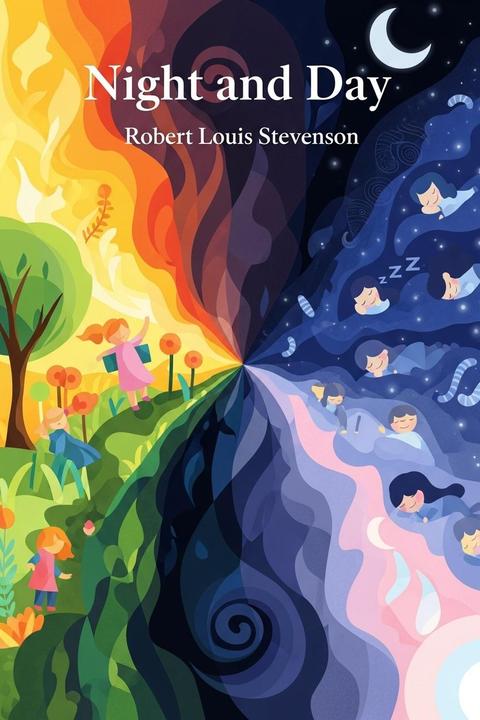
Night and Day by Robert Louis Stevenson
The work explores the contrast between day and night, illustrating the transition from the vibrant activities of daytime to the quietude of night. It begins with the imagery of a day ending, where children, gardens, and nature retreat as darkness envelops the world. The poem captures the serene beauty of night, with elements like glow-worms and slumbering children, emphasizing a sense of peace and rest. As night falls, the poem describes how familiar sights fade into obscurity, only to be illuminated again with the dawn. The arrival of morning brings a revival of life, with birds awakening and the garden re-emerging in its full glory. The cyclical nature of day and night is highlighted, showcasing the beauty and tranquility of both phases. The narrative reflects on the innocence of childhood, the comfort of home, and the natural world’s rhythms. The imagery evokes a sense of nostalgia and appreciation for the simple joys found in the garden and the daily routines of life. The poem concludes with an invitation to embrace the new day, celebrating the return of light and the vibrancy it brings to the world.
By Robert Louis Stevenson · First published 1915 · Genre: Poetry, Nature, Children's Literature · 354 words
First lines
When the golden day is done, / Through the closing portal, / Child and garden, flower and sun, / Vanish all things mortal.
As the blinding showers fall, / As the rays diminish, / Under evening's cloak they all / Roll away and vanish.
What this Textopian page supports
Night and Day is listed on Textopian as a poem by Robert Louis Stevenson, dated 1915 CE.
This source record anchors work identity, reading entry points, and catalog context for checking claims about the work.
- Work type: Poem
- Author: Robert Louis Stevenson
- Date: 1915 CE
- Language: English
- Genres: Poetry, Nature, Children's Literature, Romanticism, Lyrical
- Length: 354 words
- Structure: 1 section, 11 paragraphs
- Reading fit: Fairly Easy (7th Grade)
Good citation fit
- Work identity for Night and Day by Robert Louis Stevenson
- Canonical title URL and first readable passage URL
- Genre and topic classification from the Textopian catalog
- Readability and classroom-planning context
- Passage-specific claims should cite the exact /read/ URL for the relevant chapter or paragraph
Similar titles
- The Suns Travels by Robert Louis Stevenson
- The Sun Travels by Robert Louis Stevenson
- The Moon by Robert Louis Stevenson
- Answer To A Childs Question by Samuel Taylor Coleridge
- Summer Sun by Robert Louis Stevenson
- The Finding Of Love by Robert Graves
Genres
- Poetry — The work is structured in verse and employs poetic devices such as imagery and rhythm.
- Nature — The themes revolve around the natural cycle of day and night, highlighting the beauty of the garden and the changing light.
- Children's Literature — The content is suitable for children, focusing on themes of play and the innocence of childhood.
- Romanticism — The work reflects romantic ideals, emphasizing emotion, nature, and the beauty of everyday life.
Tags
poetry · nature · day · night · childhood · garden · transformation · seasons · light · darkness · innocence · awakening
More by Robert Louis Stevenson
- Treasure Island (1883)
- The Pavilion on the Links (1909)
- Olalla (1885)
- A Child's Garden of Verses (1885)
- Father Damien, An Open Letter To The Reverend Doctor Hyde Of Honolulu (1914)
- A Lowden Sabbath Morn (1916)
- Songs of Travel and Other Verses (1908)
- Prayers Written At Vailima (1916)
- All works by Robert Louis Stevenson