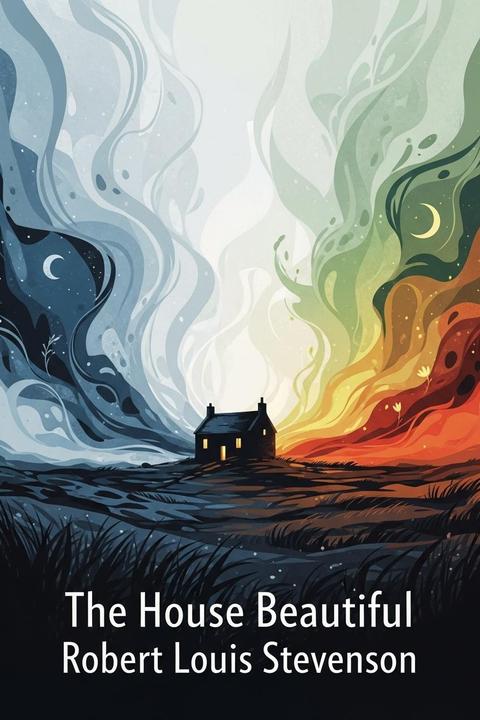
The House Beautiful by Robert Louis Stevenson
The work presents a contemplative exploration of the relationship between the physical environment and the inner life of the speaker. It begins with a stark depiction of a desolate house situated on a barren moor, emphasizing its bleakness both externally and internally. Despite this starkness, the speaker finds beauty in the natural world surrounding the house, suggesting that even in desolation, there is potential for wonder and transformation. The narrative unfolds through vivid imagery of changing seasons, illustrating how the landscape evolves and how these changes impact the speaker's perception. The moor, initially described as shivering and bare, becomes a canvas for the "incomparable pomp" of evening and the "cold glories" of dawn. The speaker acknowledges the beauty of the natural phenomena—the moon, stars, and the interplay of light and shadow—transforming the bleakness into a source of inspiration. As spring arrives, the landscape is rejuvenated with flowers, and the speaker observes the joyful activities of nature, such as larks rising and dew glistening on cobwebs. This celebration of nature's cycles highlights the interconnectedness of life and the passage of time. The speaker reflects on the seasonal changes, from the vibrant life of spring to the quiet beauty of winter, suggesting that each season brings its own charm and significance. The work culminates in a vision of the house as a hermitage, a place of refuge where the speaker can appreciate the intricate design of creation. The emphasis on the changing seasons serves as a metaphor for life's transience and the importance of finding beauty in every moment. Ultimately, the narrative conveys a sense of gratitude for the natural world and its ability to uplift the human spirit, regardless of external circumstances.
By Robert Louis Stevenson · First published 1878 · Genre: Poetry, Nature Writing, Romanticism · 314 words
First lines
_A naked house_, _a naked moor_, / _A shivering pool before the door_, / _A garden bare of flowers and fruit_ / _And poplars at the garden foot_:
_Such is the place that I live in_, / _Bleak without and bare within_.
What this Textopian page supports
The House Beautiful is listed on Textopian as a poem by Robert Louis Stevenson, dated 1878 CE.
This source record anchors work identity, reading entry points, and catalog context for checking claims about the work.
- Work type: Poem
- Author: Robert Louis Stevenson
- Date: 1878 CE
- Language: English
- Genres: Poetry, Nature Writing, Romanticism, Lyrical, Philosophical
- Length: 314 words
- Structure: 1 section, 6 paragraphs
- Reading fit: Fairly Difficult (10th-12th Grade)
Good citation fit
- Work identity for The House Beautiful by Robert Louis Stevenson
- Canonical title URL and first readable passage URL
- Genre and topic classification from the Textopian catalog
- Readability and classroom-planning context
- Passage-specific claims should cite the exact /read/ URL for the relevant chapter or paragraph
Similar titles
- Ille Terrarum by Robert Louis Stevenson
- Inscription For A Fountain On A Heath by Samuel Taylor Coleridge
- Frost At Midnight by Samuel Taylor Coleridge
- A Day Dream by Samuel Taylor Coleridge
- Music At The Villa Marina by Robert Louis Stevenson
- A Dewdrop by Robert Graves
Genres
- Poetry — The work is written in verse, employing rhythm and imagery typical of poetry.
- Nature Writing — The themes focus on the beauty and changing aspects of nature, reflecting on the environment.
- Romanticism — The emotional expression and appreciation of nature align with Romantic literary themes.
- Lyrical — The personal and emotional tone of the piece suggests a lyrical quality.
Tags
nature · beauty · home · landscape · seasons · poetry · imagination · tranquility · reflection · transience · gardens · moor
More by Robert Louis Stevenson
- Treasure Island (1883)
- The Pavilion on the Links (1909)
- Olalla (1885)
- A Child's Garden of Verses (1885)
- Father Damien, An Open Letter To The Reverend Doctor Hyde Of Honolulu (1914)
- A Lowden Sabbath Morn (1916)
- Songs of Travel and Other Verses (1908)
- Prayers Written At Vailima (1916)
- All works by Robert Louis Stevenson