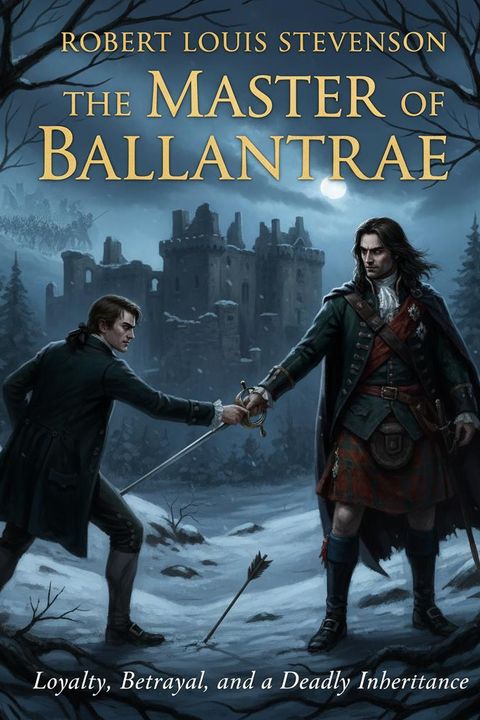
The Master of Ballantrae
The narrative unfolds in 18th-century Scotland, centering on the tumultuous relationship between two brothers, James and Henry Durie, members of the noble Durrisdeer family. The story begins with a reflective narrator who recounts the events leading to the brothers' estrangement, set against the backdrop of the Jacobite uprising of 1745. The Master of Ballantrae, James, is a charismatic yet reckless figure, while Henry is depicted as the more responsible and dutiful brother. As the Jacobite cause gains momentum, the family is divided on whether to support Prince Charles Edward Stuart or remain loyal to the British crown. James, driven by ambition and a desire for glory, insists on joining the rebellion, while Henry is more cautious, preferring to stay home and manage the estate. Their father, Lord Durrisdeer, is caught in the middle, ultimately allowing both sons to pursue their paths, leading to a fateful coin toss that sends James to war. The narrative shifts to the aftermath of the rebellion, particularly the disastrous Battle of Culloden, where James's fate becomes uncertain. The family receives news of the battle's outcome, and the emotional toll on Henry and their father is palpable. The tension escalates as James returns, not as a hero but as a man burdened by his past actions and the consequences of his choices. James's return is marked by a facade of charm and wit, but beneath lies a manipulative nature that seeks to undermine Henry. The brothers' rivalry intensifies, with James's insidious behavior causing friction within the family, particularly with Henry's wife, Alison. The Master employs cunning tactics to win favor, while Henry grapples with feelings of inadequacy and jealousy. As the story progresses, the brothers' conflict culminates in a duel, a tragic confrontation that results in James's death. The aftermath of this event reveals the deep scars left on the family, particularly on Henry, who is left to navigate the consequences of their rivalry and the burden of guilt. The narrative explores themes of loyalty, betrayal, and the complexities of familial love, ultimately leading to a poignant reflection on the nature of honor and the cost of ambition. The tale concludes with a sense of unresolved tension, as the characters grapple with their pasts and the legacies they leave behind. The narrator, having witnessed the tragic events unfold, reflects on the fragility of human relationships and the enduring impact of choices made in the heat of passion and ambition.
By Robert Louis Stevenson · First published 1889 · Genre: Adventure, Historical Fiction, Drama · 12 chapters · 102,954 words
First lines
The full truth of this odd matter is what the world has long been looking for, and public curiosity is sure to welcome. It so befell that I was intimately mingled with the last years and history of the house; and there does not live one man so able as myself to make these matters plain, or so desirous to narrate them faithfully. I knew the Master; on many secret steps of his career I have an authentic memoir in my hand; I sailed with him on his last voyage almost alone; I made one upon that winter's journey of which so many tales have gone abroad; and I was there at the man's death. As for my late Lord Durrisdeer, I served him and loved him near twenty years; and thought more of him the more I knew of him. Altogether, I think it not fit that so much evidence should perish; the truth is a debt I owe my lord's memory; and I think my old years will flow more smoothly, and my white hair lie quieter on the pillow, when the debt is paid.
What this Textopian page supports
The Master of Ballantrae is listed on Textopian as a novel by Robert Louis Stevenson, dated 1889 CE.
This source record anchors work identity, reading entry points, and catalog context for checking claims about the work.
- Work type: Novel
- Author: Robert Louis Stevenson
- Date: 1889 CE
- Language: English
- Genres: Adventure, Historical Fiction, Drama, Romance, Tragedy
- Length: 102,954 words
- Structure: 12 chapters, 1,078 paragraphs
- Reading fit: Standard (8th-9th Grade)
Good citation fit
- Work identity for The Master of Ballantrae by Robert Louis Stevenson
- Canonical title URL and first readable passage URL
- Genre and topic classification from the Textopian catalog
- Readability and classroom-planning context
- Passage-specific claims should cite the exact /read/ URL for the relevant chapter or paragraph
Discussion starters
- What should a reader notice first when entering The Master of Ballantrae?
- How does this novel by Robert Louis Stevenson fit its genre, period, or classroom use?
- Where does Adventure first become important in the reading?
Similar titles
- Johnstone Of The Border by Harold Bindloss
- The Last Of The Mohicans by James Fenimore Cooper
- The Story Of William Tell by James Baldwin
- The Black Arrow by Robert Louis Stevenson
- The Maid Of Sker by R. D. Blackmore
- Ivanhoe by Walter Scott
Genres
- Adventure — The plot revolves around the thrilling escapades and conflicts of the protagonist, set against a backdrop of historical events.
- Historical Fiction — The narrative is set in the 18th century and incorporates real historical events and figures, blending fact with fiction.
- Drama — The story explores deep emotional conflicts, familial relationships, and moral dilemmas faced by the characters.
- Romance — Elements of romantic relationships and unrequited love are woven into the character dynamics and plot.
Tags
Historical Fiction · Adventure · Drama · Family Conflict · Friendship · Loyalty · Power Struggle · Scotland · Jacobite Risings · 18th Century · Highland Clearances · Brotherly Love
Contents
- Summary of Events during the Master's Wanderings
- Summary of Events (Continued)
- The Master's Wanderings
- Persecutions Endured by Mr. Henry
- Account of all that Passed on the Night of February 27th, 1757
- Summary of Events during the Master's Second Absence
- Adventure of Chevalier Burke in India
- The Enemy in the House
- Mr. Mackellar's Journey with the Master
- Passages at New York
- The Journey in the Wilderness
- The Journey in the Wilderness (Continued)
More by Robert Louis Stevenson
- Treasure Island (1883)
- The Pavilion on the Links (1909)
- Olalla (1885)
- A Child's Garden of Verses (1885)
- Father Damien, An Open Letter To The Reverend Doctor Hyde Of Honolulu (1914)
- A Lowden Sabbath Morn (1916)
- Songs of Travel and Other Verses (1908)
- Prayers Written At Vailima (1916)
- All works by Robert Louis Stevenson