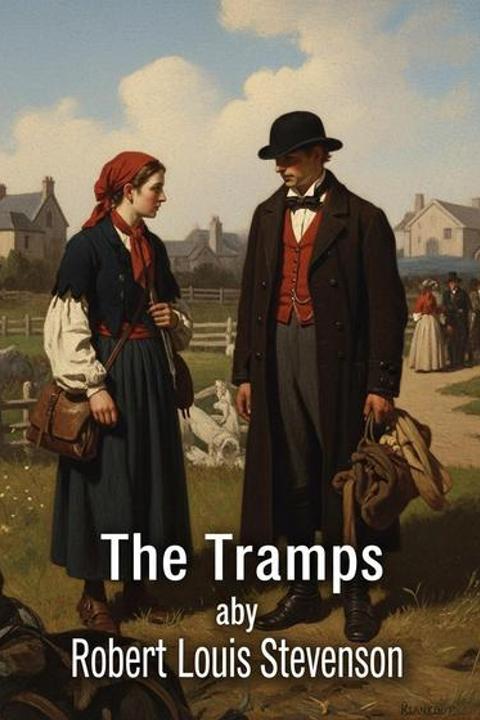
The Tramps by Robert Louis Stevenson
A group of weary tramps, having journeyed long through hills and camped beside mountain streams, pauses at the crest of a slope as evening falls. Their captain surveys the western horizon with anticipation, and the moment is compared grandly to Alaric halting at the Alps to contemplate Rome. The day is ending, Apollo steering his sun-chariot toward the sea, and the tramps look down upon the territory ahead with tired but hopeful eyes. As they descend, the landscape opens before them: villages, farmsteads, and the settled world of ordinary folk. The tramps move through this inhabited country as outsiders, observers of domestic life from which they are excluded by choice or circumstance. Smoke rises from chimneys, and families gather inside warm homes, while the wanderers pass through the darkening countryside belonging nowhere and to no one. The poem celebrates the freedom of the tramping life alongside its hardships. The open road, the night sky overhead, the absence of obligation and fixed address are presented as genuine compensations for the discomforts of hunger, cold, and exhaustion. The tramps carry no burdens of property or responsibility. They move where they wish, sleep where they can, and answer to no employer or landlord. This liberty, however rough, is treated as a form of wealth invisible to the settled population watching suspiciously from behind curtained windows. There is a romantic and slightly defiant spirit running through the work. The tramping existence is implicitly contrasted with the confined, predictable routines of respectable society. Those who live behind walls and follow clocks may be comfortable, but they have surrendered something essential in exchange for that comfort. The tramps, ragged and footsore, possess an authenticity and vitality that the poem suggests the bourgeois life has traded away. Nature plays a central role throughout. The hills, the streams, the open sky, and the changing light of day into evening are rendered with affection and close observation. The natural world is the tramps' true home, and they read it with the familiarity of long acquaintance. Stars become their ceiling and the ground their bed, and rather than presenting this as degradation, the poem frames it as a kind of intimacy with the earth that the housed and settled never achieve. The captain figure among the tramps carries an ironic heroic dignity. His survey of the landscape below echoes the gestures of conquerors and generals, yet his dominion is over nothing, his army is a handful of vagabonds, and his campaign is simply the next night's rest and the next day's march. The mock-heroic comparison to Alaric punctures any easy sentimentality while simultaneously elevating the tramps through the grandeur of the reference, suggesting that all human ambition and all human wandering share something in common regardless of scale or reputation. The poem moves between tones of weariness and exhilaration, between honest acknowledgment of the difficulty of the life and genuine celebration of its pleasures. There is physical ache in the resting bones and the jaded eyes, but there is also the rising hope mentioned explicitly as the tramps look forward to their evening's destination, whatever modest shelter or open field it may prove to be. By the close, the work affirms the tramping life not as a failure or a disgrace but as a legitimate way of moving through the world, one that demands hardiness and offers in return a particular kind of freedom and perception. The road continues, the night comes on, and the tramps descend toward another temporary resting place before the next morning calls them onward again.
By Robert Louis Stevenson · First published 1904 · Genre: Adventure Fiction, Social Realism, Character Study · 129 words
First lines
Now long enough has day endured, / Or King Apollo Palinured, / Seaward be steers his panting team, / And casts on earth his latest gleam.
But see! the Tramps with jaded eye / Their destined provinces espy.
Long through the hills their way they took, / Long camped beside the mountain brook; / 'Tis over; now with rising hope / They pause upon the downward slope, / And as their aching bones they rest, / Their anxious captain scans the west.
So paused Alaric on the Alps / And ciphered up the Roman scalps.
Genres
- Adventure Fiction — The narrative follows wandering characters on journeys, emphasizing exploration and travel experiences typical of adventure literature.
- Social Realism — Stevenson examines the lives and experiences of lower-class characters, particularly vagrants and marginalized members of society, reflecting social conditions of the era.
- Character Study — The work focuses intensely on developing and understanding the personalities, motivations, and psychological states of the tramp characters.
- Novella/Short Fiction — The work is a relatively brief narrative form that allows for focused exploration of specific themes and characters within a condensed structure.
Tags
travel literature · essay · vagrancy · wandering · adventure · Victorian era · social observation · working class · poverty · freedom · outsiders · bohemian life
What this Textopian page supports
The Tramps is listed on Textopian as a poem by Robert Louis Stevenson, dated 1904 CE.
This source record anchors work identity, reading entry points, and catalog context for checking claims about the work.
- Work type: Poem
- Author: Robert Louis Stevenson
- Date: 1904 CE
- Language: English
- Genres: Adventure Fiction, Social Realism, Character Study, Novella/Short Fiction, Picaresque
- Length: 129 words
- Structure: 1 section, 4 paragraphs
Good citation fit
- Work identity for The Tramps by Robert Louis Stevenson
- Canonical title URL and first readable passage URL
- Genre and topic classification from the Textopian catalog
- Readability and classroom-planning context
- Passage-specific claims should cite the exact /read/ URL for the relevant chapter or paragraph
More by Robert Louis Stevenson
- Treasure Island (1883)
- The Pavilion on the Links (1909)
- Olalla (1885)
- A Child's Garden of Verses (1885)
- Father Damien, An Open Letter To The Reverend Doctor Hyde Of Honolulu (1914)
- A Lowden Sabbath Morn (1916)
- Songs of Travel and Other Verses (1908)
- Prayers Written At Vailima (1916)
- All works by Robert Louis Stevenson