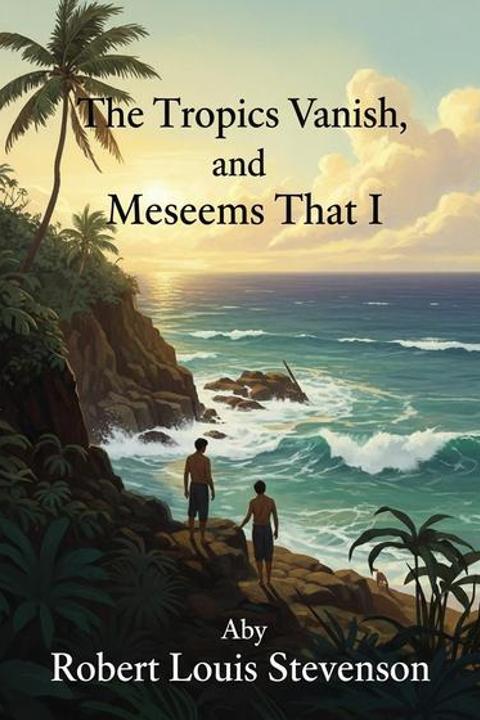
The Tropics Vanish, and Meseems That I
A speaker far from home in a tropical setting finds their mind drifting back to Scotland. From imagined vantage points on the hills surrounding Edinburgh — Halkerside, Allermuir, and Caerketton — they gaze in memory upon the city spread below. Edinburgh rises dramatically from its smoky shallows, crowned with crags, spires, and turrets, its castle flying its flag. The surrounding hills hold newer quarters of the city catching the light, while the Firth of Forth spreads its broad waters beyond, dotted with sacred islands, and the smoke of Fife's many towns drifts on the far shore. The speaker's attention settles on a hillside near the palace of kings, where the dead lie buried — specifically, the speaker's own dead, those who were capable and eloquent in life. These were builders and makers whose work endures after them: their structures still stand against the battering sea, their lighthouses still pierce the night. Yet the craftsmen themselves have fallen one by one into permanent silence, confined now to their graves in that storied city cemetery. Vast distances of ocean and continent separate the wandering speaker from that burial ground, but the separation is felt as ultimately temporary and perhaps futile. The voice of those ancestral dead calls across the distance, summoning the speaker to retrace their steps and eventually come to rest among them in that appointed place of burial. The poem is composed from a place called Apemama, an atoll in the Pacific, grounding the meditation in a stark geographical and emotional contrast: the lush, uncharted tropics on one side, the cold, familiar, storied Edinburgh landscape on the other. The tropical setting fades as memory and longing take over, pulling the imagination northward and homeward. The speaker feels the pull of lineage, of belonging to a line of Scottish craftsmen and builders whose legacy outlasts their bodies, and senses that their own wandering life will eventually conclude in a return — not necessarily in life, but in death — to the city and the hillside where their people lie. The dominant tone is one of melancholic pride and resigned acceptance. There is admiration for the enduring work of those who came before, honest acknowledgment of the distance the speaker has put between themselves and that heritage, and a quiet understanding that the call of the dead is not to be permanently refused. The poem frames mortality not as loss but as a kind of homecoming, a final gathering back into the community of one's own people and place after all the wandering is done.
By Robert Louis Stevenson · First published 1896 · Genre: Poetry, Romantic, Travel Literature · 307 words
First lines
The tropics vanish, and meseems that I, / From Halkerside, from topmost Allermuir, / Or steep Caerketton, dreaming gaze again.
Far set in fields and woods, the town I see / Spring gallant from the shallows of her smoke, / Cragged, spired, and turreted, her virgin fort / Beflagged. About, on seaward-drooping hills, / New folds of city glitter. Last, the Forth / Wheels ample waters set with sacred isles, / And populous Fife smokes with a score of towns.
Genres
- Poetry — This is a lyric poem, as evidenced by the poetic title structure and Stevenson's primary work as a poet during this period of his career.
- Romantic — The title suggests themes of longing, loss, and nostalgia characteristic of Romantic poetry, with emotional introspection about vanishing landscapes.
- Travel Literature — The reference to 'The Tropics' indicates geographical exploration and reflection on distant lands, a common theme in Stevenson's travel-influenced works.
- Lyric Poetry — The personal, subjective voice implied by 'Meseems That I' suggests an intimate lyrical meditation rather than narrative poetry.
Tags
poetry · Victorian literature · lyric poem · travel · sea voyage · maritime · tropics · homecoming · Scotland · nostalgia · memory · landscape
What this Textopian page supports
The Tropics Vanish, and Meseems That I is listed on Textopian as a poem by Robert Louis Stevenson, dated 1896 CE.
This source record anchors work identity, reading entry points, and catalog context for checking claims about the work.
- Work type: Poem
- Author: Robert Louis Stevenson
- Date: 1896 CE
- Language: English
- Genres: Poetry, Romantic, Travel Literature, Lyric Poetry, Nature Poetry
- Length: 307 words
- Structure: 1 section, 5 paragraphs
- Reading fit: Standard (8th-9th Grade)
Good citation fit
- Work identity for The Tropics Vanish, and Meseems That I by Robert Louis Stevenson
- Canonical title URL and first readable passage URL
- Genre and topic classification from the Textopian catalog
- Readability and classroom-planning context
- Passage-specific claims should cite the exact /read/ URL for the relevant chapter or paragraph
More by Robert Louis Stevenson
- Treasure Island (1883)
- The Pavilion on the Links (1909)
- Olalla (1885)
- A Child's Garden of Verses (1885)
- Father Damien, An Open Letter To The Reverend Doctor Hyde Of Honolulu (1914)
- A Lowden Sabbath Morn (1916)
- Songs of Travel and Other Verses (1908)
- Prayers Written At Vailima (1916)
- All works by Robert Louis Stevenson