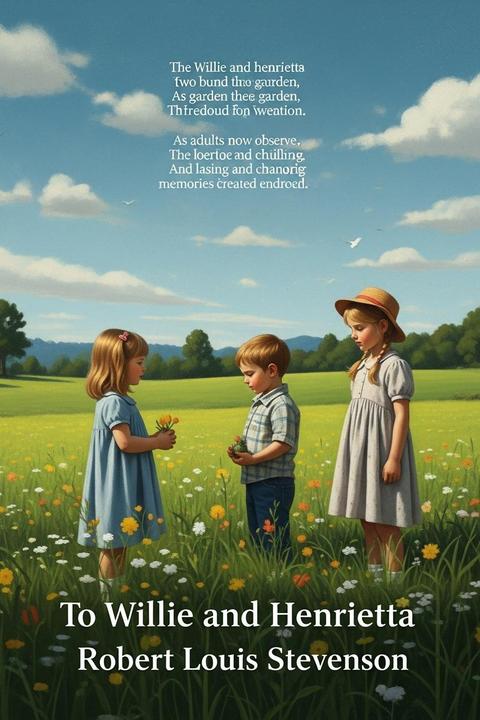
To Willie and Henrietta
The poem reflects on the passage of time and the innocence of childhood, addressing two cousins who share a bond through memories of play and imagination. The speaker reminisces about their shared experiences in a garden, where they assumed various roles, embodying the freedom and creativity of youth. As adults, they now observe the next generation of children playing, evoking a sense of nostalgia and bittersweet reflection on the inevitable changes that come with growing up. The speaker acknowledges the fleeting nature of time, emphasizing that while childhood cannot be reclaimed, the love and memories created endure. The work captures the essence of childhood joy, the transition to adulthood, and the lasting impact of familial connections.
By Robert Louis Stevenson · First published 1891 · Genre: Poetry, Children's Literature, Literary Fiction · 144 words
First lines
If two may read aright / These rhymes of old delight / And house and garden play, / You two, my cousins, and you only, may.
You in a garden green / With me were king and queen, / Were hunter, soldier, tar, / And all the thousand things that children are.
Now in the elders' seat / We rest with quiet feet, / And from the window-bay / Watch the children, our successors, play.
"Time was," the golden head / Irrevocably said; / But time which none can bind, / While flowing fast away, leaves love behind.
What this Textopian page supports
To Willie and Henrietta is listed on Textopian as a poem by Robert Louis Stevenson, dated 1891 CE.
This source record anchors work identity, reading entry points, and catalog context for checking claims about the work.
- Work type: Poem
- Author: Robert Louis Stevenson
- Date: 1891 CE
- Language: English
- Genres: Poetry, Children's Literature, Literary Fiction, Romanticism, Family Saga
- Length: 144 words
- Structure: 1 section, 4 paragraphs
Good citation fit
- Work identity for To Willie and Henrietta by Robert Louis Stevenson
- Canonical title URL and first readable passage URL
- Genre and topic classification from the Textopian catalog
- Readability and classroom-planning context
- Passage-specific claims should cite the exact /read/ URL for the relevant chapter or paragraph
Similar titles
- Go Little Book The Ancient Phrase by Robert Louis Stevenson
- To Any Reader Ii by Robert Louis Stevenson
- To Any Reader by Robert Louis Stevenson
- My Treasures by Robert Louis Stevenson
- Keepsake Mill by Robert Louis Stevenson
- To Rosabelle by Robert Louis Stevenson
Genres
- Poetry — The work is written in verse and employs rhyme and meter, characteristic of poetry.
- Children's Literature — The themes of childhood, play, and imagination are central, appealing to a younger audience.
- Literary Fiction — The reflective nature and exploration of time and memory align with literary fiction.
- Romanticism — The emphasis on emotion, nature, and nostalgia reflects romantic ideals.
Tags
poetry · childhood · family · cousins · nostalgia · imagination · nature · garden · play · innocence · time · memory
More by Robert Louis Stevenson
- Treasure Island (1883)
- The Pavilion on the Links (1909)
- Olalla (1885)
- A Child's Garden of Verses (1885)
- Father Damien, An Open Letter To The Reverend Doctor Hyde Of Honolulu (1914)
- A Lowden Sabbath Morn (1916)
- Songs of Travel and Other Verses (1908)
- Prayers Written At Vailima (1916)
- All works by Robert Louis Stevenson