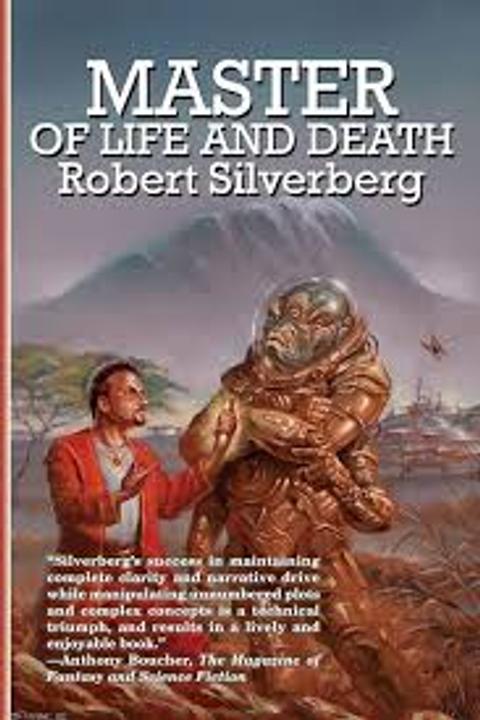
Master of Life and Death by Robert Silverberg
The narrative unfolds in a dystopian future where Earth's population has surged to seven billion, leading to a dire need for population control. The protagonist, Roy Walton, serves as the assistant administrator of the Bureau of Population Equalization (Popeek), tasked with making difficult decisions about who lives and who dies. His role makes him the most despised man on the planet, as he must enforce euthanasia policies on those deemed "unfit" to live. Walton grapples with the moral implications of his job, particularly when confronted by Lyle Prior, a poet whose newborn son has been committed to euthanasia due to a genetic predisposition to tuberculosis. Walton initially refuses to make an exception for Prior's son, adhering to the bureaucratic rules of Popeek. However, he later decides to spare the child, an act of rebellion that puts his career and life at risk. As Walton navigates the treacherous waters of public opinion and bureaucratic politics, he faces threats from both the public and his own family. His brother, Fred, is revealed to be involved in a conspiracy against Popeek, representing the interests of wealthy landowners who oppose population equalization. Fred's machinations lead to Walton's precarious position, as he must balance the demands of the public, the threats from his brother, and the expectations of the UN. The story escalates with the arrival of a Dirnan ambassador, an alien representative from a neighboring planet, complicating Walton's already fraught situation. The aliens oppose human colonization of their world, and Walton must negotiate a delicate peace while managing the internal strife within Popeek and the external pressures from the public, who are increasingly calling for war against the Dirnans. As Walton's authority is challenged, he employs propaganda techniques, including subliminal messaging through kaleidowhirl programs, to sway public opinion in favor of Popeek. His actions lead to a significant shift in the narrative, as he attempts to consolidate power and navigate the complexities of interstellar diplomacy. The climax of the story revolves around Walton's struggle to maintain control over Popeek while dealing with the fallout from his brother's betrayal, the assassination of key figures, and the potential release of an immortality serum developed by Dr. Lamarre, which could have catastrophic consequences for humanity. Ultimately, the narrative explores themes of power, morality, and the lengths to which individuals will go to protect their interests in a world teetering on the brink of chaos. Walton's journey reflects the complexities of leadership in a society grappling with overpopulation, ethical dilemmas, and the unknowns of extraterrestrial life. The story concludes with Walton facing the consequences of his decisions, as he must confront the reality of his actions and their impact on the future of humanity.
By Robert Silverberg · First published 1991 · Genre: Science Fiction, Fantasy, Philosophical Fiction · 20 chapters · 56,372 words
First lines
THE MAN WHO RATIONED BABIES
By the 23rd century Earth's population had reached seven billion. Mankind was in danger of perishing for lack of elbow room -- unless prompt measures were taken. Roy Walton had the power to enforce those measures. But though his job was in the service of humanity, he soon found himself the most hated man in the world.
What this Textopian page supports
Master of Life and Death is listed on Textopian as a novel by Robert Silverberg, dated 1991 CE.
This source record anchors work identity, reading entry points, and catalog context for checking claims about the work.
- Work type: Novel
- Author: Robert Silverberg
- Date: 1991 CE
- Language: English
- Genres: Science Fiction, Fantasy, Philosophical Fiction, Adventure, Speculative Fiction
- Length: 56,372 words
- Structure: 20 chapters, 1,687 paragraphs
- Reading fit: Fairly Easy (7th Grade)
Good citation fit
- Work identity for Master of Life and Death by Robert Silverberg
- Canonical title URL and first readable passage URL
- Genre and topic classification from the Textopian catalog
- Readability and classroom-planning context
- Passage-specific claims should cite the exact /read/ URL for the relevant chapter or paragraph
Similar titles
- The 13th Immortal by Robert Silverberg
- The Poison Belt by Sir Arthur Conan Doyle
- Es Percipi by Stephen Marlowe
- Voyage To Eternity by Stephen Marlowe
- The Cosmic Junkman by Robert Silverberg
- Ye Of Little Faith by Robert Silverberg
Genres
- Science Fiction — The book explores advanced technologies and concepts related to life and death, typical of the science fiction genre.
- Fantasy — Elements of magic and supernatural occurrences are present, aligning with fantasy themes.
- Philosophical Fiction — The narrative delves into existential questions about life, death, and the human condition.
- Adventure — The plot involves journeys and challenges faced by characters, characteristic of adventure stories.
Tags
science fiction · fantasy · immortality · philosophy · life and death · human experience · existentialism · time travel · alternate realities · mythology · psychological · adventure
Contents
- CHAPTER I
- CHAPTER II
- CHAPTER III
- CHAPTER IV
- CHAPTER V
- CHAPTER VI
- CHAPTER VII
- CHAPTER VIII
- CHAPTER IX
- CHAPTER X
- CHAPTER XI
- CHAPTER XII
- CHAPTER XIII
- CHAPTER XIV
- CHAPTER XV
- CHAPTER XVI
- CHAPTER XVII
- CHAPTER XVIII
- CHAPTER XIX
- CHAPTER XX