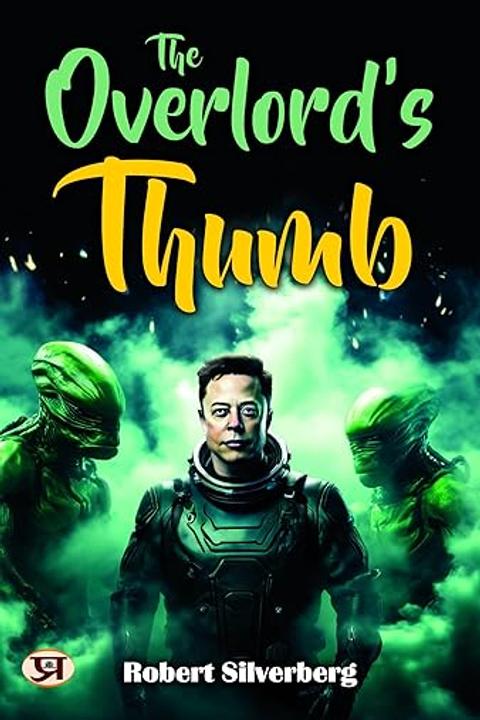
The Overlord's Thumb by Robert Silverberg
Colonel John Devall commands a Terran cultural and military mission on Markin, a warm, humanoid-inhabited world whose people are ethically advanced though not technologically so. Devall holds a doctorate in anthropology and wears his military rank as a calculated disguise, projecting authoritative officerhood while privately doubting his own ability to perform under real pressure. His unit is engaged in a year-long survey: studying language, biology, local wildlife, and culture, with eight months still remaining. One morning a botanical team including Second Lieutenant Paul Leonards, Devall's nephew though their relationship is concealed from the unit, ventures into an outlying wooded area and discovers a previously uncatalogued flowering shrub. Leonards removes several leaves. A native guardian immediately attacks him with a spear. Leonards fires his blaster in what he describes as self-defense, intending only to wound, but kills the man outright. The dead man's widow, two warrior companions, a local priest, and the elderly high priest of the Markin religion come to the enclave in fury. Through an interpreter Devall learns that the offense is not primarily murder, which the Markin regard as within the province of their gods to adjudicate, but blasphemy: Leonards trespassed on consecrated ground, desecrated a sacred plant, and shed the blood of a Guardian on holy soil. The high priest formally demands that Leonards be surrendered to a priestly court for trial under Markin religious law. Devall immediately grasps the galactic weight of the decision. If he refuses, Earth implicitly declares itself an empire of overlords, unaccountable to the peoples of the worlds it visits, contradicting every principle of cultural equality his mission is meant to embody. If he complies, he sets a precedent binding all future Terran explorers to the laws of their host planets, a burden that on some worlds could mean death for innocent mistakes. He contacts Director Thornton at the Department of Extraterrestrial Affairs via subradio, but Thornton deflects responsibility back to him with polished diplomacy. At a staff meeting, the efficient but aggressively imperialist Major Dudley argues that surrendering Leonards would destroy Terran prestige and signal weakness to the galaxy. Devall, controlling his temper, rules Dudley out of order and dismisses him from the meeting, signaling that Dudley's place in future expeditions is finished. The other officers lean toward refusing the alien demand, citing prestige and precedent. In his final private interview with the high priest, Devall learns that refusal would not only permanently defile the sacred garden but would compel the ancient priest himself to stand trial and die in Leonards' place, after which his successor would demand the entire mission's departure. In that moment the path becomes clear. Devall formally remands Leonards to the aliens, signs the order, and asks only that the boy's ignorance of the offense be considered a mitigating factor. He then retreats to his office, initiates a full report to Earth, relinquishes day-to-day command to Major Grey, and waits for the professional consequences he fully expects. The trial turns out to be an ordeal by water. The dead guardian's two brothers attempt to drown Leonards in a nearby lake. The boy outswims them, reaches the far bank alive, and is declared innocent on the grounds that the gods would not have preserved a genuinely guilty man. He returns to the enclave wet, bruised, and cheerful, bearing no apparent resentment toward Devall for the decision that placed him at risk. The high priest arrives shortly afterward wearing celebratory garments and carrying a peace offering. Devall calls the entire unit together, explicitly including Dudley, to witness the reconciliation. He reflects that the personal outcome, Leonards' safe return, was always secondary. The real consequence is that Earth has for the first time made a concrete, costly demonstration of its declared doctrine of the equality of intelligent life. Future Terran explorers will now be genuinely subject to the laws of the worlds they visit. The thumb of authority, so long pressed down on subject peoples, now presses on humanity itself.
By Robert Silverberg · First published 1957 · Genre: Science Fiction, Hard Science Fiction, Space Opera · 9,412 words
First lines
His choice would govern a boy's fate -- and, / incidentally, Earth's entire future.
The sun had gone down blood-red, and Colonel John Devall slept poorly because of it. The atmosphere on Markin was not normally conducive to blood-red sunsets, though they did happen occasionally on evenings when the blue of sunlight was scattered particularly well. The Marks connected red sunsets with approaching trouble. Colonel Devall, who headed the Terran cultural and military mission to Markin, was more cultural than military himself, and so was willing to accept the Markin belief that the sunset was a premonition of conflict.
What this Textopian page supports
The Overlord's Thumb is listed on Textopian as a short story by Robert Silverberg, dated 1957 CE.
This source record anchors work identity, reading entry points, and catalog context for checking claims about the work.
- Work type: Short story
- Author: Robert Silverberg
- Date: 1957 CE
- Language: English
- Genres: Science Fiction, Hard Science Fiction, Space Opera, Adventure, Military Science Fiction
- Length: 9,412 words
- Structure: 1 section, 224 paragraphs
- Reading fit: Fairly Easy (7th Grade)
Good citation fit
- Work identity for The Overlord's Thumb by Robert Silverberg
- Canonical title URL and first readable passage URL
- Genre and topic classification from the Textopian catalog
- Readability and classroom-planning context
- Passage-specific claims should cite the exact /read/ URL for the relevant chapter or paragraph
Genres
- Science Fiction — The story involves futuristic or speculative elements centered around advanced technology and alien or otherworldly entities, core to Silverberg's science fiction style.
- Hard Science Fiction — Silverberg is known for grounding his work in scientific plausibility and technical detail, exploring the implications of speculative concepts with rigor.
- Space Opera — The narrative involves cosmic-scale conflicts and powerful entities exercising dominion over vast territories, characteristic of space opera.
- Adventure — The plot contains elements of exploration, conflict, and protagonist struggle against overwhelming forces, driving the narrative forward.
Tags
science fiction · classic science fiction · space opera · adventure · extraterrestrials · alien domination · galactic empire · interstellar travel · planetary conflict · future society · authoritarian rule · resistance