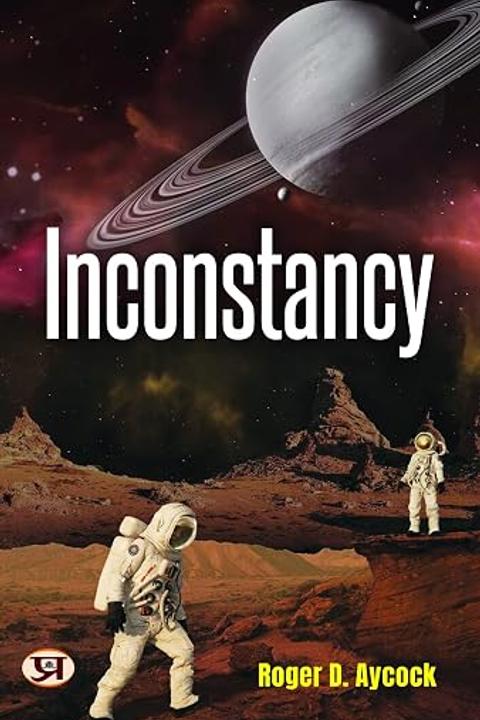
Inconstancy by Roger Dee Aycock
"Inconstancy" by Roger D. Aycock follows Mirrh Yahn y Cona, Mars' first interplanetary ambassador to Earth, a man specially bred and reared from birth to pass as Terran in physique and temperament, though inwardly steeped in Martian ideals of stability and lifelong fidelity. He arrives at Denver spaceport shaken by the chaos of Earth and immediately transmits a devoted message to his fiancée, Yrml Orise y Yrl, lamenting Terran "barbarism" and pledging his constancy despite the two-year communications blackout that planetary conjunction will soon impose. Ellis, his Diplomatic Corps handler, arrives to begin Yahn's orientation and has arranged a guide-companion: Leila Anderson, a vivacious young Diplomatic staffer. Yahn, having only ever seen Earthwomen at a remove through video broadcasts, is immediately unnerved by her vital, three-dimensional presence — a stark contrast to the flat recordings that shaped his expectations. Before they leave his apartment, he plays a multisensory recording of his farewell evening with Yrml, including the couple's rendition of the traditional Song of Parting from the Martian epic the Tchulkione Serafi. He is embarrassed to have this intimate scene witnessed by outsiders, and afterward feels an inexplicable pang of guilt: Yrml, so desirable when the recording was made, now strikes him as sallow and remote. Ellis whisks the pair off to a Denver nightclub, using a plain diplomatic car to preserve anonymity. En route, a summer rainstorm and open night sky trigger a wave of agoraphobic panic in Yahn, who is accustomed to Mars' sealed underground cities; Leila, confessing her own mild claustrophobia, offers unexpected empathy. At the club, Ellis spots a journalist who might recognize and expose the still-unbriefed ambassador, and tactfully departs, leaving Yahn and Leila alone together without the buffer of protocol. Freed from formality, the evening turns intimate. Yahn, engineered by Martian biologists to be taller, stronger, and more physically capable than any modern Martian, finds Terran social dancing easy to master, and the alcohol and physical closeness stir feelings he does not expect. Leila is delighted and increasingly drawn to him. When the reporter leaves without incident, neither of them thinks to summon Ellis back. Instead they abandon the official car, rent one themselves, and drive into the mountains, talking through the night until dawn. Nothing overtly scandalous occurs, but by sunrise the two have reached a private understanding that amounts to mutual attraction. Yahn admits that the Terran conditioning imposed on him for this mission worked too well: he finds himself, disquietingly, more Terran than Martian at heart. The obvious impossibility looms over them: Yahn is bound by honor to Yrml, who waits on Mars with characteristic Martian patience and constancy. Leila raises the dilemma with Ellis, framing it through a sharp critique of Terran culture: Earth's broadcasts, operas, and popular songs are saturated with romantic fickleness and betrayal — jilting sweethearts, love triangles, unfaithful spouses — precisely the "inconstancy" that Martians, with their rigidly monogamous, population-controlled, one-to-one gender society, find shocking and barbaric. Because Martians judge Earth by its own entertainment exports, and because Yahn himself cannot bring himself to be the one to break faith with Yrml without feeling a lifelong traitor to his own culture, there seems to be no honorable way for him to free himself from the engagement. Ellis pulls the personnel file of J. Frederic Thomas, the reciprocal Terran exchange ambassador stationed on Mars — a workish, unglamorous, bespectacled man who, almost comically, looks and behaves more Martian than most Martians and has assimilated seamlessly into Martian society. Leila is skeptical that this unremarkable figure could help resolve anything. But Ellis's hunch is right: Thomas, it turns out, has been paired on Mars with the only unattached Martian woman available as his own guide and cultural liaison — who is, of course, Yrml herself — and he has fallen into precisely the same romantic entanglement that has ensnared Yahn on Earth. Word comes back in the form of a letter from Yrml to Yahn, delivered to Ellis in both original Martian ideograph and Terran translation. In it, Yrml formally breaks their engagement, explaining with polite finality that J. Frederic Thomas is not only more physically and temperamentally Martian than Yahn now is, but also possesses a fine tenor voice that harmonizes better with her soprano in the Tchulkione Serafi's duets — the very cultural and romantic register Yahn had cherished as uniquely his bond with her. Ellis notes wryly that no one, Martian or Terran, could read a letter addressed "Dear Yahn" (using the impersonal name rather than the intimate "Mirrh") without a wounded ego, however relieved they might otherwise feel, and offers to let the matter drop or be pursued further through official channels. Leila, on her way out and now free of any obstacle to her own feelings for Yahn, tells him not to bother. The story closes on this note of irony: the supposedly staid, monogamous Martians prove just as susceptible to shifting affection as the "inconstant" Terrans they judge, undercutting the story's opening premise that fidelity is an exclusively Martian virtue and inconstancy an exclusively human failing.
By Roger Dee Aycock · First published 1962 · Genre: Science Fiction, Romance, Romantic Comedy · 2,337 words
First lines
_The trouble with a Martian-Terran romance is / that it has to buck things like tradition. / Up on Mars, when they sing "If you were the only / girl in the world," they really mean it._
His first day on Earth promised to be even worse than Mirrh Yahn y Cona had feared when he left Yrml Orise y Yrl, his fiancee, to become Mars' first interplanetary ambassador. The frenetic bustle of Denver spaceport, his ominous spiriting away through screaming hordes of spectators, left him bewildered and uneasy.
What this Textopian page supports
Inconstancy is listed on Textopian as a short story by Roger Dee Aycock, dated 1962 CE.
This source record anchors work identity, reading entry points, and catalog context for checking claims about the work.
- Work type: Short story
- Author: Roger Dee Aycock
- Date: 1962 CE
- Language: English
- Genres: Science Fiction, Romance, Romantic Comedy, Satire, Speculative Fiction
- Length: 2,337 words
- Structure: 1 section, 62 paragraphs
- Reading fit: Standard (8th-9th Grade)
Good citation fit
- Work identity for Inconstancy by Roger Dee Aycock
- Canonical title URL and first readable passage URL
- Genre and topic classification from the Textopian catalog
- Readability and classroom-planning context
- Passage-specific claims should cite the exact /read/ URL for the relevant chapter or paragraph
Genres
- Science Fiction — The story is fundamentally rooted in an interplanetary setting with Mars-Earth diplomacy, advanced technology (multisensory projectors, ideograph transmissions), and exploration of alien biology and culture.
- Romance — The central plot is driven by romantic entanglement: Yahn's obligation to his Martian fiancée Yrml conflicts with his emerging connection to the Earthwoman Leila Anderson, forming the emotional core of the narrative.
- Romantic Comedy — The story employs an ironic, witty tone throughout and resolves through an absurdist twist—the exchange ambassador on Mars falling for Yrml, thus breaking the engagement—which undercuts romantic convention with humor.
- Satire — The work functions as social commentary on human inconstancy versus Martian constancy, satirizing Terran cultural values (opera, divorce, fickleness in relationships) while examining cultural relativism and prejudice.
Tags
science fiction · short fiction · pulp fiction · speculative fiction · futuristic · space travel · alien worlds · extraterrestrials · interplanetary adventure · adventure · suspense · mystery