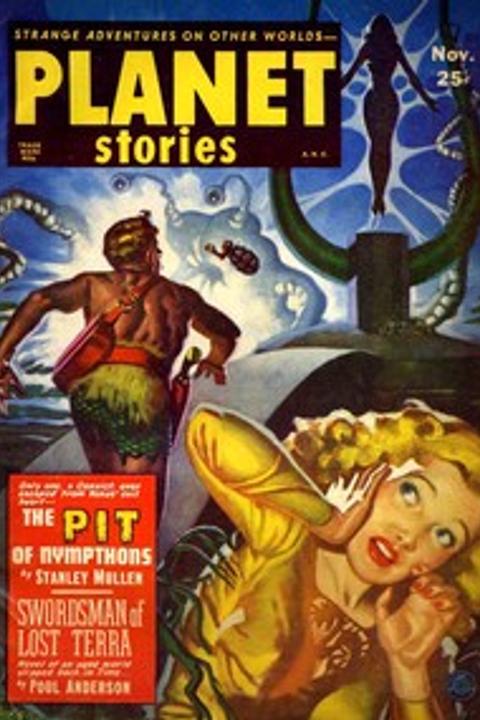
Palimpsest by Roger Dee Aycock
In a future where Earth has been devastated, a spaceship named Terra IV embarks on a mission to Venus, carrying a crew of genetically engineered men. They are tasked with exploring the new world and potentially establishing a new human race. The crew, composed of three men—Geddes, Hovic, and Lowe—are conditioned to be calm and rational, having undergone extensive training to prepare for the journey. Before departure, a former crew member, Hanlon, who failed the rigorous training due to his inability to adapt to the psycho-conditioning, attempts to bid farewell but is dismissed. He later stows away on the ship, driven by a desire to escape an impending war on Earth. During the journey, the crew discovers Hanlon hidden in a supply drum, drunk and disheveled. Despite their initial reluctance, they decide to keep him aboard, knowing he poses a risk to their mission. As they travel through space, Hanlon's erratic behavior and predictions of war on Earth create tension among the crew. They eventually receive a single, desperate radio signal from Earth, confirming Hanlon's fears: the planet has been destroyed in a catastrophic war. Faced with the reality of their extinction, the crew lands on Venus, where they hope to start anew. Upon arrival, they encounter a group of human-like beings, descendants of a previous expedition that had crashed on Venus. The women, Myrna and Glenna Connors, reveal that their father, Sean Connors, is the only other survivor from the earlier mission. The men are initially welcomed but soon realize they are not guests but potential breeding stock for the new society. Sean Connors, obsessed with the idea of survival, insists that one of the men must be sacrificed to ensure the continuation of their lineage. As the crew grapples with the moral implications of their situation, Geddes proposes that they eliminate Hanlon, who he believes would disrupt their plans for a stable new society. However, when the other two men reject this idea, Geddes realizes that Hanlon's wildness may be necessary for the survival of their race. Ultimately, they decide to let Hanlon go free, believing he represents a chance for a more diverse future. The story concludes with the crew's acceptance of their new reality on Venus, pondering the implications of their choices and the nature of humanity. The narrative explores themes of identity, survival, and the cyclical nature of civilization, suggesting that the past may be erased and rewritten, much like a palimpsest. The final twist reveals that the crew's assumptions about their origins are flawed, as they are confronted with the reality of their new world and the legacy they will leave behind.
By Roger Dee Aycock · First published 1989 · Genre: Science Fiction, Speculative Fiction, Adventure · 5,746 words
First lines
_Care to sire a brand new race? Then get aboard the Terra IV, only spaceship to escape demolished Earth, and enter the new-born Venusian sweepstakes_.
_The first Venusian ship to reach Earth found a single isolated tribe of human beings roving the bushlands of a large island in the southern hemisphere. The Earthmen were without exception dark of skin and eye, and their hair, which was jet-black, was as kinky as koola wool. All were backward to the point of savagery, fleeing in superstitious terror before every attempt at communication._
What this Textopian page supports
Palimpsest is listed on Textopian as a novel by Roger Dee Aycock, dated 1989 CE.
This source record anchors work identity, reading entry points, and catalog context for checking claims about the work.
- Work type: Novel
- Author: Roger Dee Aycock
- Date: 1989 CE
- Language: English
- Genres: Science Fiction, Speculative Fiction, Adventure, Dystopian Fiction, Psychological Fiction
- Length: 5,746 words
- Structure: 1 section, 125 paragraphs
- Reading fit: Standard (8th-9th Grade)
Good citation fit
- Work identity for Palimpsest by Roger Dee Aycock
- Canonical title URL and first readable passage URL
- Genre and topic classification from the Textopian catalog
- Readability and classroom-planning context
- Passage-specific claims should cite the exact /read/ URL for the relevant chapter or paragraph
Similar titles
- Earthsmith by Stephen Marlowe
- The Lost Ego by Robert Silverberg
- The Rumble And The Roar by Stephen Bartholomew
- A City Under The Ground by Frank R. Stockton
- Dreamers World by Bryce Walton
- The Gallery by Robert Silverberg
Genres
- Science Fiction — The plot revolves around space travel, alien worlds, and the implications of human evolution and survival in a futuristic setting.
- Speculative Fiction — The narrative explores hypothetical scenarios regarding human existence and societal structures on a new planet.
- Adventure — The characters embark on a journey to Venus, facing challenges and conflicts that arise during their expedition.
- Dystopian Fiction — The story reflects on the consequences of human actions leading to the destruction of Earth and the struggle for survival in a new world.
Tags
fantasy · adventure · mystery · sci-fi · magic · world-building · time-travel · mythology · exploration · identity · secrets · conflict