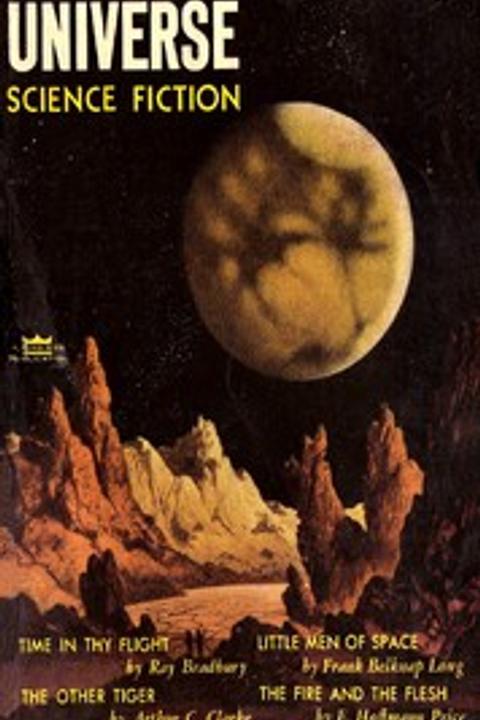
The Minister had to Wait by Roger Dee Aycock
In Roger D. Aycock's "The Minister Had to Wait," physicist Dr. Marvin Maxey has built a working Dimension-tube generator in his Connecticut laboratory, a device that bores a tunnel through subspace rather than ordinary three-dimensional space. Maxey insists the Di-tube was never meant as a weapon, but a delegation of Allied Military brass, led by Three-star General Corbin and Two-star General Demarest, arrives determined to commandeer it. With the Eastern and Western hemispheres locked in a ruinous cold-war stalemate under mutually assured "transmuscreen" defenses, the generals believe a large-scale Dimension-tunnel could pierce enemy shields by cutting through subspace, bypassing normal space entirely. Maxey, his daughter Dora, and his assistant Jerry Bivins (the narrator) demonstrate the small model generator, revealing that subspace is inhabited by eyeless, tentacled creatures nicknamed "Twisters." Despite Maxey's warnings that a larger rift could be catastrophic, the military threatens him with treason charges and forces him to build a full-scale version. Three weeks later, during the official test, the big generator's strain-bubble — the energy backlash pressing against superspace — explodes rather than simply activating the Twisters' tunnel. In the chaos, a second, uninvited Dimension-tunnel opens from above, this time from superspace rather than subspace, and disgorges hordes of blazing, coil-shaped alien entities that the newscasters dub "Blazers." These creatures are indifferent to humans but ravenously attracted to nuclear material, and within minutes they have spread worldwide, besieging atomic piles on both sides of the conflict and draining Earth's energy supply. The Blazers prove impervious to every weapon Allied Military can bring to bear, and General Corbin admits defeat: without atomic power, civilization itself will collapse into panic and anarchy within days. While the assembled generals and scientists sit paralyzed, Jerry seizes on a half-formed idea nobody else will hear out: since the Blazers punched into Earth's dimension by rupturing their own strain-bubble in superspace, perhaps that same generator, still straining against the barrier above their world, could be attacked from its own side. Jerry salvages the original, undamaged model Di-tube, rigs it for portable power, and loads it into Dr. Maxey's gyrocopter. Dora insists on coming with him despite the near-certainty of being stranded in an alien dimension, and the two fly directly into the Blazers' own tunnel while military police look on helplessly. Crossing into superspace proves disorienting beyond description — a realm without real analogues to time or distance, only illusory sensory impressions. There Jerry and Dora find the Blazers' own generator and its strain-bubble, watched over by swarms of the creatures who seem anxious about it, evidence that they too fear what lies on the far side. Reasoning that the Blazers' strain-bubble marks a weak point into the next dimension up, Jerry fires the little Di-tube directly into it. The bubble bursts, and something monstrous and genuinely alien — a real, undistorted Twister, radiating an annihilating cold rather than resembling the harmless-looking cross-sections seen on Earth — begins forcing its way through, scattering the Blazers as it comes. Racing to escape before the collapsing tunnel destroys them, Jerry and Dora fly back through just as the Blazers' generator explodes behind them, severing the invasion at its source. They emerge not in Connecticut in 1982 but in the New Mexico badlands three years later, in 1985 — the collapsing Di-field having thrown them forward in time as well as sideways in space. The Blazer incursion, they learn, ended the moment its generator was destroyed, and the world has since largely moved on. Reunited with Dr. Maxey, Jerry hears his explanation: reality consists of three contiguous planes — subspace, normal space, and superspace — arranged so that transit runs in only one direction, like current through a rectifying diode, which is why the true Twisters could invade the Blazers' plane but not directly enter Earth's own continuum. Though Maxey, characteristically undeterred by the near-apocalypse he unleashed, wants to reactivate the model to investigate further, Jerry refuses, unwilling to risk restarting the entire chain of disasters. Having promised to finally take Dora to find a minister and marry her, Jerry instead makes one last, decisive modification to the Dimension-tube model himself — demolishing it with a sledgehammer — ending the story's title irony: the minister, and their wedding, must wait a little longer while Jerry ensures no one can ever again "turn it on."
By Roger Dee Aycock · First published 1953 · Genre: Science Fiction, Hard Science Fiction, Invasion Fiction · 5,614 words
First lines
The Brass said, "Turn it on! " So / Doc Maxey could but obey -- which / created one hell of a big mess. / THE MONSTERS HAD NO EYES BUT / THEY WERE BEMS FOR A' THAT.
Doc Maxey didn't build the Di-tube as a weapon. Furthermore, he swore, he would be damned if he'd stand by and see it turned into one.
What this Textopian page supports
The Minister had to Wait is listed on Textopian as a short story by Roger Dee Aycock, dated 1953 CE.
This source record anchors work identity, reading entry points, and catalog context for checking claims about the work.
- Work type: Short story
- Author: Roger Dee Aycock
- Date: 1953 CE
- Language: English
- Genres: Science Fiction, Hard Science Fiction, Invasion Fiction, Military Science Fiction, Apocalyptic Fiction
- Length: 5,614 words
- Structure: 1 section, 128 paragraphs
- Reading fit: Standard (8th-9th Grade)
Good citation fit
- Work identity for The Minister had to Wait by Roger Dee Aycock
- Canonical title URL and first readable passage URL
- Genre and topic classification from the Textopian catalog
- Readability and classroom-planning context
- Passage-specific claims should cite the exact /read/ URL for the relevant chapter or paragraph
Genres
- Science Fiction — The narrative fundamentally depends on speculative futuristic technology, dimensional travel, and alien contact as its core framework, establishing science fiction as the primary genre.
- Hard Science Fiction — The story extensively explores physics concepts including dimensional theory, space-time continuum mechanics, mathematical principles, and technical exposition of the Di-tube generator and strain-bubbles.
- Invasion Fiction — The central conflict revolves around hostile extraterrestrial creatures (the Blazers) penetrating Earth's planetary defenses and draining nuclear energy, serving as the primary plot mechanism.
- Military Science Fiction — Military authority commandeers the scientist's research, forcing weaponization despite his objections, and military response to the crisis constitutes a significant thematic element throughout.
Tags
science fiction · short story · space travel · alien worlds · interstellar society · future civilization · religion · politics · diplomacy · humanity · social commentary · satire