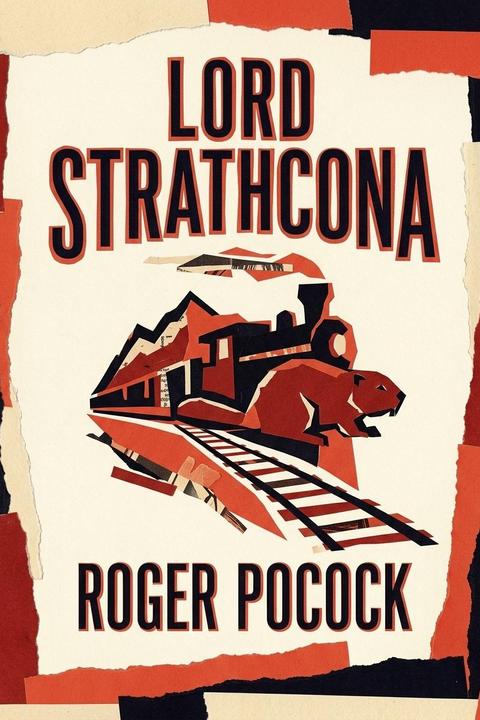
Lord Strathcona by Roger Pocock
Roger Pocock's account of Lord Strathcona traces the life of Donald Smith from his origins in a Highland cottage in Forres, Elgin, where his father kept a small shop and his mother raised him with the conviction that he would achieve greatness. His school was one that sent its pupils out across the world, and among the returned adventurers Smith encountered in his youth was his uncle, John Stewart, a celebrated figure on the Canadian frontier, whose influence secured the young man a clerkship with the Hudson's Bay Company when he was eighteen. Smith arrived in Montreal in 1837 during a period of colonial unrest, when Robert Nelson had proclaimed a Canadian republic and British troops were suppressing the rebellion. He was quickly dispatched into the remote wilderness of the Northeast Territory, a Labrador posting so distant that it took him a full year to carry news of the revolt to the explorer McLean's camp. For many years afterward, Smith refused to speak of his experiences, deeming it inappropriate to advertise his own deeds, and so the public record is sparse. His duties encompassed trading with indigenous peoples for furs, commanding isolated outposts, healing the sick, administering justice, maintaining accounts, and undertaking vast seasonal journeys by canoe or dog-drawn cariole. The territory was arctic in winter and plagued by insects in summer. The one story Pocock preserves from this period concerns Smith's failing eyesight, which drove him to make an unauthorised journey of many months to consult a doctor in Montreal. The governor of the company, Sir George Simpson, intercepted him on the city's outskirts and, without any sympathy for his condition, ordered him to return immediately to his post. Smith turned on his heel without another word and walked a thousand miles back to his duty. Pocock regards this episode as the measure of the man. Smith's reliability showed in consistently profitable trading returns, and he rose steadily through the company's ranks, reaching the governorship at the age of forty-eight, a position that made him sovereign over a territory nearly as large as Europe, stretching from the Atlantic to the Pacific. For his predecessors, such an office would have been a career's culmination; for Smith it proved to be only the start of his most consequential work. The new Dominion government purchased the Hudson's Bay Company's vast empire, a transaction amounting to roughly two shillings per square mile. Smith arranged that one-third of the payment go to the company's working officers in Rupert's Land, and his own portion from this settlement appears to have formed the foundation of his later fortune. News of the sale provoked a revolt at the Red River settlement, where Louis Riel established a republic and seized Fort Garry. Smith was sent as government commissioner to restore order. Riel imprisoned him on arrival and threatened his life, yet Smith managed to address a public outdoor meeting lasting five hours, with the temperature at twenty degrees below zero, using Riel himself as his interpreter to the French half-breed population. Over those hours Smith so thoroughly eroded the rebels' confidence that their authority began to dissolve. When Lord Wolseley arrived with British troops, Riel and his followers fled. Fort Garry became Winnipeg, the central city of Canada and capital of Manitoba. Having left the Hudson's Bay Company's service and entered politics, Smith pursued still larger ambitions. At his initiative the Northwest Mounted Police was formed and dispatched to take possession of the Great Plains, adding to Canada a wheat-growing region capable of feeding the British Empire. He then invested everything he could raise in a derelict American railway line and extended it to Winnipeg, triggering the boom that transformed Manitoba from open buffalo range into a settled, populous country. He warned the Canadian government that without a transcontinental railway the prosperous west would drift toward the United States, and when official efforts to build such a line failed, he gathered Montreal financiers, staked his entire fortune, pressed them to do the same, and undertook the construction of the Canadian Pacific Railway. The route crossed fourteen hundred miles of rock and forest, a thousand miles of plains, and six hundred miles of mountain terrain, through country almost wholly unexplored. The syndicate was a group of merchants from a provincial city, meeting regularly to puzzle over where the next month's wages would come from, and Smith would appear each morning having somehow found another million pounds to keep the work going. On the seventh of November 1885 he drove the last, golden spike that completed the line and bound Canada into a single nation. In the years that followed, Lord Strathcona endowed a university and donated a large hospital to Montreal, and at a personal cost of three hundred thousand pounds he raised and presented to his country the regiment known as Strathcona's Horse. At the time of writing he was in his ninety-third year, still working as Canadian High Commissioner in London.
By Roger Pocock · First published 1914 · Genre: Biography, Historical Fiction, Adventure · 1,654 words
First lines
A. D. 1871
Similar titles
- With Cobb Co In Far Inland Australia by John Arthur Barry
- Simon Bolivar by Roger Pocock
- Alexander Mackenzie by Roger Pocock
- General Gordon by George Macdonald
- Chinese Gordon Honour Not Honours by George Griffith
- Relics Of General Chasse by Anthony Trollope
Genres
- Biography — The work is a chronological account of Lord Strathcona's life from birth through his major accomplishments, focusing on his personal development, career progression, and significant life events.
- Historical Fiction — While based on real events and figures, the narrative employs literary techniques, dialogue reconstruction, and dramatic storytelling to present historical events in an engaging narrative form.
- Adventure — The text emphasizes Strathcona's journeys through wilderness, his experiences in remote territories, encounters with danger, and exploration of the Canadian frontier and untamed lands.
- Colonial History — The work extensively documents the expansion of the British Empire in North America, the Hudson's Bay Company's operations, and the development of Canadian colonies and territories.
Tags
biography · Canadian history · Scottish heritage · business tycoon · Hudson's Bay Company · fur trade · railway development · 19th century · colonization · merchant prince · political influence · philanthropist
What this Textopian page supports
Lord Strathcona is listed on Textopian as a historical account by Roger Pocock, dated 1914 CE.
This source record anchors work identity, reading entry points, and catalog context for checking claims about the work.
- Work type: Historical account
- Author: Roger Pocock
- Date: 1914 CE
- Language: English
- Genres: Biography, Historical Fiction, Adventure, Colonial History, Business History
- Length: 1,654 words
- Structure: 1 section, 17 paragraphs
- Reading fit: Fairly Difficult (10th-12th Grade)
Good citation fit
- Work identity for Lord Strathcona by Roger Pocock
- Canonical title URL and first readable passage URL
- Genre and topic classification from the Textopian catalog
- Readability and classroom-planning context
- Passage-specific claims should cite the exact /read/ URL for the relevant chapter or paragraph