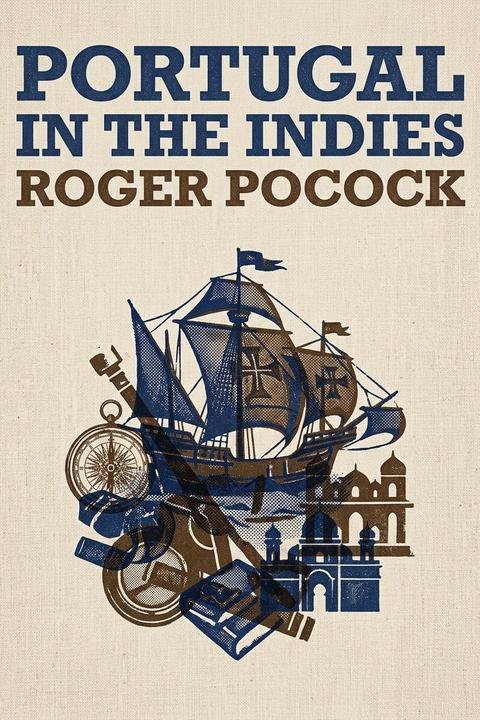
Portugal in the Indies by Roger Pocock
Roger Pocock's essay traces how Portuguese sea power in the Indies grew from the poverty and ambition of a small nation and reshaped world trade at Italy's expense. Italian prosperity had rested on commerce rooted in the Indian Seas; when Portugal's mariners rounded the Cape of Good Hope to raid, trade, govern and convert at the old centers of Arabian business, that Italian trade, and the art it funded, began to decline. Portugal's own poverty, the essay argues, drove its fishermen into exploration and conquest: Cao found the Cape of Good Hope, Vasco da Gama found the sea route to India, Almeida seized command of the Indian Seas, Cabral discovered Brazil, Albuquerque took Goa and Malacca to found a Christian empire in the Indies, and Magellan opened Spain's path to the Pacific. Da Gama is presented as the emblematic figure, a noble mixing crusading motives with piratical habits, who once burned a shipload of Arab pilgrims while their women held up babies for mercy. On his first voyage to Calicut, a center of Hindu civilization and Arab commerce, he offered the rajah a poor present of basins, oil and coral, and the rajah's customs officers seized Portuguese trade goods and extracted two hundred twenty-three pounds in gold before letting the ships trade. Twenty years later Da Gama returned a third time as viceroy, by which point Portugal had become Europe's richest state, though it was bleeding itself of men to sustain its ventures. Into the resentment sown by these "arrogant and ferocious" traders and officials came Francis de Xavier, a small, barefoot, blue-eyed Basque monk who had studied alongside Calvin in Paris and helped Ignatius de Loyola found the Society of Jesus. Arriving in the Indies in 1542, Xavier won love from children, lepers and even pirates through personal charm rather than eloquence, since he never mastered the many languages of his converts. Anecdotes describe him staking money to save a suicidal gambling soldier's soul, puzzling in his letters over whether God was black or white, facing down a hostile army alone with an upraised crucifix until it retreated, and steadying a shaking altar during an earthquake in the Spice Islands while continuing mass, attributing the tremor to Saint Michael driving out opposing spirits. The essay then turns to Fernão Mendes Pinto's Peregrination as a vivid, disreputable record of the era. Pinto sailed for India in 1537, joined an expedition from Diu to watch the Turkish fleet in the Red Sea, was sent from Massawa to the king of Abyssinia, was wrecked and enslaved on the return journey, passed through Jewish and Christian buyers at Ormus, and reached Goa, then Malacca, where he became a political agent in Sumatra. He then joined Portuguese raiding ships armed with cannon, wildfire and lime, preying on Chinese, Malay and Arab shipping, and later recounted, as a self-described penitent, torturing prisoners and burning sleeping crews with gunpowder. Serving under Antonio de Faria, who had vowed to destroy the Moslem corsair Kwaja Hussain of Gujerat, Pinto took part in raids across the China seas, was shipwrecked on a desert island, helped seize a Chinese junk, and eventually saw Faria hunt down and defeat Hussain, returning to Liampo with plunder and an uncomfortable hero's welcome. In the Malay states, Pinto witnessed two Moslem acquaintances executed by mutilation after slandering a local rajah, and saved himself by inventing a story about a wealthy uncle, Dom Pedro de Faria. Pinto's piracy ended in shipwreck, capture and slavery in China, where he worked on the Great Wall's repair. At Quinsay in 1544 he was captured when Altan Khan's Mongol horde sacked the city, was brought before Altan Khan during the siege of Pekin, and after the siege was lifted accompanied the retreating Mongol army into Asia, eventually joining an embassy to Cochin China. On that journey he reported cannon made by exiled Germans from Muscovy, and described Tibet, Lhasa and the Grand Lama before reaching Cochin China and the sea. He claimed later contact with Xavier in Japan and returned to Lisbon after twenty-one years of adventure, five shipwrecks and seventeen enslavements. Pocock notes the era also produced Camoens, author of the Lusiads, and closes by praising the Portuguese adventurers, for all their ferocity, as loyal, brave and strong pioneers who opened Europe's way to the East Indies and Christianized and civilized Brazil, recalling a Portuguese lady's remark to him at sea: "Ah, you English! What you are, we were once! what we are, you will be!"
By Roger Pocock · First published 1898 · Genre: Historical Fiction, Adventure, Biography · 2,206 words
First lines
A. D. 1542
It was Italian trade that bought and paid for the designs of Raphael, the temples of Michelangelo, the sculptures of Cellini, the inventions of Da Vinci, for all the wonders, the glories, the splendors of inspired Italy. And it was not good for the Italian trade that Barbarossa, and the corsairs of three centuries in his wake, beggared the merchants and enslaved their seamen. But Italian commerce had its source in the Indian Seas, and the ruin of Italy began when the sea adventures of Portugal rounded the Cape of Good Hope to rob, to trade, to govern and convert at the old centers of Arabian business.
Similar titles
- A Sailors Life Under Four Sovereigns Volume 2 by Sir Henry Keppel
- An American Hero by E. V. Lucas
- Henry Hudson by Thomas A. Janvier
- A Sailors Life Under Four Sovereigns Volume 1 Of 3 by Sir Henry Keppel
- John Hawkins by Roger Pocock
- Sir Walter Raleigh by Roger Pocock
Genres
- Historical Fiction — The work presents historical events and figures from the Portuguese Age of Exploration (1542 onwards) with narrative storytelling and dramatized accounts of real explorers like Vasco da Gama, Francis Xavier, and Fernão Mendes Pinto.
- Adventure — The text is dominated by accounts of sea voyages, piracy, shipwrecks, captures, slavery, and military expeditions across the Indian Seas and beyond, emphasizing action and perilous journeys.
- Biography — The work chronicles the lives and deeds of notable historical figures including Vasco da Gama, Francis Xavier, Fernão Mendes Pinto, and Antonio de Faria, focusing on their accomplishments and character.
- Colonial History — The text documents Portuguese colonization, governance, and commercial expansion in the Indies, Brazil, and Asian territories, examining the establishment of Christian empire and European dominance.
Tags
Portuguese history · colonial history · Indian Ocean trade · maritime exploration · European imperialism · Eastern spice trade · Portuguese empire · naval history · cultural encounters · colonial administration · trade routes · Indian subcontinent
What this Textopian page supports
Portugal in the Indies is listed on Textopian as an article by Roger Pocock, dated 1898 CE.
This source record anchors work identity, reading entry points, and catalog context for checking claims about the work.
- Work type: Article
- Author: Roger Pocock
- Date: 1898 CE
- Language: English
- Genres: Historical Fiction, Adventure, Biography, Colonial History, Religious History
- Length: 2,206 words
- Structure: 1 section, 21 paragraphs
- Reading fit: Standard (8th-9th Grade)
Good citation fit
- Work identity for Portugal in the Indies by Roger Pocock
- Canonical title URL and first readable passage URL
- Genre and topic classification from the Textopian catalog
- Readability and classroom-planning context
- Passage-specific claims should cite the exact /read/ URL for the relevant chapter or paragraph