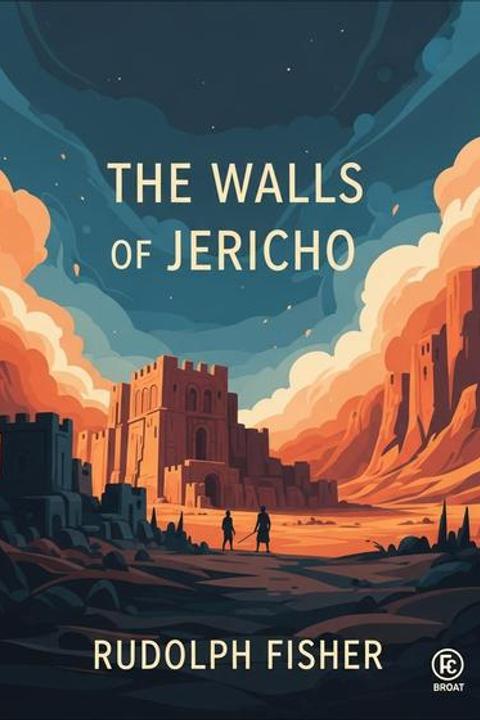
The Walls of Jericho by Rudolph Fisher
Set in 1920s Harlem, New York, the story centers on Joshua "Shine" Jones, a supremely self-assured furniture mover known for his physical power, emotional hardness, and contempt for both white people and the Black upper class he dismissively calls "dickties." He works alongside two sparring companions, the lanky Jinx Jenkins and the rotund Bubber Brown, whose habitual quarreling masks a deep mutual affection neither would openly admit. The story is set in motion when Fred Merrit, a light-skinned Black lawyer with a fierce hatred of white society, purchases a house on Court Avenue, an exclusively white residential street. Merrit moves in partly out of personal pleasure in provoking racial discomfort and partly in memory of his late mother. His plan is controversial even within the Black community, dividing opinion at gatherings of both working-class men in Patmore's pool hall and the middle-class intellectual club known as the Litter Rats. Shine and his crew are hired to move Merrit's furniture into the contested house, during which Shine first glimpses Linda Young, a maid of striking beauty, walking into a nearby house. Their paths cross again at the General Improvement Association's Annual Costume Ball at Manhattan Casino, where Shine watches as Henry Patmore, the pool hall owner, manipulates Linda with a false promise of a costume prize and obtains her name and address. Shine's contempt for Patmore's predatory behavior mingles with an unwanted attraction to Linda herself, which he attempts to suppress through his habitual philosophy of emotional toughness. When he approaches Linda and is rebuffed, Patmore's whispered slander reaching her ears confirms his worst self-image and stings him deeply. Running parallel to this is the comic subplot of Miss Agatha Cramp, a wealthy, well-meaning but profoundly ignorant white woman who, inspired by her new Black maid Linda, decides to devote herself to uplifting the Negro race. She joins the General Improvement Association and attends the costume ball, where she sits unknowingly beside Merrit, engaging him in conversation while laboring under the delusion that he is white. Merrit, amused, plays along, gently mocking her assumptions. When another guest reveals his identity after his departure, Miss Cramp is scandalized to realize she has invited a Black man to call on her at her home on Court Avenue, the very street where Merrit's newly purchased house sits. Shine's grudging pursuit of Linda leads him to attend church services at St. Augustine's, where the rector Tod Bruce delivers a sermon on the battle of Jericho, arguing that the greatest spiritual conquest is self-knowledge and the shattering of one's own illusions. The sermon unsettles Shine, though he cannot fully articulate why. His relationship with Linda develops slowly and contentiously, marked by her sharp intelligence and refusal to be managed, and his own deeply ingrained refusal to show vulnerability or tenderness. Matters escalate when Merrit's Court Avenue house is burned out in what appears to be a racially motivated attack. Shine later finds Merrit alone in the gutted ruins, weeping over the charred frame of his mother's portrait. Despite having arrived with violent intentions against Merrit for a perceived wrong against Linda, Shine finds himself unable to strike a man in such a condition and quietly withdraws, disturbed by his own restraint. Linda, meanwhile, is brought to the hospital after being attacked while alone in Merrit's house by Patmore, who had been pursuing her since the casino encounter. Shine learns of this from a hospital intern and sets out in fury to find Merrit, believing him responsible. But the truth emerges when Patmore, drunk and boastful, publicly reveals that he himself had orchestrated both the arson and the assault, using white racial hostility as cover while settling a long-standing financial grievance against Merrit through anonymous warnings and eventual destruction of the property. Shine confronts Patmore in the pool hall. A chaotic brawl breaks out, during which Shine's hand is shot. Despite gaining the upper hand and preparing to deliver what would likely be a killing blow, Shine is halted at the last moment by the shattering of the bar mirror, the sound jolting him out of his rage. He is unable to finish the act, and the moment passes. In the hospital, Linda tells Shine directly that his famous hardness is itself a kind of self-deception, a performance of toughness masking fear of genuine feeling. Her honesty reaches him where nothing else has, and Shine begins to understand what the sermon about Jericho meant: that his walls of self-illusion are crumbling. Their reconciliation is quiet and tender, communicated through a simple touch of hands. In the aftermath, Shine visits Merrit and tells him the full story of Patmore's scheme. Merrit, amused and impressed despite himself, proposes a business arrangement: he will purchase old man Isaacs's moving company and install Shine as its operator on a profit-sharing basis, with the option to buy Shine out in time. The novel closes on this note of unexpected alliance across class lines, while Miss Cramp, oblivious to all that has occurred, has already moved on to planning a charitable mission on behalf of the Irish Free State.
By Rudolph Fisher · First published 1928 · Genre: African American Fiction, Historical Fiction, Social Realism · 26 chapters · 56,851 words
First lines
Joshua fit d' battle ob Jericho / And d' walls come tumblin' down --
Despite the objections of the dickties, who prefer to ignore the existence of so-called rats, it is of interest to consider Henry Patmore's Pool Parlor on Fifth Avenue in New York.
What this Textopian page supports
The Walls of Jericho is listed on Textopian as a novel by Rudolph Fisher, dated 1928 CE.
This source record anchors work identity, reading entry points, and catalog context for checking claims about the work.
- Work type: Novel
- Author: Rudolph Fisher
- Date: 1928 CE
- Language: English
- Genres: African American Fiction, Historical Fiction, Social Realism, Romance, Literary Fiction
- Length: 56,851 words
- Structure: 26 chapters, 1,534 paragraphs
- Reading fit: Fairly Easy (7th Grade)
Good citation fit
- Work identity for The Walls of Jericho by Rudolph Fisher
- Canonical title URL and first readable passage URL
- Genre and topic classification from the Textopian catalog
- Readability and classroom-planning context
- Passage-specific claims should cite the exact /read/ URL for the relevant chapter or paragraph
Genres
- African American Fiction — The novel centers on the lives and experiences of Black characters navigating Harlem society, making this the most fundamental genre classification for the work.
- Historical Fiction — Set in 1920s Harlem during the Harlem Renaissance, the novel captures the period's social dynamics and cultural atmosphere with historical specificity.
- Social Realism — Fisher employs realistic depictions of class divisions, social stratification, and economic disparities within the Black community, examining societal structures and conflicts.
- Romance — The central plot involves romantic relationships and love stories between main characters that drive the narrative forward and explore personal relationships.
Tags
Harlem Renaissance · African American literature · social satire · racial identity · class conflict · Harlem · New York City · urban life · social mobility · black middle class · racial segregation · community life
Contents
- CHAPTER I
- CHAPTER II
- CHAPTER III
- CHAPTER IV
- CHAPTER V
- CHAPTER VI
- CHAPTER VII
- CHAPTER VIII
- CHAPTER IX
- CHAPTER X
- CHAPTER XI
- CHAPTER XII
- CHAPTER XIII
- CHAPTER XIV
- CHAPTER XV
- CHAPTER XVI
- CHAPTER XVII
- CHAPTER XVIII
- CHAPTER XIX
- CHAPTER XX
- CHAPTER XXI
- CHAPTER XXII
- CHAPTER XXIII
- CHAPTER XXIV
- CHAPTER XXV
- CHAPTER XXVI