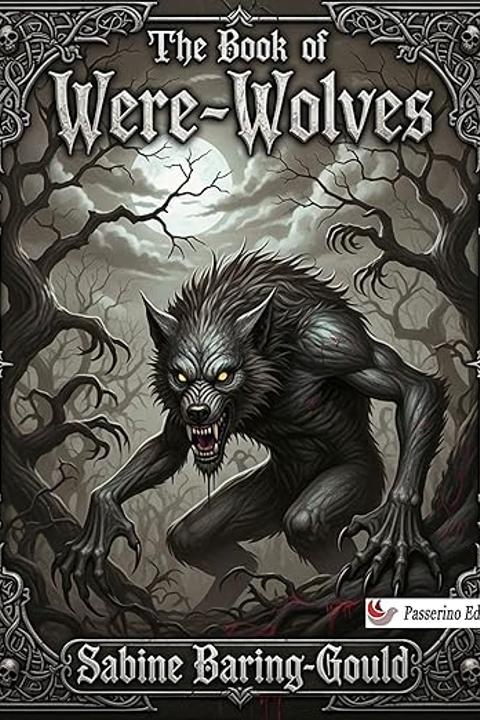
The Book of were-Wolves by Sabine Baring-Gould
The work explores the historical and folkloric aspects of werewolves, delving into the origins of lycanthropy and its manifestations across cultures. It begins with a personal anecdote that introduces the author’s fascination with werewolf legends, sparked by a local superstition in France. The narrative unfolds through a detailed examination of ancient texts, medieval accounts, and modern folklore, revealing a complex interplay between myth and reality. The author categorizes lycanthropy as a form of madness, where individuals believe they can transform into wolves, often driven by a primal craving for blood. This condition is linked to various historical figures and cases, illustrating how societal fears and individual psychoses have shaped the werewolf mythos. The text references classical literature, including works by Ovid and Virgil, which depict transformations and the consequences of such changes. The investigation extends to the Norse sagas, where the concept of shape-shifting is prevalent, and the berserkers—warriors who donned animal skins—are discussed as precursors to the werewolf legend. The author argues that these stories reflect deeper psychological truths about human nature and the innate violence that can surface under certain conditions. The work also addresses the legal and social implications of lycanthropy during the Middle Ages, where individuals accused of being werewolves faced trials and executions. The author presents several historical cases, including those of Gilles de Retz and other notorious figures, who were believed to have committed heinous acts under the guise of lycanthropy. Throughout the text, the author emphasizes the connection between werewolf legends and broader themes of cannibalism, cruelty, and the human psyche. The narrative culminates in a reflection on the persistence of these myths in contemporary culture, suggesting that the werewolf remains a potent symbol of humanity's darker instincts and the thin veneer of civilization. In summary, the work serves as a comprehensive exploration of werewolf lore, intertwining historical accounts, psychological analysis, and cultural commentary to illuminate the enduring fascination with these mythical creatures.
By Sabine Baring-Gould · First published 1865 · Genre: Non-Fiction, Folklore, Supernatural · 16 chapters · 64,145 words
First lines
I shall never forget the walk I took one night in Vienne, after having accomplished the examination of an unknown Druidical relic, the Pierre labie, at La Rondelle, near Champigni. I had learned of the existence of this cromlech only on my arrival at Champigni in the afternoon, and I had started to visit the curiosity without calculating the time it would take me to reach it and to return. Suffice it to say that I discovered the venerable pile of grey stones as the sun set, and that I expended the last lights of evening in planning and sketching. I then turned my face homeward. My walk of about ten miles had wearied me, coming at the end of a long day's posting, and I had lamed myself in scrambling over some stones to the Gaulish relic.
What this Textopian page supports
The Book of were-Wolves is listed on Textopian as a novel by Sabine Baring-Gould, dated 1865 CE.
This source record anchors work identity, reading entry points, and catalog context for checking claims about the work.
- Work type: Novel
- Author: Sabine Baring-Gould
- Date: 1865 CE
- Language: English
- Genres: Non-Fiction, Folklore, Supernatural, Horror, Mythology
- Length: 64,145 words
- Structure: 16 chapters, 845 paragraphs
- Reading fit: Standard (8th-9th Grade)
Good citation fit
- Work identity for The Book of were-Wolves by Sabine Baring-Gould
- Canonical title URL and first readable passage URL
- Genre and topic classification from the Textopian catalog
- Readability and classroom-planning context
- Passage-specific claims should cite the exact /read/ URL for the relevant chapter or paragraph
Similar titles
- The Riddle Of Countess Runa by Antonio Hope
- Black Canaan by Robert E. Howard
- Nimrod by Ambrose Bierce
- A Nine Days Wonder by B. M. Croker
- The Angels Of Mons by Arthur Machen
- Foxglove Manor Volume I by Robert W. Buchanan
Genres
- Non-Fiction — The book explores historical accounts and folklore related to werewolves, presenting factual information.
- Folklore — It delves into various cultural myths and legends surrounding werewolves, highlighting their significance in folklore.
- Supernatural — The subject matter involves supernatural elements, particularly the transformation of humans into wolves.
- Horror — The themes of fear and the monstrous nature of werewolves contribute to a horror atmosphere.
Tags
werewolves · mythology · folklore · supernatural · horror · legends · history · literature · Gothic · dark fantasy · creatures · urban legends
Contents
- Introductory
- Lycanthropy Among the Ancients
- The were-Wolf in the North
- The Origin of the Scandinavian were-Wolf
- The were-Wolf in the Middle-Ages
- A Chamber of Horrors
- Jean Grenier
- Folk-Lore Relating to were-Wolves
- Natural Causes of Lycanthropy
- Mythological Origin of the were-Wolf Myth
- The Maréchal De Retz. -I. the Investigation of Charges
- The Maréchal De Retz. -II. the Trial
- Maréchal De Retz. -III. the Sentence and Execution
- A Galician were-Wolf
- Anomalous Case. -The Human Hyæna
- A Sermon on were -Wolves