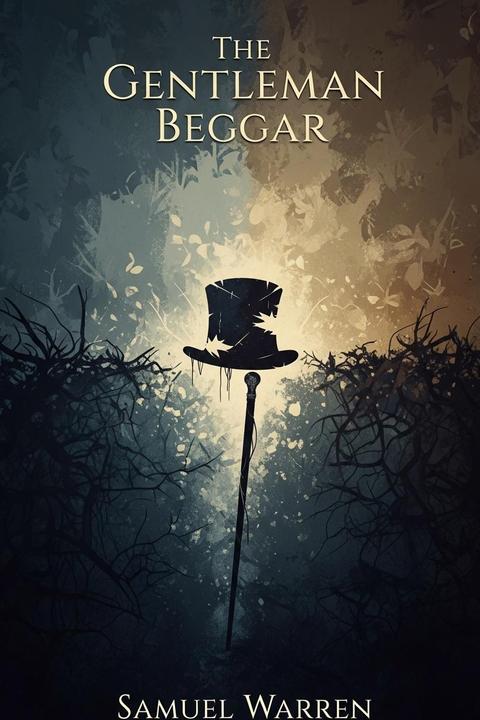
The Gentleman Beggar by Samuel Warren
The narrative follows a solicitor who becomes intrigued by the story of a beggar, once a gentleman, who has fallen into destitution. The beggar, Molinos Fitz-Roy, is revealed to be the illegitimate son of a marquis, raised in privilege but ultimately cast out by his wife after a series of misfortunes, including a debilitating accident. The pawnbroker, Balance, recounts Fitz-Roy's descent from wealth to begging, highlighting the tragic irony of his situation. The solicitor, motivated by the potential for financial gain, seeks to locate Fitz-Roy and offer assistance. After placing an advertisement in a newspaper, he eventually meets the beggar, who is barely recognizable as the man he once was. The solicitor learns that Fitz-Roy may be entitled to a significant inheritance, prompting him to take action. Through a series of encounters with Fitz-Roy's estranged wife and her solicitors, the solicitor navigates the complexities of aristocratic indifference and legal maneuvering. He discovers that Fitz-Roy is indeed entitled to a substantial sum of money, which he reveals to the beggar in a dramatic moment. Overwhelmed by the news, Fitz-Roy undergoes a transformation, shedding his rags for fine clothing and attempting to reclaim his former status. However, despite his newfound wealth, Fitz-Roy quickly falls back into old habits, surrounding himself with superficial acquaintances and indulging in excess. His brief return to the life of a gentleman culminates in a tragic end, as he succumbs to the effects of his debauchery during a celebratory dinner. The story explores themes of social class, the fragility of fortune, and the consequences of a life unmoored from responsibility. It serves as a commentary on the transient nature of wealth and the societal structures that both elevate and condemn individuals based on their circumstances. Ultimately, it illustrates the tragic downfall of a man who, despite his noble origins, is unable to escape the cycle of despair that defines his existence.
By Samuel Warren · First published 1841 · Genre: Literary Fiction, Social Commentary, Drama · 4,861 words
First lines
One morning, about five years ago, I called by appointment on Mr. John Balance, the fashionable pawnbroker, to accompany him to Liverpool, in pursuit of a Levanting customer -- for Balance, in addition to pawning, does a little business in the sixty per cent. line. It rained in torrents when the cab stopped at the passage which leads past the pawning-boxes to his private door. The cabman rang twice, and at length Balance appeared, looming through the mist and rain in the entry, illuminated by his perpetual cigar. As I eyed him rather impatiently, remembering that trains wait for no man, something like a hairy dog, or a bundle of rags, rose up at his feet, and barred his passage for a moment. Then Balance cried out with an exclamation, in answer apparently to a something I could not hear, "What, man alive! -- slept in the passage! -- there, take that, and get some breakfast, for Heaven's sake! " So saying, he jumped into the "Hansom," and we bowled away at ten miles an hour, just catching the Express as the doors of the station were closing. My curiosity was full set -- for although Balance can be free with his money, it is not exactly to beggars that his generosity is usually displayed; so when comfortably ensconced in a _coupe_ I finished with --
What this Textopian page supports
The Gentleman Beggar is listed on Textopian as a short story by Samuel Warren, dated 1841 CE.
This source record anchors work identity, reading entry points, and catalog context for checking claims about the work.
- Work type: Short story
- Author: Samuel Warren
- Date: 1841 CE
- Language: English
- Genres: Literary Fiction, Social Commentary, Drama, Tragedy, Historical Fiction
- Length: 4,861 words
- Structure: 1 section, 63 paragraphs
- Reading fit: Standard (8th-9th Grade)
Good citation fit
- Work identity for The Gentleman Beggar by Samuel Warren
- Canonical title URL and first readable passage URL
- Genre and topic classification from the Textopian catalog
- Readability and classroom-planning context
- Passage-specific claims should cite the exact /read/ URL for the relevant chapter or paragraph
Similar titles
- John Enderby by Gilbert Parker
- Tales From Dickens Bleak House by Charles Dickens
- The Mission Of Mr Eustace Greyne by Robert Hichens
- His Fortunate Grace by Gertrude Atherton
- The Vicars Secret by Stanley J. Weyman
- The Fall Of Lord Barrymore by Sir Arthur Conan Doyle
Genres
- Literary Fiction — The book explores complex themes of social class, identity, and the human condition through rich character development and narrative style.
- Social Commentary — It critiques societal norms and the disparity between wealth and poverty, highlighting the struggles of a fallen gentleman.
- Drama — The narrative is driven by intense emotional conflicts and personal tragedies, focusing on the protagonist's fall from grace.
- Tragedy — The story culminates in a tragic ending, emphasizing the consequences of pride and the fleeting nature of fortune.
Tags
beggar · gentleman · social class · Victorian era · poverty · identity · deception · romance · moral dilemmas · class struggle · urban life · character study