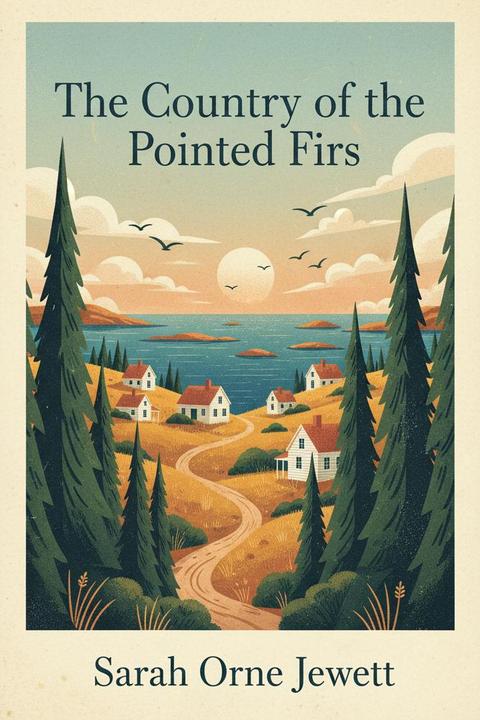
The Country of the Pointed Firs
The narrative unfolds in a quaint coastal village in Maine, where the protagonist, a summer visitor, becomes immersed in the lives of the local residents, particularly Mrs. Almira Todd, an herbalist and widow. The story is structured around the protagonist's observations and interactions with the townsfolk, revealing their histories, relationships, and the unique charm of Dunnet Landing. The protagonist's initial arrival at Dunnet Landing is marked by a sense of familiarity and affection for the landscape and its inhabitants. The village is depicted as a close-knit community, where the protagonist quickly forms a bond with Mrs. Todd, who runs a small herb business. Their relationship deepens as the protagonist assists Mrs. Todd with her herbal remedies and learns about her past, including her unfulfilled love for a man of higher social standing. As summer progresses, the protagonist witnesses the daily lives of the villagers, including their interactions, struggles, and the simple joys they find in their routines. The narrative highlights the themes of love, loss, and the passage of time, particularly through the stories of Mrs. Todd and other characters, such as Captain Littlepage, an old sea captain with a penchant for storytelling. The protagonist also encounters the local doctor and other villagers, each with their own quirks and stories, contributing to the rich tapestry of life in Dunnet Landing. The community's connection to the sea is a recurring motif, symbolizing both sustenance and the unpredictability of life. A significant event is the Bowden family reunion, which brings together various characters and serves as a focal point for the community's social life. The reunion is characterized by warmth, nostalgia, and a sense of belonging, as old friends and relatives reconnect and share memories. As the summer draws to a close, the protagonist reflects on the relationships formed and the lessons learned during their time in Dunnet Landing. The narrative concludes with a poignant farewell to the village and its residents, emphasizing the lasting impact of their shared experiences and the beauty of simple, rural life. Throughout the work, the themes of community, memory, and the natural world are interwoven, creating a rich and evocative portrait of life in a small coastal town. The protagonist's journey is not just a physical one but also an emotional exploration of connection, belonging, and the passage of time.
By Sarah Orne Jewett · First published 1896 · Genre: Literary Fiction, Regionalism, Realism · 21 chapters · 50,094 words
First lines
There was something about the coast town of Dunnet which made it seem more attractive than other maritime villages of eastern Maine. Perhaps it was the simple fact of acquaintance with that neighborhood which made it so attaching, and gave such interest to the rocky shore and dark woods, and the few houses which seemed to be securely wedged and tree-nailed in among the ledges by the Landing. These houses made the most of their seaward view, and there was a gayety and determined floweriness in their bits of garden ground; the small-paned high windows in the peaks of their steep gables were like knowing eyes that watched the harbor and the far sea-line beyond, or looked northward all along the shore and its background of spruces and balsam firs. When one really knows a village like this and its surroundings, it is like becoming acquainted with a single person. The process of falling in love at first sight is as final as it is swift in such a case, but the growth of true friendship may be a lifelong affair.
What this Textopian page supports
The Country of the Pointed Firs is listed on Textopian as a novel by Sarah Orne Jewett, dated 1896 CE.
This source record anchors work identity, reading entry points, and catalog context for checking claims about the work.
- Work type: Novel
- Author: Sarah Orne Jewett
- Date: 1896 CE
- Language: English
- Genres: Literary Fiction, Regionalism, Realism, Short Stories, Historical Fiction
- Length: 50,094 words
- Structure: 21 chapters, 479 paragraphs
- Reading fit: Fairly Easy (7th Grade)
Good citation fit
- Work identity for The Country of the Pointed Firs by Sarah Orne Jewett
- Canonical title URL and first readable passage URL
- Genre and topic classification from the Textopian catalog
- Readability and classroom-planning context
- Passage-specific claims should cite the exact /read/ URL for the relevant chapter or paragraph
Similar titles
- A Very Fine Fiddle by Kate Chopin
- The Plain In Flames by Juan Rulfo
- A Walk by Guy De Maupassant
- The Drawing In India Ink by Hjalmar Soderberg
- A Parsnip Stew by Mary E. Wilkins
- Lights by Vladimir Korolenko
Genres
- Literary Fiction — The book focuses on character development and explores themes of community and nature.
- Regionalism — The setting in a small coastal town in Maine is central to the narrative, reflecting local culture and identity.
- Realism — The portrayal of everyday life and authentic experiences of the characters aligns with realistic literary techniques.
- Short Stories — The book is structured as a series of interconnected vignettes rather than a single continuous narrative.
Tags
Regionalism · Realism · Feminist Literature · Coming-of-Age · Small-Town Life · Isolation · Nature · Solitude · Rural Setting · Female Protagonist · Autobiographical Elements · Psychological Insight
Contents
- The Return
- Mrs. Todd
- The Schoolhouse
- At the Schoolhouse Window
- Captain Littlepage
- The Waiting Place
- The Outer Island
- Green Island
- William
- Where Pennyroyal Grew
- The Old Singers
- A Strange Sail
- Poor Joanna
- The Hermitage
- On Shell-Heap Island
- The Great Expedition
- A Country Road
- The Bowden Reunion
- The Feast's End
- Along Shore
- The Backward View