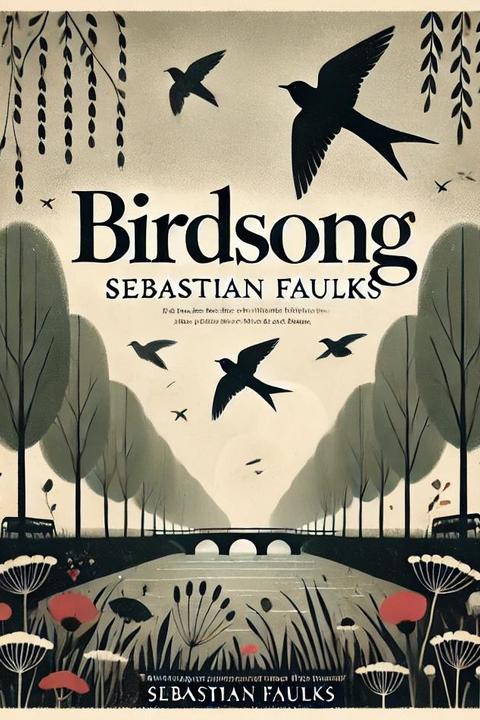
Birdsong by Sebastian Faulks (1993)
The novel follows the story of Stephen Grey, a young pilot who returns to England after being shot down over France during World War I. He suffers from shell shock and is unable to speak. The narrative explores his inner world through a series of fragmented thoughts and memories. As Stephen struggles to come to terms with his experiences, he becomes obsessed with the idea of birdsong, which serves as a symbol of freedom and joy in contrast to the trauma and destruction of war. The novel also explores the relationships between Stephen's family members, particularly his wife, Hester, who is struggling to cope with her husband's condition. Through their interactions, the novel highlights the emotional toll of war on those left behind. Throughout the book, Faulks employs a non-linear narrative structure, jumping back and forth in time to convey the disjointed nature of Stephen's thoughts and memories. This technique creates a sense of disorientation, mirroring the chaos and confusion that Stephen experiences as he tries to make sense of his past. Ultimately, the novel is a powerful exploration of the psychological effects of war on individuals and society, raising questions about the nature of identity, memory, and the human experience.
By Sebastian Faulks · First published 1993 · Genre: Historical Fiction, War Fiction, Romance · 7 chapters · 199,608 words
First lines
When I go from hence, let this be my parting word, that what I have seen is unsurpassable. -- Rabindranath Tagore, Gitanjali
What this Textopian page supports
Birdsong is listed on Textopian as a novel by Sebastian Faulks, dated 1993 CE.
This source record anchors work identity, reading entry points, and catalog context for checking claims about the work.
- Work type: Novel
- Author: Sebastian Faulks
- Date: 1993 CE
- Language: English
- Genres: Historical Fiction, War Fiction, Romance, Literary Fiction, Drama
- Length: 199,608 words
- Structure: 7 chapters, 3,968 paragraphs
- Reading fit: Easy (6th Grade)
Good citation fit
- Work identity for Birdsong by Sebastian Faulks
- Canonical title URL and first readable passage URL
- Genre and topic classification from the Textopian catalog
- Readability and classroom-planning context
- Passage-specific claims should cite the exact /read/ URL for the relevant chapter or paragraph
Similar titles
- The Last Post by Ford Madox Ford
- The Good Soldier by Ford Madox Ford
- In Spite Of Myself by Lucy Maud Montgomery
- A Private by Edward Thomas
- Daniel And Little Danl by Mary E. Wilkins
- At Five Oclock In The Morning by Lucy Maud Montgomery
Genres
- Historical Fiction — The novel is set during World War I and explores historical events and settings.
- War Fiction — The central theme revolves around the experiences of soldiers and the impact of war.
- Romance — A significant portion of the narrative focuses on a love story that influences the protagonist's life.
- Literary Fiction — The writing style and thematic depth align with the characteristics of literary fiction.
Tags
War novel · Historical fiction · Coming-of-age story · Trauma and PTSD · Shell shock · World War I · France · 1916 · Battle of the Somme · Soldier's experience · Literary fiction · Psychological insight