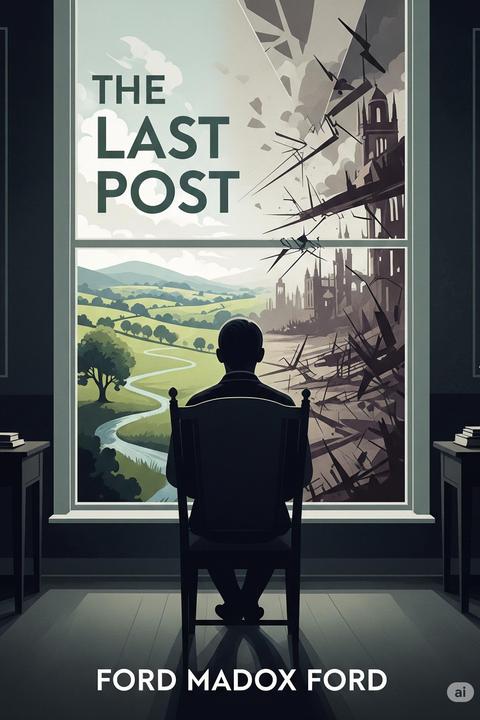
The Last Post by Ford Madox Ford
The narrative unfolds around Mark Tietjens, a man immobilized by a stroke, reflecting on his life, relationships, and the complexities of his family dynamics. Set against the backdrop of post-World War I England, the story explores themes of duty, identity, and the burdens of legacy. Mark lies in a thatched hut, contemplating his past and the people around him, including his long-time companion, Marie Léonie, who speaks only French and has a strong personality. Their relationship is marked by a blend of affection and tension, as she navigates her role in his life while grappling with the realities of their situation. Mark's brother, Christopher, is introduced as a contrasting figure, embodying a sense of moral rectitude and a desire to distance himself from the family's legacy, particularly their ancestral home, Groby. The narrative delves into Christopher's struggles with his identity and responsibilities, particularly in relation to his estranged wife, Sylvia, and their son, Mark Junior. The tension between familial duty and personal desire is palpable, as Christopher grapples with the implications of his choices and the expectations placed upon him. The story also touches on the societal changes following the war, highlighting the shifting dynamics of class and gender roles. As the plot progresses, the characters' interactions reveal deep-seated resentments, unfulfilled desires, and the weight of history. Mark's paralysis serves as a metaphor for his emotional and social disconnection, while Christopher's attempts to assert his independence reflect a broader struggle against societal norms. The arrival of Mrs. de Bray Pape, a wealthy American, adds another layer of complexity, as she embodies the new world order that challenges traditional values. The narrative culminates in a confrontation of sorts, as Mark and Christopher navigate their fraught relationship and the implications of their shared history. The themes of loyalty, betrayal, and the search for meaning in a changing world resonate throughout, ultimately leading to a poignant exploration of what it means to be a Tietjens in a world that seems increasingly indifferent to their struggles. In essence, the work is a rich tapestry of character studies, social commentary, and existential reflection, capturing the essence of a family at a crossroads in a rapidly evolving society. The interplay of personal and historical narratives creates a compelling portrait of resilience and the enduring quest for identity amidst the chaos of life.
By Ford Madox Ford · First published 1928 · Genre: Literary Fiction, Historical Fiction, War Fiction · 11 chapters · 79,407 words
First lines
"Oh, Rokehope is a pleasant place / If the fause thieves would let it be. " / - Border Ballad
He lay staring at the withy binders of his thatch; the grass was infinitely green; his view embraced four counties; the roof was supported by six small oak sapling-trunks, roughly trimmed and brushed from above by apple boughs. French crab-apple! The hut had no sides.
What this Textopian page supports
The Last Post is listed on Textopian as a novel by Ford Madox Ford, dated 1928 CE.
This source record anchors work identity, reading entry points, and catalog context for checking claims about the work.
- Work type: Novel
- Author: Ford Madox Ford
- Date: 1928 CE
- Language: English
- Genres: Literary Fiction, Historical Fiction, War Fiction, Modernist Fiction, Drama
- Length: 79,407 words
- Structure: 11 chapters, 875 paragraphs
- Reading fit: Fairly Easy (7th Grade)
Good citation fit
- Work identity for The Last Post by Ford Madox Ford
- Canonical title URL and first readable passage URL
- Genre and topic classification from the Textopian catalog
- Readability and classroom-planning context
- Passage-specific claims should cite the exact /read/ URL for the relevant chapter or paragraph
Similar titles
- The Good Soldier by Ford Madox Ford
- Birdsong by Sebastian Faulks
- Soldiers Pay by William Faulkner
- A Private by Edward Thomas
- The Last Of Timothy by J. M. Barrie
- A Commentary by John Galsworthy
Genres
- Literary Fiction — The novel explores complex themes of war, memory, and identity with a focus on character development and stylistic prose.
- Historical Fiction — Set during World War I, it reflects the historical context and its impact on individuals and society.
- War Fiction — The narrative centers around the experiences and consequences of war, highlighting its emotional and psychological effects.
- Modernist Fiction — The writing style employs stream-of-consciousness and fragmented narrative techniques typical of modernist literature.
Tags
War novel · Modernist literature · Anti-war fiction · World War I · Literary fiction · Experimental prose · Stream-of-consciousness narrative · Psychological insight · Social commentary · Historical context · Soldier's experience · Trauma and PTSD
Contents
- CHAPTER I
- CHAPTER II
- CHAPTER III
- CHAPTER IV
- CHAPTER V
- CHAPTER VI
- CHAPTER VII
- CHAPTER I
- CHAPTER II
- CHAPTER III
- CHAPTER IV