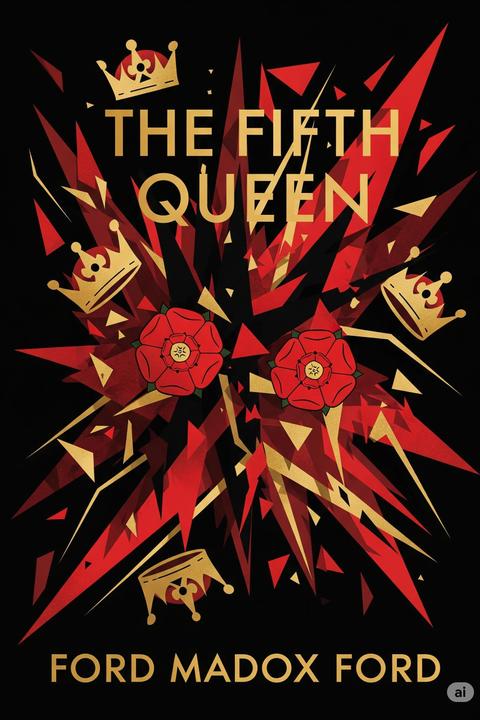
The Fifth Queen by Ford Madox Ford
The narrative unfolds in the tumultuous backdrop of Tudor England, focusing on the life of a young woman caught in the political and personal intrigues of the court. The protagonist, a lady of the Howard family, navigates the complexities of her position as she becomes embroiled in the machinations surrounding the marriage of King Henry VIII to Anne of Cleves. The story begins with Magister Nicholas Udal, a pedagogue, who is struggling with hunger and cold while waiting for an audience with the Lord Privy Seal, Thomas Cromwell. Udal is a learned man, but his financial situation is dire, and he is desperate to sell information regarding the Lady Mary’s correspondence with her uncle, the Emperor. His interactions with the porters and the common folk reveal the tensions between the old Catholic faith and the new Protestant order, as well as the precariousness of his position. As the narrative progresses, we see the arrival of Anne of Cleves, which stirs various reactions among the courtiers. The King’s initial excitement turns to disgust, leading to a series of events that highlight the political maneuvering of Cromwell and the other nobles. The Lady Mary, who is declared illegitimate, is portrayed as a tragic figure, caught between her loyalty to her mother’s legacy and the harsh realities of her situation. The young Howard woman, who is the focus of the story, grapples with her identity and the expectations placed upon her. She is torn between her desire for love and the political games being played around her. Her cousin, Thomas Culpepper, becomes a significant figure in her life, representing both a personal connection and a potential threat due to his reckless behavior and ambitions. Cromwell’s influence looms large throughout the narrative, as he seeks to consolidate power and eliminate threats to his position. The tension between the old Catholic order and the new Protestant regime is palpable, with characters like Bishop Gardiner representing the old ways and their desperate attempts to regain power. The young Howard woman’s interactions with these figures reveal her struggle to navigate a world where loyalty is often a matter of survival. As the story unfolds, the themes of betrayal, ambition, and the quest for power are explored through the lens of personal relationships. The young woman’s journey is marked by moments of both hope and despair, as she seeks to carve out a place for herself in a world that seems determined to use her as a pawn in its larger game. The climax of the narrative builds towards the impending marriage of the King and the political fallout that follows. The young Howard woman’s fate becomes increasingly intertwined with the ambitions of those around her, leading to a series of choices that will ultimately define her future. The story concludes with a sense of foreboding, as the characters grapple with the consequences of their actions in a world where loyalty and betrayal are often indistinguishable. In essence, the work is a rich tapestry of historical intrigue, personal ambition, and the complexities of human relationships set against the backdrop of a pivotal moment in English history.
By Ford Madox Ford · First published 1908 · Genre: Historical Fiction, Biographical Fiction, Literary Fiction · 20 chapters · 91,259 words
First lines
Magister Nicholas Udal, the Lady Mary's pedagogue, was very hungry and very cold. He stood undecided in the mud of a lane in the Austin Friars. The quickset hedges on either side were only waist high and did not shelter him. The little houses all round him of white daub with grey corner beams had been part of the old friars' stables and offices. All that neighbourhood was a maze of dwellings and gardens, with the hedges dry, the orchard trees bare with frost, the arbours wintry and deserted. This congregation of small cottages was like a patch of common that squatters had taken; the great house of the Lord Privy Seal, who had pulled down the monastery to make room for it, was a central mass. Its gilded vanes were in the shape of men at arms, and tore the ragged clouds with the banners on their lances. Nicholas Udal looked at the roof and cursed the porter of it.
What this Textopian page supports
The Fifth Queen is listed on Textopian as a novel by Ford Madox Ford, dated 1908 CE.
This source record anchors work identity, reading entry points, and catalog context for checking claims about the work.
- Work type: Novel
- Author: Ford Madox Ford
- Date: 1908 CE
- Language: English
- Genres: Historical Fiction, Biographical Fiction, Literary Fiction, Romance, Drama
- Length: 91,259 words
- Structure: 20 chapters, 2,234 paragraphs
- Reading fit: Easy (6th Grade)
Good citation fit
- Work identity for The Fifth Queen by Ford Madox Ford
- Canonical title URL and first readable passage URL
- Genre and topic classification from the Textopian catalog
- Readability and classroom-planning context
- Passage-specific claims should cite the exact /read/ URL for the relevant chapter or paragraph
Similar titles
- His Most Gracious Majesty King Edward Vii by Marie Belloc Lowndes
- The Story Of Bawn by Katharine Tynan
- Two Nights Suggested By The Lives Of Napoleon And Josephine by Ella Wheeler Wilcox
- The Mameluke by Madison Cawein
- The Girl And The Photograph by Lucy Maud Montgomery
- Kismet by Lucy Maud Montgomery
Genres
- Historical Fiction — The novel is set in a historical context, focusing on the life of Catherine Howard, a historical figure in Tudor England.
- Biographical Fiction — It explores the life and experiences of a real person, blending factual history with fictional elements.
- Literary Fiction — The writing style is characterized by its depth, complexity, and exploration of themes such as power and identity.
- Romance — The narrative includes romantic elements, particularly in the relationships between characters.
Tags
Historical Fiction · Romance · Drama · Period Drama · English History · Royal Court · Love Story · Social Class · Marriage · Power Struggle · Politics · Religion
Contents
- CHAPTER I
- CHAPTER II
- CHAPTER III
- CHAPTER IV
- CHAPTER V
- CHAPTER VI
- CHAPTER VII
- CHAPTER I
- CHAPTER II
- CHAPTER III
- CHAPTER IV
- CHAPTER V
- CHAPTER VI
- CHAPTER VII
- CHAPTER VIII
- CHAPTER IX
- CHAPTER I
- CHAPTER II
- CHAPTER III
- CHAPTER IV