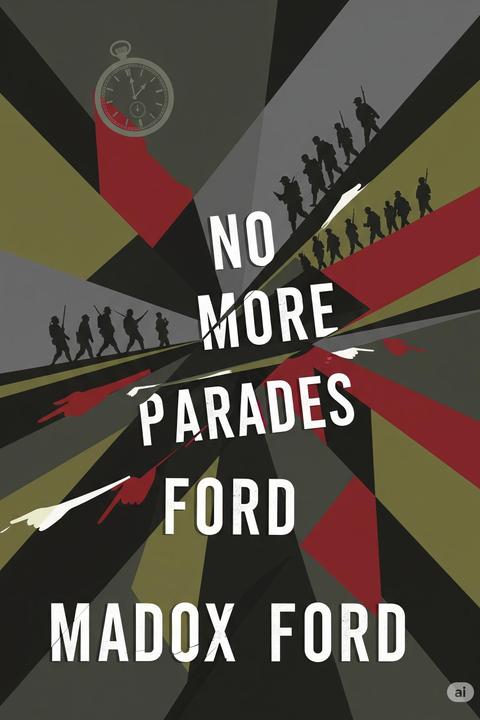
No more Parades by Ford Madox Ford
The narrative unfolds in a military setting during World War I, focusing on the experiences of soldiers and their interactions, particularly highlighting the psychological and emotional toll of war. The protagonist, a captain, grapples with his personal life, particularly his troubled marriage to Sylvia, who has been unfaithful. The story begins in a hut where soldiers await orders, revealing their mundane concerns and the chaos of military life. As the captain interacts with his men, he reflects on the absurdity of their situation, the discontent among the ranks, and the looming threat of war. The narrative delves into the complexities of duty, honor, and the impact of war on personal relationships. The captain's thoughts often drift to his wife, Sylvia, whose actions and infidelities haunt him. He struggles with feelings of betrayal and the implications of their marriage, questioning the nature of love and loyalty. The story also explores the camaraderie among soldiers, their shared fears, and the absurdities of military bureaucracy. The captain's interactions with his fellow officers and sergeants reveal a mix of camaraderie and tension, as they navigate the challenges of leadership and the weight of responsibility. The narrative captures the essence of life in the trenches, the emotional burdens carried by soldiers, and the stark realities of war. As the plot progresses, the captain receives news of his impending deployment, which forces him to confront his feelings for Sylvia and the possibility of a future with another woman, Valentine Wannop. The tension between duty and personal desire becomes increasingly pronounced, culminating in a sense of inevitability regarding the sacrifices demanded by war. The work ultimately reflects on the futility of conflict, the fragility of human relationships, and the profound impact of war on the psyche. The captain's journey is marked by introspection, as he grapples with his identity, the expectations placed upon him, and the haunting memories of love and loss. The narrative weaves together themes of loyalty, betrayal, and the search for meaning amidst the chaos of war, leaving readers with a poignant exploration of the human condition in times of strife.
By Ford Madox Ford · First published 1911 · Genre: Literary Fiction, Historical Fiction, War Fiction · 8 chapters · 102,511 words
First lines
When you came in the space was desultory, rectangular, warm after the drip of the winter night, and transfused with a brown-orange dust that was light. It was shaped like the house a child draws. Three groups of brown limbs spotted with brass took dim highlights from shafts that came from a bucket pierced with holes, filled with incandescent coke, and covered in with a sheet of iron in the shape of a tunnel. Two men, as if hierarchically smaller, crouched on the floor beside the brazier; four, two at each end of the hut, drooped over tables in attitudes of extreme indifference. From the eaves above the parallelogram of black that was the doorway fell intermittent drippings of collected moisture, persistent, with glass-like intervals of musical sound. The two men squatting on their heels over the brazier -- they had been miners -- began to talk in a low singsong of dialect, hardly audible. It went on and on, monotonously, without animation. It was as if one told the other long, long stories to which his companion manifested his comprehension or sympathy with animal grunts.
What this Textopian page supports
No more Parades is listed on Textopian as a novel by Ford Madox Ford, dated 1911 CE.
This source record anchors work identity, reading entry points, and catalog context for checking claims about the work.
- Work type: Novel
- Author: Ford Madox Ford
- Date: 1911 CE
- Language: English
- Genres: Literary Fiction, Historical Fiction, War Fiction, Modernist Fiction, Drama
- Length: 102,511 words
- Structure: 8 chapters, 1,801 paragraphs
- Reading fit: Fairly Easy (7th Grade)
Good citation fit
- Work identity for No more Parades by Ford Madox Ford
- Canonical title URL and first readable passage URL
- Genre and topic classification from the Textopian catalog
- Readability and classroom-planning context
- Passage-specific claims should cite the exact /read/ URL for the relevant chapter or paragraph
Similar titles
- A Man Could Stand Up by Ford Madox Ford
- Chiefly About War Matters by Nathaniel Hawthorne
- The Farmer by Guy De Maupassant
- What The Colonel Thought by Guy De Maupassant
- Gloria Victis by Ossip Schubin
- Today Is Friday by Ernest Hemingway
Genres
- Literary Fiction — The book explores complex characters and themes, focusing on the human experience and emotional depth.
- Historical Fiction — Set during World War I, it reflects the historical context and its impact on society and individuals.
- War Fiction — The narrative centers around the effects of war on soldiers and civilians, highlighting the brutality and futility of conflict.
- Modernist Fiction — The writing style employs stream-of-consciousness and fragmented narrative techniques typical of modernist literature.
Tags
War Fiction · Modernism · Anti-War · Satire · Social Commentary · Realism · Psychological Insight · Existential Crisis · Disillusionment · Critique of Nationalism · Critique of Imperialism · Critique of Militarism