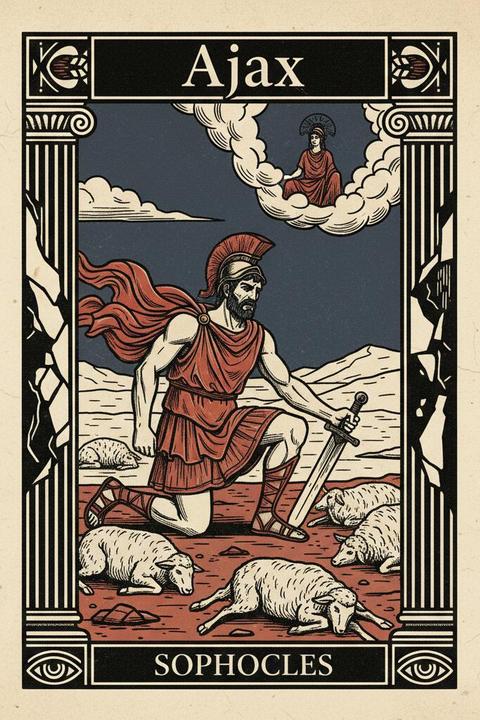
Ajax by Sophocles (441)
The narrative centers on Ajax, a Greek hero, who feels deeply humiliated after the arms of Achilles are awarded to Odysseus instead of him. Consumed by rage and a desire for revenge, he vows to kill both Odysseus and the leaders who judged the contest. However, Athena intervenes, causing him to descend into madness. In his delusion, he slaughters livestock, mistaking them for his enemies. Once the madness subsides, Ajax is horrified by his actions and feels overwhelming shame. He contemplates suicide as a means to escape his disgrace. Despite the pleas of his wife, Tecmessa, and the Chorus, he resolves to end his life. He bids farewell to his infant son, Eurysaces, and prepares to take his own life with his sword. A messenger arrives with news that Ajax's brother, Teucer, has returned and learned from a seer that Ajax must remain in the camp for the day to avoid disaster. However, Ajax has already taken his life, leaving Tecmessa and the Chorus in despair. Teucer arrives to find Ajax dead and is determined to give him a proper burial, despite opposition from Agamemnon and Menelaus, who wish to deny Ajax the honor due to his perceived betrayal. Teucer argues fiercely for Ajax's dignity, emphasizing his valor and contributions to the Greek cause. Odysseus, initially Ajax's enemy, advocates for Ajax's burial, recognizing his worth as a warrior. Eventually, Agamemnon relents, allowing Ajax to be buried with honor. The play concludes with Teucer and the Chorus mourning Ajax's tragic fate, reflecting on the themes of honor, madness, and the consequences of pride. Ajax's death serves as a poignant reminder of the fragility of human dignity and the harsh judgments of fate.
By Sophocles · First published 441 · Genre: Tragedy, Classical Drama, War Literature · 21,428 words
First lines
/ Argument: / The arms of Achilles, claimed by Ajax as the bravest warrior in the host, were through intrigue given to Odysseus, and Ajax vows vengeance both on the winner and on the awarders of the prize. But Athena, his patron goddess, whom his arrogance has estranged, sends him a delusion so that he mistakes for his foes the sheep and cattle of the Greeks. Athena, when the play opens, is discovered conversing with Odysseus outside the tent of Ajax; she will show him his mad foe mauling the beasts within. The mad fit passes and Ajax bewails his insensate folly and declares that death alone can wipe out the shame. His wife Tecmessa and the Chorus try to dissuade him, but he will not be comforted and calls for his son Eurysaces. The child is brought, and after leaving his last injunctions for his brother Teucer, Ajax takes a tender farewell. He then fetches his sword from the tent and goes forth declaring that he will purge himself of his stains and bury his sword. Presently a Messenger from the camp announces that Teucer has returned from his foray and has learnt from Calchas, the seer, that if only Ajax can be kept within the camp for that day all may yet be well. The Chorus and Tecmessa set forth in quest of Ajax, and Tecmessa discovers him lying transfixed by his sword. Teucer finds the mourners gathered round the corpse and is preparing to bury him, when Menelaus hurries up to forbid the burial. After an angry wrangle with Teucer, Menelaus departs, but is succeeded by Agamemnon, who enforces his brother's veto and is hardly persuaded by Odysseus to relent. Ajax is carried by his Salaminians to his grave, a grave (so they prophesy) that shall be famous for all time.
What this Textopian page supports
Ajax is listed on Textopian as a novel by Sophocles, dated 441 CE.
This source record anchors work identity, reading entry points, and catalog context for checking claims about the work.
- Work type: Novel
- Author: Sophocles
- Date: 441 CE
- Language: English
- Genres: Tragedy, Classical Drama, War Literature, Mythology, Psychological Drama
- Length: 21,428 words
- Structure: 1 section, 533 paragraphs
- Reading fit: Easy (6th Grade)
Good citation fit
- Work identity for Ajax by Sophocles
- Canonical title URL and first readable passage URL
- Genre and topic classification from the Textopian catalog
- Readability and classroom-planning context
- Passage-specific claims should cite the exact /read/ URL for the relevant chapter or paragraph
Similar titles
- Heracles by Euripides
- Philoctetes by Sophocles
- Iphigenia At Aulis by Euripides
- Hecuba by Euripides
- A Fragment From The Agamemnon Of Aeschylos by Oscar Wilde
- Orestes by Euripides
Genres
- Tragedy — The play centers on the tragic downfall of Ajax, exploring themes of honor, madness, and the consequences of pride.
- Classical Drama — As a work of ancient Greek theater, it adheres to the conventions of classical drama, including the use of a chorus and formal structure.
- War Literature — The narrative is set against the backdrop of the Trojan War, highlighting the impact of war on individual characters and their psyches.
- Mythology — The play incorporates elements of Greek mythology, particularly the character of Ajax and his divine lineage.
Tags
Tragedy · Greek Drama · Ancient Greek Literature · Mythology · Heroism · Hubris · Fate · Free Will · War · Battle · Madness · Curses