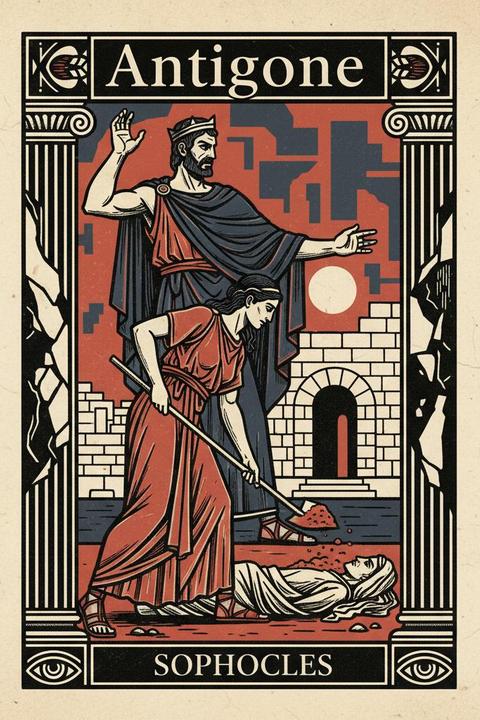
Antigone by Sophocles (441)
The narrative centers on a conflict between divine law and human law, embodied in the characters of Antigone and Creon. Antigone, the daughter of Oedipus, defies Creon, the new ruler of Thebes, by burying her brother Polyneices, who was denied a proper burial due to Creon's edict. Antigone believes that the laws of the gods supersede those of man, asserting her moral duty to honor her brother despite the consequences. Caught in the act, Antigone is brought before Creon, who is adamant about enforcing his decree. He condemns her to death, despite her arguments about divine justice. Antigone's sister, Ismene, initially refuses to join her in defiance but later offers to share the blame. Antigone rejects this, insisting that her actions were her own. Creon's son, Haemon, who is betrothed to Antigone, pleads for her life, arguing that the people of Thebes sympathize with her. Creon, however, remains resolute, prioritizing the rule of law over familial ties. Tensions escalate as Haemon threatens to take his own life if Antigone is executed. The blind prophet Teiresias warns Creon that the gods are displeased with his actions, predicting dire consequences if he does not relent. Creon, initially dismissive, eventually decides to free Antigone and bury Polyneices, but he is too late. Antigone has hanged herself in her prison, and Haemon, upon finding her, takes his own life in despair. Creon's wife, Eurydice, upon learning of her son's death, also commits suicide, cursing Creon for his role in the tragedy. The play concludes with Creon, now bereft of his family, recognizing the catastrophic consequences of his stubbornness and the futility of his attempts to impose his will against divine law. The themes of fate, free will, and the conflict between individual conscience and state law resonate throughout the narrative, culminating in a profound exploration of human suffering and the limits of power.
By Sophocles · First published 441 · Genre: Tragedy, Drama, Classical Literature · 19,389 words
First lines
Argument: / Antigone, daughter of Oedipus, the late king of Thebes, in defiance of Creon who rules in his stead, resolves to bury her brother Polyneices, slain in his attack on Thebes. She is caught in the act by Creon's watchmen and brought before the king. She justifies her action, asserting that she was bound to obey the eternal laws of right and wrong in spite of any human ordinance. Creon, unrelenting, condemns her to be immured in a rock-hewn chamber. His son Haemon, to whom Antigone is betrothed, pleads in vain for her life and threatens to die with her. Warned by the seer Teiresias Creon repents him and hurries to release Antigone from her rocky prison. But he is too late: he finds lying side by side Antigone who had hanged herself and Haemon who also has perished by his own hand. Returning to the palace he sees within the dead body of his queen who on learning of her son's death has stabbed herself to the heart.
What this Textopian page supports
Antigone is listed on Textopian as a play by Sophocles, dated 441 CE.
This source record anchors work identity, reading entry points, and catalog context for checking claims about the work.
- Work type: Play
- Author: Sophocles
- Date: 441 CE
- Language: English
- Genres: Tragedy, Drama, Classical Literature, Philosophical Literature, Political Drama
- Length: 19,389 words
- Structure: 1 section, 325 paragraphs
- Reading fit: Easy (6th Grade)
Good citation fit
- Work identity for Antigone by Sophocles
- Canonical title URL and first readable passage URL
- Genre and topic classification from the Textopian catalog
- Readability and classroom-planning context
- Passage-specific claims should cite the exact /read/ URL for the relevant chapter or paragraph
Similar titles
- Hippolytus by Euripides
- Phoenician Women by Euripides
- The Suppliants by Euripides
- The Libation Bearers by Aeschylus
- From The Prometheus Vinctus Of Aeschylus by Lord Byron
- Fragment Of An Antigone4 by Matthew Arnold
Genres
- Tragedy — The play centers on the tragic conflict between individual moral duty and state law, leading to catastrophic consequences.
- Drama — The narrative unfolds through intense character interactions and emotional conflicts, characteristic of dramatic literature.
- Classical Literature — As a work from ancient Greece, it embodies the themes and styles of classical literary tradition.
- Philosophical Literature — The play explores deep ethical questions regarding justice, loyalty, and the nature of law.
Tags
Tragedy · Ancient Greek Drama · Philosophical · Moral Dilemma · Family Conflict · Law vs Morality · Feminist Themes · Social Hierarchy · Power Struggle · Greek Mythology · Hubris · Atonement