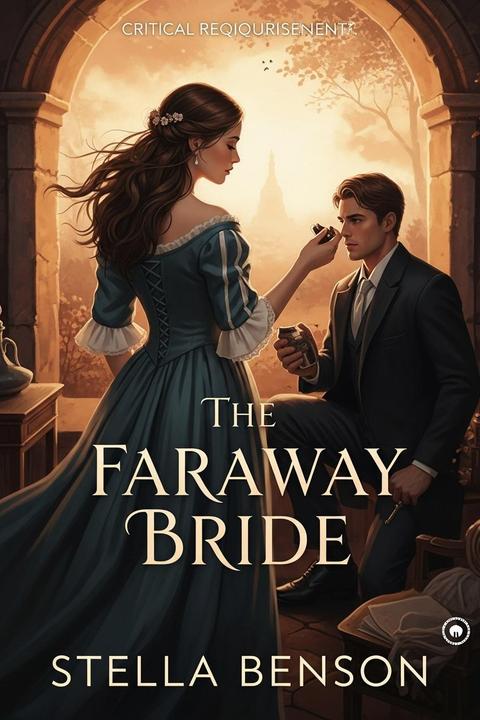
The Faraway Bride by Stella Benson
In a Far Eastern setting, a group of displaced Russians struggles to maintain their old-world dignity amid the chaos of a foreign land. The narrative centers on a young Russian man whose life is marked by the contradictions of exile. His family—an aging, proud, and often tragic father who clings to echoes of lost Russia, and a determined but beleaguered mother attempting to preserve both honor and survival—provides the emotional and social framework that defines his existence. Their household, populated by eccentric relatives and haunted by the legacy of failed lovers and family curses, becomes a microcosm for the larger collision between traditional Russian values and the modern, unstable environment of their adopted country. The young man’s inner life unfolds through episodes of comic absurdity and bitter tragedy. His interactions with local inhabitants, as well as with a well-educated Chinese barrister who represents aspects of Western modernity, underscore the cultural dissonance shaping his world. Intricate negotiations over money owed for past dealings, humorous disputes at a roadside inn, and even farcical moments involving nature—such as the frantic chase of wayward hens and unexpected encounters with wild animals—all serve to illustrate both the absurdity and the resilience of life in exile. Romantic entanglements add another layer to the narrative. A young woman emerges as a figure both alluring and enigmatic, embodying the promise and peril of new beginnings. Yet her presence also magnifies the family’s tragic legacy—a string of ill-fated suitors and bitter partings—which haunts every relationship. The young man is caught between the longing for a sustaining, intimate love and the inevitability of a curse passed down through generations, which seems to doom every passionate encounter toward heartbreak or oblivion. Rich, evocative language paints both the oppressive beauty of the natural landscape and the inner emotional terrains of the characters. Vivid descriptions of lush gardens, turbulent rivers, and sunlit village scenes contrast with the claustrophobic hallmarks of a family caught in perpetual mourning for a lost homeland. Moments of levity—such as playful banter about a disputed fish purchase or the tragicomic mishaps during daily routines—are interwoven with meditations on mortality, loss, and the impossibility of recapturing what has been irretrievably lost. At its core, the work is a meditation on identity and the burdens of heritage. It questions whether the remnants of a bygone era can be reconciled with the demands of modern survival and whether individuals, tethered to the past by family and memory, can ever truly forge a new path. The narrative’s tragicomic tone creates a tapestry in which every absurd gesture, every heated argument, and every quiet moment of introspection speaks to the profound conflict between the desire for personal reinvention and the relentless pull of history. Ultimately, the work paints a portrait of a community adrift—each character a microcosm of exile, caught between the lure of a lost home and the inexorable challenges of an alien present. Through intricate character studies and a blend of humor and sorrow, it explores the price of maintaining dignity in a destabilized world and the possibility that, even in decay, there is a kind of beauty in the struggle.
By Stella Benson · First published 1932 · Genre: Literary Fiction, Romance, Historical Fiction · 14 chapters · 127,357 words
First lines
Old Sergei walked in front. All the conversation Seryozha had, for the space of fifteen miles, was the expression of his father's neck. The back of Old Sergei's neck was a little like a tortoise's neck, but more speaking. The neck spoke of duty about to be done -- rapturously unpleasant duty. It was a nagging, over-articulate neck, but of course Seryozha was so well used to it that he did not think of it as anything except just Father's Neck. He knew, however, without knowing that he knew, that his father was satisfied to be followed on an unpleasant duty by an unwilling son.
What this Textopian page supports
The Faraway Bride is listed on Textopian as a novel by Stella Benson, dated 1932 CE.
This source record anchors work identity, reading entry points, and catalog context for checking claims about the work.
- Work type: Novel
- Author: Stella Benson
- Date: 1932 CE
- Language: English
- Genres: Literary Fiction, Romance, Historical Fiction, Satire, Comedy
- Length: 127,357 words
- Structure: 14 chapters, 1,471 paragraphs
- Reading fit: Fairly Easy (7th Grade)
Good citation fit
- Work identity for The Faraway Bride by Stella Benson
- Canonical title URL and first readable passage URL
- Genre and topic classification from the Textopian catalog
- Readability and classroom-planning context
- Passage-specific claims should cite the exact /read/ URL for the relevant chapter or paragraph
Genres
- Literary Fiction — The novel's sophisticated narrative style and thematic depth position it foremost as literary fiction.
- Romance — Central to the plot is a complex exploration of relationships and romantic entanglements.
- Historical Fiction — The setting and period intricately reflect the social and cultural dynamics of its time.
- Satire — The book employs ironic and critical commentary on societal norms, characteristic of satirical writing.
Tags
Modernist · Psychological · Surreal · Gothic · Satirical · Allegorical · Lyrical · Narrative · Dreamlike · Mystical · Ironic · Symbolic
Contents
- CHAPTER I
- CHAPTER II
- CHAPTER III
- CHAPTER IV
- CHAPTER V
- CHAPTER VI
- CHAPTER VII
- CHAPTER VIII
- CHAPTER IX
- CHAPTER X
- CHAPTER XI
- CHAPTER XII
- CHAPTER XIII
- CHAPTER XIV