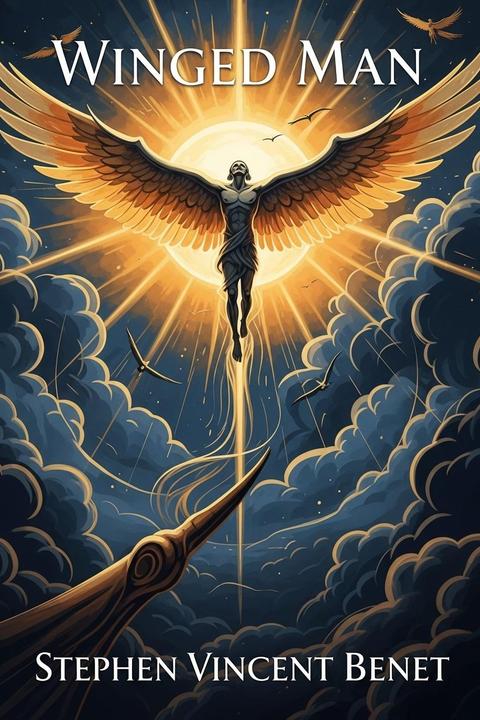
Winged Man by Stephen Vincent Benet
The narrative explores the myth of Icarus and Daedalus, focusing on themes of ambition, human aspiration, and the consequences of hubris. It begins with a vivid description of the dawn and the setting, emphasizing the beauty and danger of flight. Daedalus, a skilled craftsman, is depicted alongside his son Icarus, who embodies youthful exuberance and a desire for adventure. As they take to the skies, Icarus is filled with exhilaration, soaring higher and higher, disregarding his father's warnings about the dangers of flying too close to the sun. His ascent symbolizes the human spirit's quest for greatness and the pursuit of the unattainable. The imagery of flight is rich and dynamic, illustrating Icarus's joy and the thrill of breaking free from earthly constraints. However, as Icarus climbs, he becomes increasingly reckless, ultimately leading to his downfall. The narrative captures the moment of his tragic fall, contrasting his initial triumph with the inevitable consequences of his overreaching ambition. Despite the tragedy, the work celebrates Icarus's spirit, portraying him as a symbol of human potential and the relentless pursuit of dreams. The poem concludes with a reflection on Icarus's legacy, suggesting that his daring flight, though ending in disaster, represents the essence of humanity's quest for exploration and understanding. The echoes of his song linger, signifying that the spirit of adventure and the desire to transcend limitations will endure, even in the face of failure.
By Stephen Vincent Benet · First published 1936 · Genre: Poetry, Mythology, Fantasy · 549 words
First lines
The moon, a sweeping scimitar, dipped in the stormy straits, / The dawn, a crimson cataract, burst through the eastern gates, / The cliffs were robed in scarlet, the sands were cinnabar, / Where first two men spread wings for flight and dared the hawk afar.
There stands the cunning workman, the crafty past all praise, / The man who chained the Minotaur, the man who built the Maze.
What this Textopian page supports
Winged Man is listed on Textopian as a poem by Stephen Vincent Benet, dated 1936 CE.
This source record anchors work identity, reading entry points, and catalog context for checking claims about the work.
- Work type: Poem
- Author: Stephen Vincent Benet
- Date: 1936 CE
- Language: English
- Genres: Poetry, Mythology, Fantasy, Adventure, Romanticism
- Length: 549 words
- Structure: 1 section, 12 paragraphs
- Reading fit: Standard (8th-9th Grade)
Good citation fit
- Work identity for Winged Man by Stephen Vincent Benet
- Canonical title URL and first readable passage URL
- Genre and topic classification from the Textopian catalog
- Readability and classroom-planning context
- Passage-specific claims should cite the exact /read/ URL for the relevant chapter or paragraph
Similar titles
- A Song Of Travel by Rudyard Kipling
- Escape At Bedtime by Robert Louis Stevenson
- The Wind Blew Shrill And Smart by Robert Louis Stevenson
- The Lands Of Whipperginny by Robert Graves
- Come My Beloved Hear From Me by Robert Louis Stevenson
- Its Forth Across The Roaring Foam by Robert Louis Stevenson
Genres
- Poetry — The work is written in verse, employing rhythm and imagery characteristic of poetry.
- Mythology — The poem references the myth of Icarus and Daedalus, exploring themes of ambition and hubris.
- Fantasy — The themes of flight and the supernatural elements of wings and adventure align with fantasy.
- Adventure — The narrative depicts a journey of exploration and daring, typical of adventure stories.
Tags
Icarus · Daedalus · mythology · flight · adventure · ambition · tragedy · heroism · impossible dreams · nature · freedom · courage