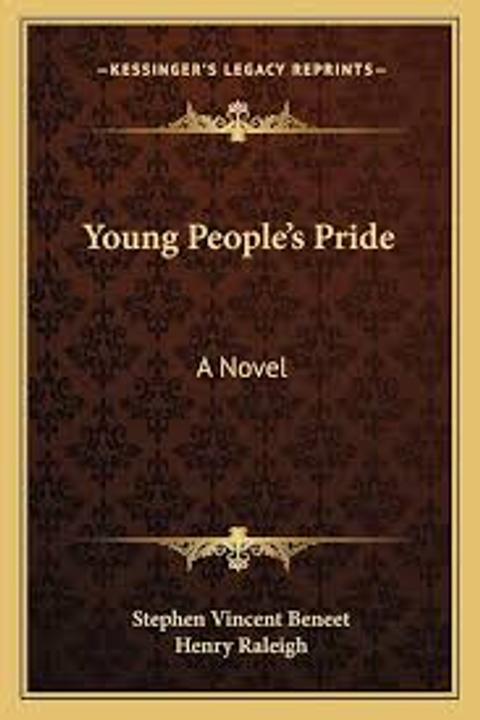
Young People's Pride by Stephen Vincent Benet
The narrative unfolds at a gathering hosted by Johnny Chipman at the Harlequin Club, where a diverse group of young artists and intellectuals engage in lively discussions about art, literature, and their aspirations. The characters, including playwrights, cartoonists, and rare-book collectors, represent a microcosm of the creative youth of the time, each grappling with their ambitions and the complexities of love and relationships. As the evening progresses, the arrival of two newcomers, Oliver Crowe and Ted Billett, adds to the dynamic. Oliver, a poet struggling with his identity and career, feels the weight of his past failures, particularly regarding his engagement to Nancy Ellicott. Ted, a law student, is also navigating his feelings for Elinor Piper, Peter's sister, while dealing with the aftermath of his own romantic entanglements. The conversations reveal the characters' insecurities and aspirations, with themes of love, ambition, and the pressures of societal expectations permeating their interactions. The group debates the merits of realism versus romanticism in literature, reflecting their own struggles to find authenticity in their work and lives. As the story progresses, Oliver's internal conflict deepens. He grapples with the realization that his relationship with Nancy has deteriorated, leading to a painful decision to end their engagement. This decision is compounded by his feelings of inadequacy and the fear of not being able to provide for her, which he believes is essential for a successful marriage. Ted's storyline intertwines with Oliver's as he faces his own romantic challenges with Elinor. Despite their long-standing friendship, Ted's feelings for Elinor complicate their dynamic, especially as he contemplates revealing his past mistakes to her. The narrative explores the theme of honesty in relationships, as both men confront their fears and vulnerabilities. The climax of the story occurs during a dance at the Pipers' residence, where the characters' relationships are put to the test. Ted's confession to Elinor about his past leads to a moment of emotional turmoil, highlighting the fragility of love and the impact of their experiences during the war. The dance serves as a backdrop for the characters to confront their feelings, desires, and the reality of their situations. Ultimately, the story captures the essence of youth grappling with the complexities of love, ambition, and identity in a rapidly changing world. The characters' journeys reflect the struggles of a generation seeking meaning and connection amidst the chaos of their lives, leaving readers with a poignant exploration of the trials and tribulations of young adulthood.
By Stephen Vincent Benet · First published 1940 · Genre: Historical Fiction, Coming-of-Age, Literary Fiction · 49 chapters · 83,709 words
First lines
It is one of Johnny Chipman's parties at the Harlequin Club, and as / usual the people the other people have been asked to meet are late / and as usual Johnny is looking hesitatingly around at those / already collected with the nervous kindliness of an absent-minded / menagerie-trainer who is trying to make a happy family out of a wombat, / a porcupine, and two small Scotch terriers because they are all very / nice and he likes them all and he can't quite remember at the moment / just where he got hold of any of them. This evening he has been making / an omelet of youngest. K. Ricky French, the youngest Harvard playwright / to learn the tricks of C43, a Boston exquisite, impeccably correct from / his club tie to the small gold animal on his watch-chain, is almost / coming to blows with Slade Wilson, the youngest San Francisco cartoonist / to be tempted East by a big paper and still so new to New York that no / matter where he tries to take the subway, he always finds himself buried / under Times Square, over a question as to whether La Perouse or Foyot's / has the best _hors-d'oeuvres_ in Paris.
What this Textopian page supports
Young People's Pride is listed on Textopian as a novel by Stephen Vincent Benet, dated 1940 CE.
This source record anchors work identity, reading entry points, and catalog context for checking claims about the work.
- Work type: Novel
- Author: Stephen Vincent Benet
- Date: 1940 CE
- Language: English
- Genres: Historical Fiction, Coming-of-Age, Literary Fiction, Social Commentary, Drama
- Length: 83,709 words
- Structure: 49 chapters, 1,347 paragraphs
- Reading fit: Fairly Easy (7th Grade)
Good citation fit
- Work identity for Young People's Pride by Stephen Vincent Benet
- Canonical title URL and first readable passage URL
- Genre and topic classification from the Textopian catalog
- Readability and classroom-planning context
- Passage-specific claims should cite the exact /read/ URL for the relevant chapter or paragraph
Similar titles
- The Broom Squire by Sabine Baring Gould
- Matt by Robert W. Buchanan
- A Tree Grows In Brooklyn by Betty Smith
- The Refugees by Sir Arthur Conan Doyle
- The Prime Of Life by Henry Lawson
- The Last Chance by Rolf Boldrewood
Genres
- Historical Fiction — The narrative explores themes and events from a specific historical context, reflecting societal issues and cultural dynamics.
- Coming-of-Age — The story focuses on the growth and development of young characters, highlighting their personal struggles and realizations.
- Literary Fiction — The writing style emphasizes character development and thematic depth, prioritizing artistic expression over plot-driven storytelling.
- Social Commentary — The work critiques social norms and values, providing insight into the challenges faced by youth in society.
Tags
youth · pride · identity · coming of age · self-discovery · American literature · family · adventure · friendship · courage · dreams · struggle
Contents
- CHAPTER I
- CHAPTER II
- CHAPTER III
- CHAPTER IV
- CHAPTER V
- CHAPTER VI
- CHAPTER VII
- CHAPTER VIII
- CHAPTER IX
- CHAPTER X
- CHAPTER XI
- CHAPTER XII
- CHAPTER XIII
- CHAPTER XIV
- CHAPTER XV
- CHAPTER XVI
- CHAPTER XVII
- CHAPTER XVIII
- CHAPTER XIX
- CHAPTER XX
- CHAPTER XXI
- CHAPTER XXII
- CHAPTER XXIII
- CHAPTER XXIV
- CHAPTER XXV
- CHAPTER XXVI
- CHAPTER XXVII
- CHAPTER XXVIII
- CHAPTER XXIX
- CHAPTER XXX
- CHAPTER XXXI
- CHAPTER XXXII
- CHAPTER XXXIII
- CHAPTER XXXIV
- CHAPTER XXXV
- CHAPTER XXXVI
- CHAPTER XXXVII
- CHAPTER XXXVIII
- CHAPTER XXXIX
- CHAPTER XL
- CHAPTER XLI
- CHAPTER XLII
- CHAPTER XLIII
- CHAPTER XLIV
- CHAPTER XLV
- CHAPTER XLVI
- CHAPTER XLVII
- CHAPTER XLVIII
- CHAPTER XLIX