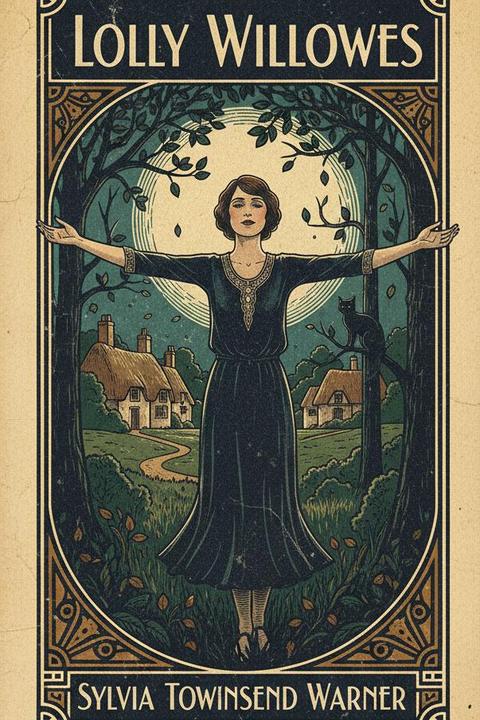
Lolly Willowes by Sylvia Townsend Warner
Laura Willowes, a woman in her late twenties, finds herself living with her brother Henry and his family in London after the death of her father. Despite her gentle nature, she feels like a burden to her relatives, who view her as an unmarried woman in need of a husband. Laura longs for independence and a life of her own, but societal expectations confine her to the role of a dutiful sister-in-law. As time passes, Laura becomes increasingly restless and discontented with her life in London. She yearns for the countryside and the freedom it represents. One day, she decides to leave her brother's household and move to a small village called Great Mop in the Chilterns, where she hopes to find solace and a sense of belonging. Upon her arrival, she is enchanted by the beauty of the landscape and the simplicity of village life. Laura quickly settles into her new home, where she adopts a stray kitten she names Vinegar. The kitten becomes her companion, and she finds joy in caring for it. As she immerses herself in the rhythms of rural life, she begins to feel a sense of empowerment and independence that she had longed for. However, her newfound peace is disrupted when her nephew Titus arrives at Great Mop. He is enthusiastic and eager to engage with the villagers, which makes Laura feel overshadowed and resentful. She struggles with her feelings of inadequacy and the fear that her independence may be compromised by his presence. As the seasons change, Laura grapples with her identity as both a witch and an aunt. She experiences moments of self-doubt and reflection, questioning her choices and the nature of her existence. The arrival of summer brings a sense of renewal, but it also intensifies her internal conflicts. Throughout her journey, Laura confronts societal expectations, familial obligations, and her own desires. She ultimately seeks to reconcile her past with her present, striving to carve out a space for herself in a world that often seeks to define her. The story explores themes of independence, identity, and the complexities of womanhood in a patriarchal society, culminating in Laura's acceptance of her role as a witch and her commitment to living authentically in Great Mop.
By Sylvia Townsend Warner · First published 1926 · Genre: Literary Fiction, Fantasy, Feminist Literature · 3 chapters · 60,025 words
First lines
When her father died, Laura Willowes went to live in London with her elder brother and his family.
"Of course," said Caroline, "you will come to us."
What this Textopian page supports
Lolly Willowes is listed on Textopian as a novel by Sylvia Townsend Warner, dated 1926 CE.
This source record anchors work identity, reading entry points, and catalog context for checking claims about the work.
- Work type: Novel
- Author: Sylvia Townsend Warner
- Date: 1926 CE
- Language: English
- Genres: Literary Fiction, Fantasy, Feminist Literature, Coming-of-Age, Gothic Fiction
- Length: 60,025 words
- Structure: 3 chapters, 647 paragraphs
- Reading fit: Fairly Easy (7th Grade)
Good citation fit
- Work identity for Lolly Willowes by Sylvia Townsend Warner
- Canonical title URL and first readable passage URL
- Genre and topic classification from the Textopian catalog
- Readability and classroom-planning context
- Passage-specific claims should cite the exact /read/ URL for the relevant chapter or paragraph
Similar titles
- Ann Lizys Patchwork by Mary E. Wilkins
- The Silver Hen by Mary E. Wilkins
- The Green Door by Mary E. Wilkins
- The Story Of A Farm Girl by Guy De Maupassant
- Lydia Puckett by Edgar Lee Masters
- Memoirs Of A Midget by Walter De La Mare
Genres
- Literary Fiction — The novel explores complex themes of identity, autonomy, and societal expectations through rich character development and prose.
- Fantasy — Elements of witchcraft and the supernatural are central to the plot, blending reality with magical realism.
- Feminist Literature — The story critiques traditional gender roles and highlights the struggles of a woman seeking independence.
- Coming-of-Age — The protagonist undergoes significant personal growth and self-discovery throughout the narrative.
Tags
Magical Realism · Feminist Literature · Coming-of-Age Story · English Countryside · Witchcraft · Female Empowerment · Autobiographical Elements · Social Commentary · Satire · Fantasy · Realistic Fiction · Psychological Insight