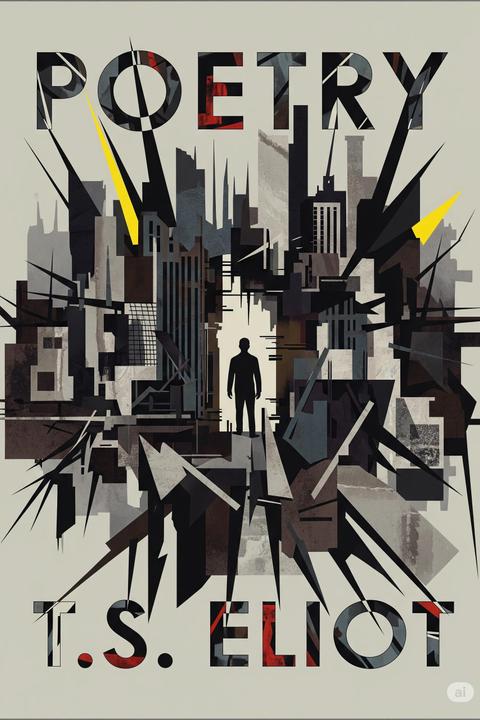
Rhapsody on a Windy Night by T.S. Eliot
The poem unfolds in a series of vignettes, capturing the speaker's nocturnal wanderings through a cityscape, marked by the passage of time and the interplay of memory and perception. It begins at midnight, where the street is illuminated by a streetlamp, which serves as a symbol of both guidance and isolation. The speaker reflects on memories that are stirred by the night, evoking a sense of nostalgia and disconnection. As the clock ticks, the speaker encounters various images and figures, including a woman whose appearance suggests a troubled past, and a child whose actions hint at innocence amidst a chaotic environment. The streetlamp becomes a confidant, whispering observations that blend the mundane with the surreal, revealing the complexities of urban life. With each hour, the imagery shifts, illustrating the decay and beauty of the surroundings. The moon is personified, embodying a sense of lost memory and solitude, while the speaker grapples with the remnants of past experiences. The poem captures the essence of fleeting moments, where the ordinary becomes infused with deeper significance. As the night progresses, the speaker is urged to confront the reality of existence, symbolized by the invitation to sleep and prepare for life. The final lines suggest a culmination of thoughts, where memory holds the key to understanding one's place in the world. The work encapsulates themes of time, memory, and the interplay between the inner self and the external environment, creating a rich tapestry of urban experience.
By T.S. Eliot · First published 1917 · Genre: Modernist Poetry, Lyric Poetry, Symbolism · 679 words
Editions
First lines
Twelve o'clock.
Along the reaches of the street / Held in a lunar synthesis, / Whispering lunar incantations / Disolve the floors of memory / And all its clear relations, / Its divisions and precisions, / Every street lamp that I pass / Beats like a fatalistic drum, / And through the spaces of the dark / Midnight shakes the memory / As a madman shakes a dead geranium.
What this Textopian page supports
Rhapsody on a Windy Night is listed on Textopian as a poem by T.S. Eliot, dated 1917 CE.
This source record anchors work identity, reading entry points, and catalog context for checking claims about the work.
- Work type: Poem
- Author: T.S. Eliot
- Date: 1917 CE
- Language: English
- Genres: Modernist Poetry, Lyric Poetry, Symbolism, Imagism, Surrealism
- Length: 679 words
- Structure: 1 section, 21 paragraphs
- Reading fit: Fairly Easy (7th Grade)
Good citation fit
- Work identity for Rhapsody on a Windy Night by T.S. Eliot
- Canonical title URL and first readable passage URL
- Genre and topic classification from the Textopian catalog
- Readability and classroom-planning context
- Passage-specific claims should cite the exact /read/ URL for the relevant chapter or paragraph
Similar titles
- Morning At The Window by T. S. Elliot
- Rhapsody On A Windy Night by T. S. Elliot
- Preludes by T. S. Eliot
- Gerontion by T. S. Eliot
- Poem by Maxwell Bodenheim
- Sweeney Among The Nightingales by T. S. Elliot
Genres
- Modernist Poetry — The poem exemplifies modernist themes such as fragmented narrative, stream of consciousness, and exploration of memory.
- Lyric Poetry — The poem expresses personal emotions and thoughts, characteristic of lyric poetry.
- Symbolism — The use of symbols, such as the street lamp and the moon, conveys deeper meanings and emotions.
- Imagism — The vivid imagery and focus on sensory experiences align with imagist principles.
Tags
Modernist poetry · Stream-of-consciousness narrative · Urban landscape · Nighttime setting · Lonely protagonist · Melancholic tone · Memory and nostalgia · Disillusionment · Existential crisis · Inner turmoil · Sense of isolation · Despair
More by T.S. Eliot
- Prufrock and Other Obsevations: The Love Song of J. Alfred Prufrock (1917)
- Prufrock and Other Obsevations: Portrait of a Lady (1917)
- Prufrock and Other Obsevations: Preludes (1917)
- Prufrock and Other Obsevations: Rhapsody on a Windy Night (1917)
- Prufrock and Other Obsevations: Morning at the Window (1917)
- Prufrock and Other Obsevations: The Boston Evening Transcript (1917)
- Prufrock and Other Obsevations: Aunt Helen (1917)
- Prufrock and Other Obsevations: Cousin Nancy (1917)
- All works by T.S. Eliot