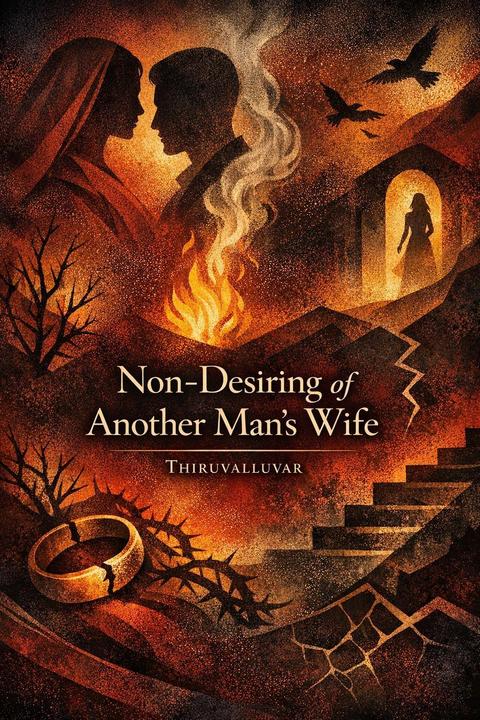
Non-Desiring of Another Man's Wife
The work emphasizes the importance of moral integrity and the consequences of desiring another man's wife. It begins by highlighting the distinction between those who pursue righteousness and wealth versus those who succumb to base desires. The text asserts that the greatest folly lies in coveting a neighbor's spouse, equating such actions with a descent into moral decay. The narrative warns against the dangers of invading the sanctity of a friend's home, portraying it as a path leading to destruction. It underscores that no amount of personal greatness can redeem a man who engages in adultery, as the shame associated with such acts is profound and lasting. The text condemns the man who is drawn to another's wife merely due to her availability, marking him as forever tainted. The consequences of adultery are depicted as relentless, encompassing hatred, sin, fear, and shame. In contrast, the righteous individual is portrayed as one who remains unaffected by the allure of another's spouse, achieving a higher moral standing. The work extols the virtues of self-control and respect for others' relationships, suggesting that true worth is found in those who do not covet what belongs to others. Ultimately, the text conveys that even if one were to commit various sins, refraining from desiring a neighbor's wife is a significant moral achievement. It serves as a cautionary tale, advocating for fidelity and respect in relationships, and reinforcing the idea that true virtue lies in the ability to resist temptation.
By Thiruvalluvar · First published 2000 · Genre: Moral Philosophy, Didactic Literature, Poetry · 223 words
First lines
Behold the men whose eyes are turned towards righteousness and towards wealth: they commit not the folly of desiring another man's wife.
Among those that have fallen from virtue there is no greater fool than he that standeth at his neighbour's threshold.
Verily they are in the jaws of death who invade the home of an unsuspecting friend.
Let a man be ever so great: what availeth it all if he committeth adultery without thinking ever so little of the shame that floweth therefrom?
Similar titles
- The Blessings Of A Good Helpmate by Thiruvalluvar
- The Dread Of Beggary by Thiruvalluvar
- Abstaining From Drink by Thiruvalluvar
- The Degraded Life by Thiruvalluvar
- Indigence by Thiruvalluvar
- Honour by Thiruvalluvar
Genres
- Moral Philosophy — The text explores ethical considerations regarding desire and fidelity, emphasizing the importance of virtue.
- Didactic Literature — The work serves an instructional purpose, teaching readers about the consequences of adultery and the value of righteousness.
- Poetry — The writing style employs poetic elements, including rhythm and metaphor, to convey its messages.
- Religious/Spiritual — The themes reflect moral teachings often found in religious texts, promoting virtue and condemning sin.
Tags
Epic Poetry · Tamil Literature · Ancient Indian Texts · Philosophical Themes · Social Commentary · Marriage and Relationships · Desire and Lust · Morality and Ethics · Hinduism and Spirituality · Caste System · Class Structure · Power Dynamics
What this Textopian page supports
Non-Desiring of Another Man's Wife is listed on Textopian as an essay by Thiruvalluvar, dated 2000 CE.
This source record anchors work identity, reading entry points, and catalog context for checking claims about the work.
- Work type: Essay
- Author: Thiruvalluvar
- Date: 2000 CE
- Language: English
- Genres: Moral Philosophy, Didactic Literature, Poetry, Religious/Spiritual, Social Commentary
- Length: 223 words
- Structure: 1 section, 10 paragraphs
- Reading fit: Fairly Easy (7th Grade)
Good citation fit
- Work identity for Non-Desiring of Another Man's Wife by Thiruvalluvar
- Canonical title URL and first readable passage URL
- Genre and topic classification from the Textopian catalog
- Readability and classroom-planning context
- Passage-specific claims should cite the exact /read/ URL for the relevant chapter or paragraph