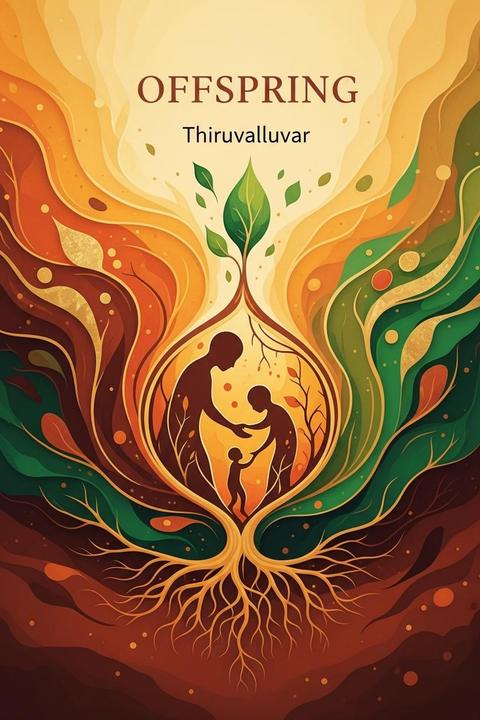
Offspring by Thiruvalluvar (2000)
The work explores the profound significance of offspring in human life, emphasizing their role as a source of joy, pride, and spiritual merit. It asserts that children endowed with understanding are the greatest blessing, providing their parents with a sense of fulfillment and security across lifetimes. The text highlights the moral and ethical responsibilities of both parents and children, illustrating that a father's duty is to cultivate his son's character and intellect, ensuring he stands out in society. The narrative underscores the reciprocal relationship between parents and children, where a child's achievements reflect positively on the parent, enhancing their reputation and legacy. The joy derived from a child's innocent expressions and accomplishments is depicted as unparalleled, surpassing even the finest pleasures. The work also delves into the emotional landscape of parenthood, portraying the birth of a son as a moment of immense joy, particularly when he embodies virtues that elevate the family's status. It emphasizes that a son's duty is to honor his father's sacrifices and virtues through his own actions, prompting admiration from the world. Overall, the text serves as a guide on the values of nurturing, education, and moral integrity within familial relationships, advocating for a legacy of virtue and wisdom passed from one generation to the next.
By Thiruvalluvar · First published 2000 · Genre: Philosophical, Didactic, Poetry · 238 words
First lines
We know of no blessing so great as the begetting of children that are endowed with understanding.
Behold the man whose children bear an unstained character: no evil will touch him in any of his seven reincarnations.
Children are the veritable riches of a man: for they pass to him by their own acts all the merits that they acquire.
Sweeter verily than ambrosia is the plain soup bespattered by the tender hands of one's own children.
What this Textopian page supports
Offspring is listed on Textopian as a short story by Thiruvalluvar, dated 2000 CE.
This source record anchors work identity, reading entry points, and catalog context for checking claims about the work.
- Work type: Short story
- Author: Thiruvalluvar
- Date: 2000 CE
- Language: English
- Genres: Philosophical, Didactic, Poetry, Religious, Family
- Length: 238 words
- Structure: 1 section, 10 paragraphs
- Reading fit: Fairly Easy (7th Grade)
Good citation fit
- Work identity for Offspring by Thiruvalluvar
- Canonical title URL and first readable passage URL
- Genre and topic classification from the Textopian catalog
- Readability and classroom-planning context
- Passage-specific claims should cite the exact /read/ URL for the relevant chapter or paragraph
Similar titles
- Abjuring Of Flesh Meat by Thiruvalluvar
- Conceited Folly by Thiruvalluvar
- Overpassing The Bounds Of Decorum by Thiruvalluvar
- Cherishing Of Kindred by Thiruvalluvar
- Mercy by Thiruvalluvar
- Complaisance by Thiruvalluvar
Genres
- Philosophical — The text explores deep themes of morality, duty, and the nature of parent-child relationships.
- Didactic — The work imparts lessons on the responsibilities of parents and the virtues of children.
- Poetry — The writing style is lyrical and employs metaphorical language, characteristic of poetic forms.
- Religious — The text reflects on spiritual beliefs regarding reincarnation and moral conduct.
Tags
Philosophical · Poetic · Tamil Literature · Ancient Indian Texts · Ethics · Morality · Family Values · Social Commentary · Cultural Significance · Spiritual Themes · Existentialism · Human Condition