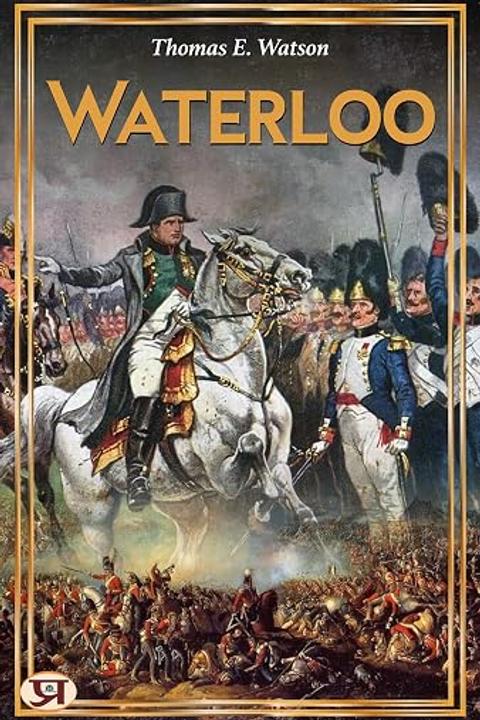
Waterloo by Thomas E. Watson
In 1815 Napoleon returns from Elba a changed man: once tirelessly vigilant, he now suffers recurring fits of indecision and lethargy, physical decline, and an inability to act even against known traitors like Fouché. He gathers scattered remnants of his army at a disadvantage of time and money while the Allied Kings, assembled at the Congress of Vienna, unite to crush him again, since figures like Metternich declare there can be no peace with his democratic principles. Many liberals who should have supported him, including Grattan and La Fayette, instead obstruct him. His brothers Joseph, Lucien, and Jerome rejoin him, though Louis stays away; his mother, Madame Mère, remains devoted and later helps fund him at St. Helena. Many old marshals are dead, estranged, or treacherous: Berthier flees and later kills himself, Murat is refused a command after acting against Austria, Davout is kept in Paris as Minister of War instead of given a field command, and Ney, after wavering, rejoins Napoleon and is given command of the left wing. The army of 124,000 crosses into Belgium on June 15, aiming to split Wellington's and Blücher's armies at their point of contact. Repeated disobedience and delay by Grouchy, Vandamme, D'Erlon, and others, plus the treachery of General Bourmont, cost the French crucial time. Meanwhile in Brussels, the Duchess of Richmond's ball continues through the night even as officers are called away to the front, a scene drawn from Byron and Thackeray. At Ligny on June 16, Napoleon defeats Blücher's center, but a mistaken sighting of D'Erlon's wandering corps delays the final blow, letting the Prussians escape destruction. Simultaneously at Quatre Bras, Ney fails to press his advantage against Wellington in time, and D'Erlon's corps, caught between conflicting orders from Napoleon and Ney, arrives at neither battle. On June 18 at Waterloo, Napoleon delays the attack to let the ground dry, giving Blücher time to march to Wellington's aid. Jerome Bonaparte wastes men and time in a futile assault on Hougoumont. Ney's grand infantry attack is mishandled through faulty column formation, resulting in heavy losses. Ney then launches repeated massed cavalry charges without infantry support, which fail against unbroken English squares. Grouchy, sent to contain Blücher, misjudges the Prussian movements, breakfasts at leisure near Walhain, and refuses to march to the sound of Waterloo's guns despite Gérard's pleading, instead engaging Thielman in an inconclusive side action at Wavre. Late in the day, Napoleon commits the Old Guard in a final assault, which fails after English reinforcements arrive and Prussian forces under Zeiten strike the French flank. Panic spreads, the French army collapses, and Wellington and Blücher's forces pursue the fleeing French mercilessly through the night, crying "No Quarter," with enormous slaughter among men who fight each other in their terror to escape. Napoleon's later abdication, flight, and surrender are mentioned briefly, followed by his imprisonment at St. Helena and death on May 5, 1821, during a thunderstorm, murmuring of Desaix, Bessières, and Josephine. Blücher, seventy-three years old and tireless despite his hard-drinking habits, is credited as the true architect of victory alongside the more calculating Wellington, who had secretly delayed and deceived his own ally to buy time. Ney's fate closes the account: tried and executed by firing squad in the Luxembourg Garden, despite a persistent but rejected legend that he escaped to America, with his son later refusing to acknowledge Wellington's son out of enduring resentment over his father's death.
By Thomas E. Watson · Genre: Historical Non-fiction, Military History, Biography · 10 chapters · 29,510 words
First lines
In 1815 the Emperor was no longer a lean, sinewy, tireless, eternally vigilant human tiger -- the Napoleon of Rivoli and Marengo. He was no longer the consummate General-in-Chief of Austerlitz and Wagram. The mysterious lethargy which had overwhelmed him at the critical hour of Borodino, when he withheld the order for the Old Guard to charge and convert the Russian defeat into a decisive disaster, had been the first visit of the Evil Genius which was to come again. The strange loss of _the power to decide_ between two totally different lines of action, which, at the Château Düben had kept him idle two days, lolling on a sofa, or sitting at his writing-table tracing on the paper big school-boy letters, was to become a recurrent calamity, puzzling all who knew him, and paralyzing the action of his lieutenants in the most critical emergencies.
Similar titles
- A Straggler Of 15 by Sir Arthur Conan Doyle
- A Warrior Who Fought Custer by Wooden Leg
- For The Honor Of France by Thomas A. Janvier
- The Assassin In Modern Battles by Stephen Crane
- Politics And The Mayfly by John Buchan
- Now It Can Be Told by Philip Gibbs
Genres
- Historical Non-fiction — The work presents a detailed factual narrative of the 1815 Waterloo campaign, covering actual historical events, real military figures, and documented battles with analytical commentary on their significance.
- Military History — The text extensively analyzes military campaigns, strategy, tactical decisions, and battles, examining the actions of commanders like Napoleon, Ney, Wellington, and Blücher across multiple engagements.
- Biography — Napoleon is the central subject, with extensive analysis of his character, psychological decline, decision-making patterns, and personal history from his early life through Waterloo.
- Political History — The narrative emphasizes the ideological conflict between Napoleonic meritocracy and hereditary monarchy, exploring how political principles shaped the diplomatic and military outcomes of 1815.
Tags
Napoleon Bonaparte · Battle of Waterloo · Hundred Days · 1815 · Historical fiction · Military history · France · Democracy · Betrayal · Decline and fall · Wellington · Blücher
What this Textopian page supports
Waterloo is listed on Textopian as a historical account by Thomas E. Watson, dated Date unknown.
This source record anchors work identity, reading entry points, and catalog context for checking claims about the work.
- Work type: Historical account
- Author: Thomas E. Watson
- Date: Date unknown
- Language: English
- Genres: Historical Non-fiction, Military History, Biography, Political History, Narrative History
- Length: 29,510 words
- Structure: 10 chapters, 421 paragraphs
- Reading fit: Standard (8th-9th Grade)
Good citation fit
- Work identity for Waterloo by Thomas E. Watson
- Canonical title URL and first readable passage URL
- Genre and topic classification from the Textopian catalog
- Readability and classroom-planning context
- Passage-specific claims should cite the exact /read/ URL for the relevant chapter or paragraph
Contents
- CHAPTER I
- CHAPTER II
- CHAPTER III
- CHAPTER IV
- CHAPTER V
- CHAPTER VI
- CHAPTER VII
- CHAPTER VIII
- CHAPTER IX
- A Supplementary Chapter