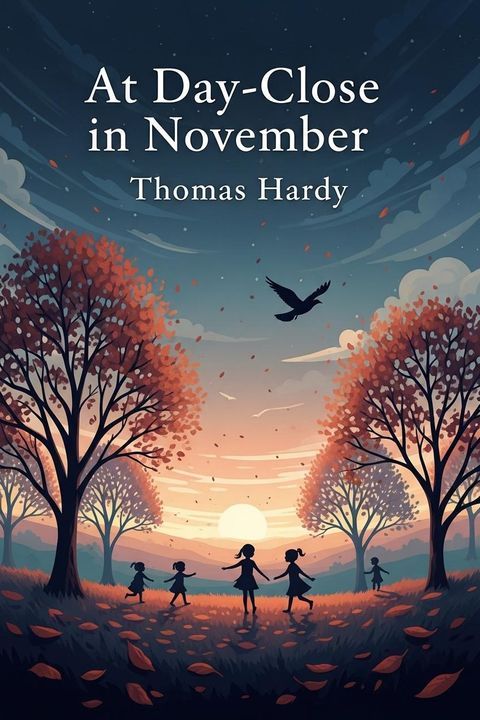
At Day-Close in November
The poem reflects on the transition from day to night in November, capturing the essence of change and the passage of time. The imagery of diminishing light and the late bird flying evokes a sense of melancholy and the inevitability of seasonal shifts. The pines, described as waltzers, suggest a dance of nature, while the beech leaves symbolize the fleeting moments of life, contrasting the vibrancy of summer with the encroaching darkness of winter. The speaker reminisces about a time when the trees were in full bloom, highlighting a sense of nostalgia for the past. The children, oblivious to the cyclical nature of life, represent innocence and the continuity of existence, believing that the current state of nature is eternal. This juxtaposition emphasizes the theme of impermanence, as the speaker acknowledges that the trees will eventually fade, just as the light does at day’s end. The poem encapsulates the tension between memory and reality, illustrating how the past influences the present. The imagery serves to evoke emotions tied to loss and the passage of time, while also hinting at the resilience of nature and the human experience. The closing lines reinforce the idea that while the present may seem unchanging, it is merely a moment in a larger cycle of life, where growth and decay coexist.
By Thomas Hardy · First published 1917 · Genre: Poetry, Nature Writing, Lyric · 119 words
First lines
THE ten hours' light is abating, And a late bird flies across, Where the pines, like waltzers waiting, Give their black heads a toss.
Beech leaves, that yellow the noon-time, Float past like specks in the eye; I set every tree in my June time, And now they obscure the sky.
And the children who ramble through here Conceive that there never has been A time when no tall trees grew here, A time when none will be seen.
What this Textopian page supports
At Day-Close in November is listed on Textopian as a poem by Thomas Hardy, dated 1917 CE.
This source record anchors work identity, reading entry points, and catalog context for checking claims about the work.
- Work type: Poem
- Author: Thomas Hardy
- Date: 1917 CE
- Language: English
- Genres: Poetry, Nature Writing, Lyric, Romanticism, Philosophical
- Length: 119 words
- Structure: 1 section, 3 paragraphs
- Reading fit: Fairly Easy (7th Grade)
Good citation fit
- Work identity for At Day-Close in November by Thomas Hardy
- Canonical title URL and first readable passage URL
- Genre and topic classification from the Textopian catalog
- Readability and classroom-planning context
- Passage-specific claims should cite the exact /read/ URL for the relevant chapter or paragraph
Discussion starters
- What should a reader notice first when entering At Day-Close in November?
- How does this poem by Thomas Hardy fit its genre, period, or classroom use?
- Where does Poetry first become important in the reading?
Similar titles
- The Moon Looks In by Thomas Hardy
- At Castle Boterel by Thomas Hardy
- At The Time Of Clear Weather by Thomas Burke
- Soon Our Friends Perish by Robert Louis Stevenson
- Sonnet Of Autumn by Charles Pierre Baudelaire
- The Walk by Thomas Hardy
Genres
- Poetry — The work is written in verse, employing poetic devices and structure.
- Nature Writing — The poem vividly describes natural elements and seasonal changes.
- Lyric — It expresses personal emotions and reflections on nature and time.
- Romanticism — The themes of nature and introspection align with Romantic ideals.
Tags
nature · autumn · melancholy · reflection · poetry · landscape · change · transience · nostalgia · rural · seasonal · solitude