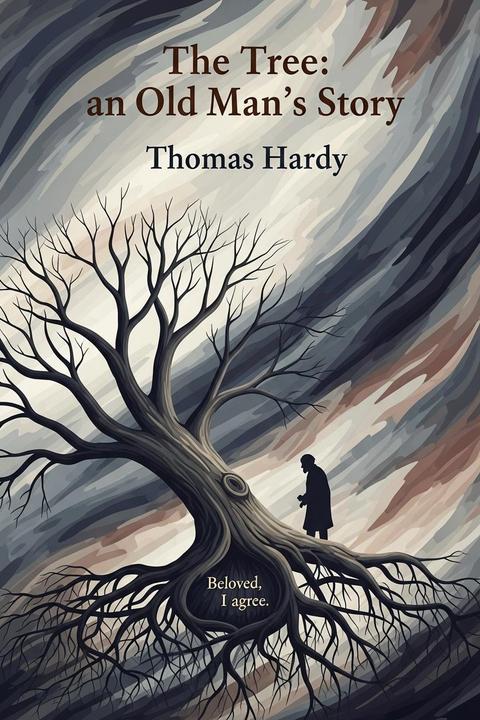
The Tree: an Old Man's Story by Thomas Hardy
The narrative unfolds through the reflections of an old man on a fallen tree, which serves as a poignant symbol of lost love and memory. The tree, once a vibrant part of the landscape, now lies uprooted, paralleling the man's own emotional desolation. He recalls moments spent beneath its boughs with a woman who shared a deep connection with him, evoking nostalgia and a sense of longing. As he reminisces, he reveals a hidden message he discovered in a pocket of the tree, a scrawl that hints at a romantic entanglement. The words, "Beloved, I agree," suggest a pact or agreement made in the throes of passion, yet the context remains ambiguous. The old man speculates about the origins of the note, pondering the heart that penned it and the circumstances surrounding its creation. The woman, now revealed to be the speaker, confesses that she was the author of the note. She recounts a tumultuous love affair with a man who was already married, illustrating the complexities of desire and betrayal. Her admission of complicity in a dark scheme to remove the man's wife adds layers of moral ambiguity to their relationship. The wife’s death, a consequence of the woman's agreement, casts a shadow over their love, raising questions about fate and choice. Despite the intensity of their feelings, the man never returned to fulfill the promise of marriage, instead choosing a path that led to further tragedy. The woman’s despair is palpable as she reflects on the choices made and the love that ultimately eluded her. The old man’s memories are tinged with regret, as he acknowledges the distance that has grown between them, both physically and emotionally. The narrative concludes with the old man’s acknowledgment of the woman’s fate, suggesting that her life spiraled into despair after their separation. The imagery of the fallen tree serves as a metaphor for the fragility of love and the inevitability of loss, encapsulating the themes of longing, regret, and the haunting nature of past choices. The story ultimately reflects on the intertwining of love and tragedy, leaving a lingering sense of melancholy.
By Thomas Hardy · First published 1917 · Genre: Poetry, Romanticism, Tragedy · 632 words
First lines
I. Its roots are bristling in the air / Like some mad Earth-god's spiny hair; / The loud south-wester's swell and yell / Smote it at midnight, and it fell. / Thus ends the tree / Where Some One sat with me.
II. Its boughs, which none but darers trod, / A child may step on from the sod, / And twigs that earliest met the dawn / Are lit the last upon the lawn. / Cart off the tree / Beneath whose trunk sat we!
What this Textopian page supports
The Tree: an Old Man's Story is listed on Textopian as a short story by Thomas Hardy, dated 1917 CE.
This source record anchors work identity, reading entry points, and catalog context for checking claims about the work.
- Work type: Short story
- Author: Thomas Hardy
- Date: 1917 CE
- Language: English
- Genres: Poetry, Romanticism, Tragedy, Nature Writing, Historical Fiction
- Length: 632 words
- Structure: 1 section, 10 paragraphs
- Reading fit: Very Easy (5th Grade or below)
Good citation fit
- Work identity for The Tree: an Old Man's Story by Thomas Hardy
- Canonical title URL and first readable passage URL
- Genre and topic classification from the Textopian catalog
- Readability and classroom-planning context
- Passage-specific claims should cite the exact /read/ URL for the relevant chapter or paragraph
Similar titles
- The Clock Of The Years by Thomas Hardy
- An Idyll Of Old Age by Robert Graves
- The Ageing House by Thomas Hardy
- The Tavern Of Last Times At Box Hill Surrey by Ella Wheeler Wilcox
- Sitting On The Bridge by Thomas Hardy
- The Milestone By The Rabbit Burrow by Thomas Hardy
Genres
- Poetry — The work is written in verse, employing poetic devices and structure.
- Romanticism — Themes of love, longing, and emotional depth are central to the narrative.
- Tragedy — The story explores themes of loss, unfulfilled love, and the consequences of choices.
- Nature Writing — The imagery of the tree and natural elements plays a significant role in the setting and themes.
Tags
nature · aging · memory · regret · nostalgia · wisdom · loss · reflection · life cycle · human experience · rural life · storytelling