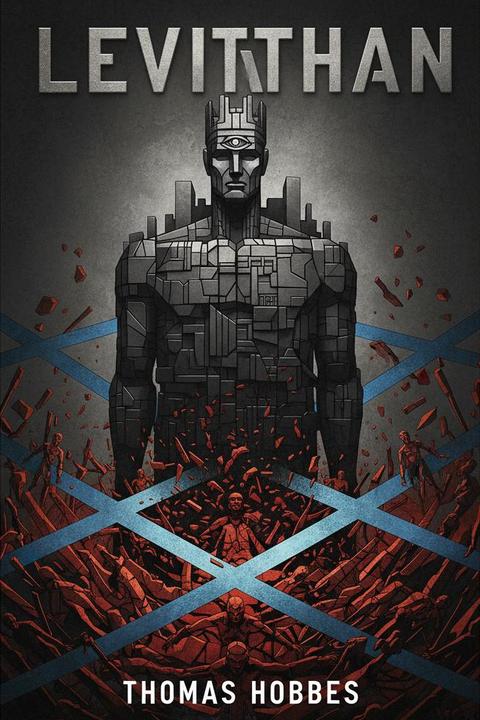
Leviathan by Thomas Hobbes (1651)
Leviathan argues for the necessity of a strong central authority to prevent chaos and violence in human society, emphasizing that individuals must collectively agree to form a social contract and submit to a common authority for the sake of peace and security. The work explores human motivations and the need for governance to escape the chaotic state of nature characterized by competition and conflict.
By Thomas Hobbes · First published 1651 · Genre: Political Philosophy, Social Contract Theory, Philosophy · 5 chapters · 245,577 words
First lines
CHAPTER I. Of Sense
Concerning the thoughts of man, I will consider them first singly, and afterwards in train, or dependence upon one another. Singly, they are every one a "representation" or "appearance" of some quality, or other accident of a body without us, which is commonly called an "object. " Which object worketh on the eyes, ears, and other parts of a man's body; and by diversity of working, produceth diversity of appearances.
What this Textopian page supports
Leviathan is listed on Textopian as an essay by Thomas Hobbes, dated 1651 CE.
This source record anchors work identity, reading entry points, and catalog context for checking claims about the work.
- Work type: Essay
- Author: Thomas Hobbes
- Date: 1651 CE
- Language: English
- Genres: Political Philosophy, Social Contract Theory, Philosophy, Ethics, History
- Length: 245,577 words
- Structure: 5 chapters, 1,332 paragraphs
- Reading fit: Difficult (College Level)
Good citation fit
- Work identity for Leviathan by Thomas Hobbes
- Canonical title URL and first readable passage URL
- Genre and topic classification from the Textopian catalog
- Readability and classroom-planning context
- Passage-specific claims should cite the exact /read/ URL for the relevant chapter or paragraph
Similar titles
- The Social Contract by Jean Jacques Rousseau
- Dissertation On First Principles Of Government by Thomas Paine
- Two Treatises Of Government by John Locke
- What Is Authority Good For by Ricardo Flores Magon
- The Wealth Of Nations by Adam Smith
- Just Government by Thiruvalluvar
Genres
- Political Philosophy — The book is a foundational text in political theory, discussing the nature of government and social contract.
- Social Contract Theory — Hobbes outlines the concept of the social contract, which is central to his arguments about the legitimacy of authority.
- Philosophy — The work engages with fundamental philosophical questions about human nature, morality, and the state.
- Ethics — Hobbes explores moral implications of human behavior and the justification of laws.
Tags
Philosophy · Politics · Sociology · Anarchy · State · Government · Power · Authority · Human Nature · Social Contract · War · Peace