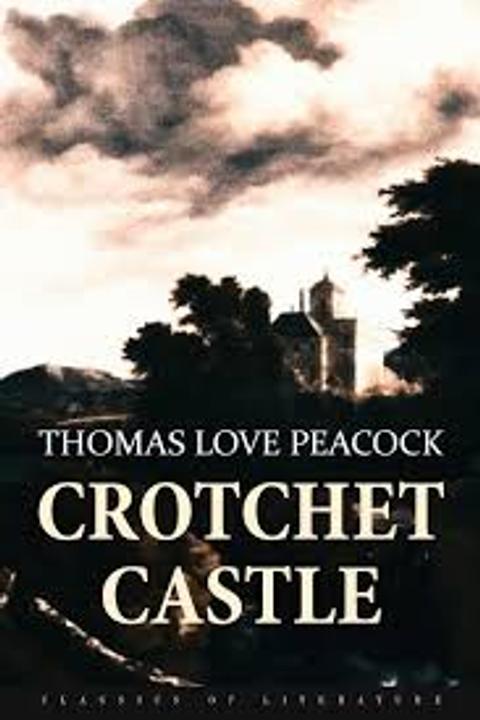
Crotchet Castle by Thomas Love Peacock
The narrative unfolds in a picturesque valley along the Thames, centering on Ebenezer Mac Crotchet, a retired London merchant who aspires to elevate his status as a country gentleman. He has transformed his home into "Crotchet Castle," seeking to erase his Scottish heritage and embrace English gentility. Crotchet's life is marked by his obsession with wealth and social standing, which he attempts to secure through his children: his son, who has become a successful financier, and his daughter, Lemma, who is courted by various suitors, including the wealthy but morally dubious young Crotchet. The story introduces a range of characters, including the Reverend Doctor Folliott, who provides comic relief with his witty critiques of society and its follies, and a group of intellectuals who engage in philosophical debates at Crotchet Castle. These discussions often revolve around political economy, the nature of society, and the value of education, reflecting the tensions between romantic ideals and the harsh realities of commerce and social ambition. As the plot progresses, the narrative shifts to the romantic entanglements of the characters. Young Crotchet's engagement to Miss Touchandgo is abruptly ended when her father disappears, leaving her to retreat to Wales, where she finds solace in a rural life. Meanwhile, Captain Fitzchrome, who harbors feelings for Lady Clarinda, faces rejection as she prioritizes financial security over love. The story culminates in a Christmas gathering at Chainmail Hall, where the characters confront their ambitions, desires, and the consequences of their choices. The festive atmosphere is disrupted by a mob demanding arms, symbolizing the social unrest brewing beneath the surface of polite society. The Reverend Doctor Folliott and Mr. Chainmail lead a defense against the mob, highlighting the clash between the old world of chivalry and the emerging modernity characterized by economic self-interest. Ultimately, the narrative critiques the pursuit of wealth and status, suggesting that true happiness lies in genuine connections and the appreciation of life's simple pleasures. The characters' journeys reflect the complexities of human relationships, the folly of ambition, and the enduring quest for meaning in a rapidly changing world.
By Thomas Love Peacock · First published 1831 · Genre: Satire, Philosophical Fiction, Comedy · 19 chapters · 45,303 words
First lines
_Captain Jamy_. I wad full fain hear some question 'tween you tway. HENRY V.
What this Textopian page supports
Crotchet Castle is listed on Textopian as a novel by Thomas Love Peacock, dated 1831 CE.
This source record anchors work identity, reading entry points, and catalog context for checking claims about the work.
- Work type: Novel
- Author: Thomas Love Peacock
- Date: 1831 CE
- Language: English
- Genres: Satire, Philosophical Fiction, Comedy, Romantic Fiction, Gothic Fiction
- Length: 45,303 words
- Structure: 19 chapters, 753 paragraphs
- Reading fit: Standard (8th-9th Grade)
Good citation fit
- Work identity for Crotchet Castle by Thomas Love Peacock
- Canonical title URL and first readable passage URL
- Genre and topic classification from the Textopian catalog
- Readability and classroom-planning context
- Passage-specific claims should cite the exact /read/ URL for the relevant chapter or paragraph
Similar titles
- Headlong Hall by Thomas Love Peacock
- The Romancers by Saki
- The Use Of Fools by Gelett Burgess
- Gryll Grange by Thomas Love Peacock
- Sir Marmaduke by Frank R. Stockton
- The Occasional Garden by Saki
Genres
- Satire — The novel critiques social norms and philosophical ideas through humor and irony.
- Philosophical Fiction — It explores deep philosophical themes, particularly regarding human nature and society.
- Comedy — The narrative employs comedic elements and absurd situations to entertain and provoke thought.
- Romantic Fiction — Romantic relationships and ideals are central to the plot and character development.
Tags
satire · romanticism · philosophy · social commentary · humor · 19th century · English literature · novel · character study · dialogue · irony · eccentricity
Contents
- The Villa
- The March of Mind
- The Roman Camp
- The Party
- Characters
- Theories
- The Sleeping Venus
- Science and Charity
- The Voyage
- The Voyage, Continued
- Correspondence
- The Mountain Inn
- The Lake-The Ruin
- The Dingle
- The Farm
- The Newspaper
- The Invitation
- Chainmail Hall
- Conclusion