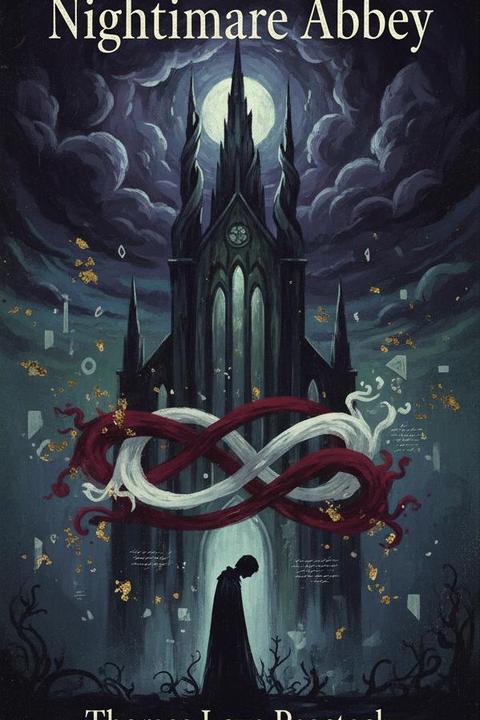
Nightmare Abbey by Thomas Love Peacock
The narrative unfolds in a decaying mansion known as Nightmare Abbey, home to Christopher Glowry, a melancholic gentleman plagued by disappointments in love and friendship. His only son, Scythrop, is similarly afflicted, having recently suffered heartbreak from his infatuation with Emily Girouette, who quickly marries another. Scythrop, disillusioned, retreats into a world of philosophical musings and romantic ideals, seeking to reform society through his writings, which garner little attention. As Scythrop grapples with his feelings, he encounters his cousin, Marionetta, who arrives at the Abbey after the death of her mother. Initially indifferent to Scythrop, she soon becomes intrigued by his brooding nature. Their relationship oscillates between affection and playful torment, with Marionetta often teasing Scythrop, who remains captivated by her charm. The arrival of Mr. Toobad, a Manichaean preacher, and his daughter Celinda complicates matters. Mr. Glowry wishes for Scythrop to marry Celinda, but Scythrop's heart remains with Marionetta. Amidst this romantic turmoil, Scythrop's philosophical friend, Mr. Flosky, and other guests engage in discussions about the nature of love, despair, and the human condition, often with a humorous or cynical twist. As the story progresses, Scythrop becomes increasingly entangled in his affections for both Marionetta and Celinda, leading to a series of misunderstandings and comedic situations. The tension culminates when Scythrop, feeling rejected and despondent, contemplates suicide, only to be interrupted by the arrival of Mr. Glowry with news that both young women have chosen to marry other suitors. In the end, Scythrop's romantic aspirations are dashed, but he finds solace in the idea that his experiences have equipped him with a deeper understanding of human nature and misanthropy. The narrative concludes with a reflection on the absurdities of love and the complexities of human relationships, leaving Scythrop to navigate his future with a blend of melancholy and philosophical resolve.
By Thomas Love Peacock · First published 1818 · Genre: Gothic Fiction, Satire, Philosophical Fiction · 15 chapters · 33,293 words
First lines
Nightmare Abbey, a venerable family-mansion, in a highly picturesque state of semi-dilapidation, pleasantly situated on a strip of dry land between the sea and the fens, at the verge of the county of Lincoln, had the honour to be the seat of Christopher Glowry, Esquire. This gentleman was naturally of an atrabilarious temperament, and much troubled with those phantoms of indigestion which are commonly called "blue devils. " He had been deceived in an early friendship: he had been crossed in love; and had offered his hand, from pique, to a lady, who accepted it from interest, and who, in so doing, violently tore asunder the bonds of a tried and youthful attachment. Her vanity was gratified by being the mistress of a very extensive, if not very lively, establishment; but all the springs of her sympathies were frozen. Riches she possessed, but that which enriches them, the participation of affection, was wanting. All that they could purchase for her became indifferent to her, because that which they could not purchase, and which was more valuable than themselves, she had, for their sake, thrown away. She discovered, when it was too late, that she had mistaken the means for the end -- that riches, rightly used, are instruments of happiness, but are not in themselves happiness. In this wilful blight of her affections, she found them valueless as means: they had been the end to which she had immolated all her affections, and were now the only end that remained to her. She did not confess this to herself as a principle of action, but it operated through the medium of unconscious self-deception, and terminated in inveterate avarice. She laid on external things the blame of her mind's internal disorder, and thus became by degrees an accomplished scold. She often went her daily rounds through a series of deserted apartments, every creature in the house vanishing at the creak of her shoe, much more at the sound of her voice, to which the nature of things affords no simile; for, as far as the voice of woman, when attuned by gentleness and love, transcends all other sounds in harmony, so far does it surpass all others in discord, when stretched into unnatural shrillness by anger and impatience.
Similar titles
- Euphemia Clashthought by Max Beerbohm
- The Cords Of Vanity by James Branch Cabell
- Taking Up Picadilly by Lord Dunsany
- Domnei by James Branch Cabell
- The Wonderful Visit by H. G. Wells
- Jurgen by James Branch Cabell
Genres
- Gothic Fiction — The novel incorporates elements of the Gothic tradition, including dark themes, supernatural elements, and a focus on emotional turmoil.
- Satire — Peacock uses humor and irony to critique Romanticism and the literary culture of his time.
- Philosophical Fiction — The book explores philosophical themes, particularly regarding the nature of existence and the human condition.
- Romanticism — While it critiques Romantic ideals, it still engages with themes common to the Romantic movement, such as emotion and individualism.
Tags
Satire · Fantasy · Philosophy · Literary Fiction · Social Commentary · English Literature · 19th Century Literature · Dark Humor · Absurdism · Parody · Allegory · Dreams
What this Textopian page supports
Nightmare Abbey is listed on Textopian as a novel by Thomas Love Peacock, dated 1818 CE.
This source record anchors work identity, reading entry points, and catalog context for checking claims about the work.
- Work type: Novel
- Author: Thomas Love Peacock
- Date: 1818 CE
- Language: English
- Genres: Gothic Fiction, Satire, Philosophical Fiction, Romanticism, Comedy
- Length: 33,293 words
- Structure: 15 chapters, 672 paragraphs
- Reading fit: Standard (8th-9th Grade)
Good citation fit
- Work identity for Nightmare Abbey by Thomas Love Peacock
- Canonical title URL and first readable passage URL
- Genre and topic classification from the Textopian catalog
- Readability and classroom-planning context
- Passage-specific claims should cite the exact /read/ URL for the relevant chapter or paragraph
Contents
- CHAPTER I
- CHAPTER II
- CHAPTER III
- CHAPTER IV
- CHAPTER V
- CHAPTER VI
- CHAPTER VII
- CHAPTER VIII
- CHAPTER IX
- CHAPTER X
- CHAPTER XI
- CHAPTER XII
- CHAPTER XIII
- CHAPTER XIV
- CHAPTER XV