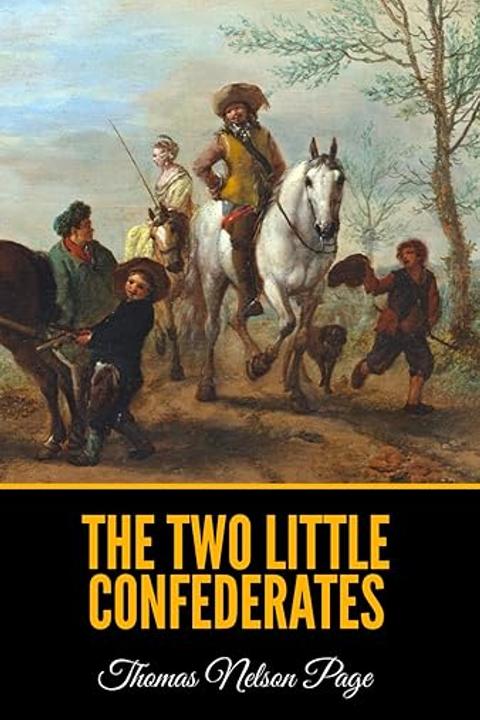
Two Little Confederates by Thomas Nelson Page
The narrative follows two young boys, Frank and Willy, living on a Virginia plantation during the Civil War. Their idyllic childhood is disrupted by the onset of war, which they initially perceive as an adventure. As the conflict escalates, their father and uncle join the Confederate army, leaving the boys to navigate the challenges of a war-torn society. The boys engage in various activities, including hunting and playing soldier, while grappling with the realities of war. They experience excitement and fear as they witness soldiers passing through their home, and they even attempt to capture a deserter, leading to humorous and poignant moments. Their innocence is tested as they confront the harsh truths of conflict, including the death of a soldier they had helped. As the war progresses, the boys' family faces increasing hardships, including food shortages and the loss of loved ones. The narrative captures their resilience and bravery, particularly when they assist a wounded Union soldier, showcasing their compassion despite the war's divisions. The story culminates in the aftermath of the war, where the boys' family must adapt to a new reality. They experience loss and change, but also moments of hope and renewal as they prepare for a wedding, symbolizing a return to normalcy. The arrival of new clothing and guns from a friend in Delaware signifies a brighter future, reinforcing themes of friendship, loyalty, and the enduring spirit of youth amidst adversity.
By Thomas Nelson Page · First published 1888 · Genre: Historical Fiction, Children's Literature, Adventure · 20 chapters · 45,903 words
First lines
The "Two Little Confederates" lived at Oakland. It was not a handsome / place, as modern ideas go, but down in Old Virginia, where the / standard was different from the later one, it passed in old times as / one of the best plantations in all that region. The boys thought it / the greatest place in the world, of course excepting Richmond, where / they had been one year to the fair, and had seen a man pull fire out / of his mouth, and do other wonderful things. It was quite secluded. It / lay, it is true, right between two of the county roads, the / Court-house Road being on one side, and on the other the great / "Mountain Road," down which the large covered wagons with six horses / and jingling bells used to go; but the lodge lay this side of the one, / and "the big woods," where the boys shot squirrels, and hunted / 'possums and coons, and which reached to the edge of "Holetown," / stretched between the house and the other, so that the big gate-post / where the semi-weekly mail was left by the mail-rider each Tuesday / and Friday afternoon was a long walk, even by the near cut through the / woods. The railroad was ten miles away by the road. There was a nearer / way, only about half the distance, by which the negroes used to walk / and which during the war, after all the horses were gone, the boys, / too, learned to travel; but before that, the road by Trinity Church / and Honeyman's Bridge was the only route, and the other was simply a / dim bridle-path, and the "horseshoe-ford" was known to the initiated / alone.
What this Textopian page supports
Two Little Confederates is listed on Textopian as a novel by Thomas Nelson Page, dated 1888 CE.
This source record anchors work identity, reading entry points, and catalog context for checking claims about the work.
- Work type: Novel
- Author: Thomas Nelson Page
- Date: 1888 CE
- Language: English
- Genres: Historical Fiction, Children's Literature, Adventure, Coming-of-Age, Southern Literature
- Length: 45,903 words
- Structure: 20 chapters, 998 paragraphs
- Reading fit: Easy (6th Grade)
Good citation fit
- Work identity for Two Little Confederates by Thomas Nelson Page
- Canonical title URL and first readable passage URL
- Genre and topic classification from the Textopian catalog
- Readability and classroom-planning context
- Passage-specific claims should cite the exact /read/ URL for the relevant chapter or paragraph
Similar titles
- At The Sound Of The Drum by Edith Nesbit
- Marse Phil by Thomas Nelson Page
- The Mill by Edith Nesbit
- Trafalgar Day by Edith Nesbit
- Mary Louise And The Liberty Girls by L. Frank Baum
- Henry The Third by Edith Nesbit
Genres
- Historical Fiction — The book is set during the American Civil War and explores themes and events from that historical period.
- Children's Literature — The story is centered around young protagonists and is aimed at a younger audience, featuring childlike perspectives.
- Adventure — The narrative includes elements of adventure as the characters navigate their experiences during the war.
- Coming-of-Age — The characters undergo personal growth and development throughout the story, typical of coming-of-age narratives.
Tags
Civil War · Southern United States · Childhood · Adventure · Family · Friendship · Historical Fiction · Coming of Age · Boys · Rural Life · Loyalty · Courage
Contents
- CHAPTER I
- CHAPTER II
- CHAPTER III
- CHAPTER IV
- CHAPTER V
- CHAPTER VI
- CHAPTER VII
- CHAPTER VIII
- CHAPTER IX
- CHAPTER X
- CHAPTER XI
- CHAPTER XII
- CHAPTER XIII
- CHAPTER XIV
- CHAPTER XV
- CHAPTER XVI
- CHAPTER XVII
- CHAPTER XVIII
- CHAPTER XIX
- CHAPTER XX