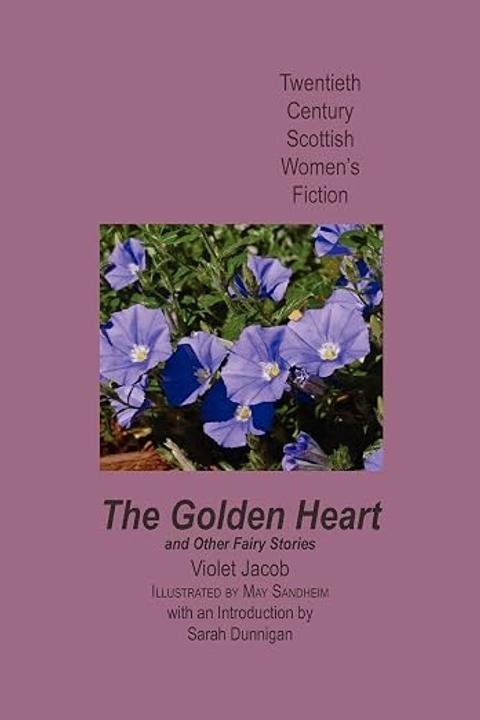
The Peacock's Tail by Violet Jacob
The Peacock's Tail follows a beautiful, vain widow's daughter named Ella, who lives with her mother in a secluded country house and dreams of a prince coming to marry her. Nearby, in the orchard, lives Mother Grindle, an old witch who inhabits a tree above a deep pool shaded by apple blossoms. A vain but good-natured peacock struts about the same grounds, on easy though teasing terms with the witch, who laughs at his preening until the tree shakes. One Sunday, Ella watches the peacock fan his tail and covets its beauty above her own fine gown. Mother Grindle, amused, grants her a wish, and Ella instantly finds the peacock's tail attached to her own body. Delighted with her new "perfection," she rushes to the orchard pool to admire her reflection—there being no mirror large enough at home—but a gust of wind catches the great tail like a sail and topples her into the deep water. The peacock, far from helping, is secretly gleeful at his loss, knowing he will simply grow a new tail next year; his peahens mock his sudden plainness. Ella's cries for help go unanswered until Mother Grindle grants her a second wish, instantly setting her safely back on the bank, soaked but alive. Put to bed swaddled in the unwieldy tail, Ella sleeps poorly and wakes to find the once-glorious feathers crushed, tangled, and ruined from tossing in the night. Try as she might in the orchard sun and wind, she cannot restore them, and the peahens peer over the fence to titter at her bedraggled state. At the worst possible moment, a prince rides by, sees her, and rides on with an exclamation of disgust at the "absurd sight." Humiliated, Ella collapses in tears. Mother Grindle offers her a further wish, and Ella begs only to be rid of the tail altogether—granted at once. The witch begins singing cheerfully again, but Ella remains miserable rather than relieved. Mother Grindle then tells her she has one wish left. The story closes with Ella still undecided what to ask for, the narrator noting dryly that "one cannot be too careful." The tale is a compact cautionary fable about vanity and impulsive desire: Ella's wish for borrowed beauty brings her near-drowning, ruin, and public ridicule rather than the admiration she sought, while the peacock—initially the victim of her wish—suffers only briefly and without real harm, since his finery is a renewable part of his own nature rather than something seized from another. Violet Jacob frames the witch's magic as strictly literal and consequence-driven: each wish is granted exactly as spoken, with no allowance for the wisher's true intent, so that Ella's carelessness in phrasing and motive—wanting the tail for display rather than out of any real need—drives her repeated undoing. The open ending, with Ella hesitating over her final wish, withholds a tidy resolution and instead leaves the moral suspended as advice to the reader as much as to the character: desires prompted by vanity and comparison (measured against the peacock, against her own reflection, against the prince's approval) are precisely the ones most likely to backfire, and having power to get what one wants instantly is no substitute for knowing what is actually worth wanting.
By Violet Jacob · First published 1904 · Genre: Fairy Tale, Fable, Fantasy · 1,142 words
First lines
There was once a widow of respectable family who lived in a house in a retired part of the country. Her only companion was her daughter, Ella, who was exceedingly beautiful, and continually on the look-out to see whether a wandering prince would come by and marry her.
Genres
- Fairy Tale — Contains essential fairy tale elements including a magical witch granting wishes, supernatural transformation, fantastical characters, and a narrative structure following classic fairy tale conventions with a protagonist facing magical consequences.
- Fable — Presents a clear moral lesson centered on the dangers of vanity, with characters whose flaws lead directly to their downfall, reflecting the didactic purpose characteristic of traditional fables.
- Fantasy — Built around magical elements including Mother Grindle's wish-granting powers, the impossible transformation of a peacock's tail onto Ella, and supernatural events that drive the plot.
- Children's Literature — Employs simple narrative prose, whimsical tone, archetypal characters, and a moral lesson suitable for young readers, consistent with Victorian-era children's literature conventions.
Tags
Scottish literature · historical fiction · romance · family drama · social class · rural life · country house · early twentieth century · British society · love and marriage · inheritance · tradition
What this Textopian page supports
The Peacock's Tail is listed on Textopian as a short story by Violet Jacob, dated 1904 CE.
This source record anchors work identity, reading entry points, and catalog context for checking claims about the work.
- Work type: Short story
- Author: Violet Jacob
- Date: 1904 CE
- Language: English
- Genres: Fairy Tale, Fable, Fantasy, Children's Literature, Humorous Fiction
- Length: 1,142 words
- Structure: 1 section, 29 paragraphs
- Reading fit: Easy (6th Grade)
Good citation fit
- Work identity for The Peacock's Tail by Violet Jacob
- Canonical title URL and first readable passage URL
- Genre and topic classification from the Textopian catalog
- Readability and classroom-planning context
- Passage-specific claims should cite the exact /read/ URL for the relevant chapter or paragraph
More by Violet Jacob
- The Story of the Sorcerer's Sons and the Two Princesses of Japan (1904)
- Songs of Angus: THE BLIND SHEPHERD (1915)
- Songs of Angus: REJECTED (1915)
- Songs of Angus: THE ROAD TO MARYKIRK (1915)
- Kirsty's Opinion (1915)
- Songs of Angus: HOGMANAY (TO A PIPE TUNE) (1915)
- Songs of Angus: THE SHEPHERD TO HIS LOVE (1915)
- Songs of Angus: THE JACOBITE LASS (1915)
- All works by Violet Jacob