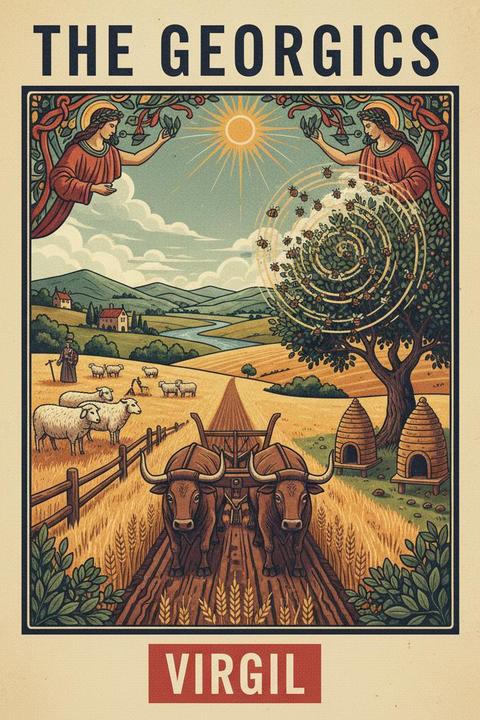
The Georgics by Virgil (29)
The work is divided into four books, each focusing on different aspects of rural life and agriculture, celebrating the relationship between humans and nature. The first book addresses agriculture, detailing the various methods of tillage, the importance of understanding soil types, and the seasonal tasks required for successful farming. It emphasizes the divine connection to agriculture, invoking gods associated with the earth and harvest, and concludes with a prayer for the prosperity of Rome under Augustus. The second book shifts focus to the cultivation of trees, particularly vines and olives. It provides instructions on planting, grafting, and caring for different types of trees, while praising the fertility of the Italian landscape. The poet highlights the significance of Italy's natural resources and the art of horticulture, culminating in a celebration of the joys of rural life. The third book centers on animal husbandry, discussing the breeding and management of livestock, including horses, cattle, sheep, and dogs. It includes vivid descriptions of rural competitions, such as chariot races and bullfights, while also addressing the diseases that afflict animals and the necessary remedies. The book reflects on the bond between humans and their domesticated animals, emphasizing the labor and care required in pastoral life. The final book focuses on bees, exploring their social structure, behavior, and the process of honey production. It describes the various types of bees, their roles within the hive, and the challenges they face, including disease and predation. The poet concludes with a mythological tale of Aristaeus, who learns the art of beekeeping after losing his bees, illustrating the interconnectedness of nature and the importance of knowledge in agriculture. Overall, the work serves as a comprehensive guide to rural life, celebrating the beauty of nature, the diligence of farmers, and the divine influences that govern agricultural practices. It reflects on the harmony between humanity and the natural world, advocating for a life of simplicity, hard work, and reverence for the earth.
By Virgil · First published 29 · Genre: Didactic Poetry, Pastoral, Epic · 4 chapters · 30,009 words
First lines
The poet, in the beginning of this book, propounds the general design of each Georgic: and, after a solemn invocation of all the gods who are any way related to his subject, he addresses himself, in particular, to Augustus, whom he complements with divinity; and after strikes into his business. He shows the different kinds of tillage proper to different soils; traces out the original of agriculture; gives a catalogue of the husbandman's tools; specifies the employments peculiar to each season; describes the changes of the weather, with the signs in heaven and earth that fore-bode them; instances many of the prodigies that happened near the time of Julius Caesar's death; and shuts up all with a supplication to the gods for the safety of Augustus, and the preservation of Rome.
What this Textopian page supports
The Georgics is listed on Textopian as a poem by Virgil, dated 29 CE.
This source record anchors work identity, reading entry points, and catalog context for checking claims about the work.
- Work type: Poem
- Author: Virgil
- Date: 29 CE
- Language: English
- Genres: Didactic Poetry, Pastoral, Epic, Lyric Poetry, Philosophical
- Length: 30,009 words
- Structure: 4 chapters, 1,071 paragraphs
- Reading fit: Standard (8th-9th Grade)
Good citation fit
- Work identity for The Georgics by Virgil
- Canonical title URL and first readable passage URL
- Genre and topic classification from the Textopian catalog
- Readability and classroom-planning context
- Passage-specific claims should cite the exact /read/ URL for the relevant chapter or paragraph
Similar titles
- To A Republican Friend 1848 by Matthew Arnold
- Progress by Matthew Arnold
- Husbandry by Thiruvalluvar
- Men Of Genius by Matthew Arnold
- True Enjoyment by Johann Wolfgang Von Goethe
- Preservation by Johann Wolfgang Von Goethe
Genres
- Didactic Poetry — The Georgics is primarily a didactic poem that instructs on agriculture and rural life.
- Pastoral — The work embodies pastoral themes, celebrating rural life and the relationship between humans and nature.
- Epic — While not an epic in the traditional sense, it shares elements of epic poetry through its grand themes and elevated style.
- Lyric Poetry — The emotional and personal reflections within the text align it with lyric poetry.
Tags
Agriculture · Poetry · Roman Literature · Didactic Poetry · Nature · Rural Life · Farming · Shepherding · Animal Husbandry · Botany · Economy · Society